

SEEFOR 17(2): 26025
Article ID: 26025
DOI: https://doi.org/10.15177/seefor.26-025
ORIGINAL SCIENTIFIC PAPER
Trap-Based Detection of Citrus Longhorned Beetle (Anoplophora chinensis) in Forest Demarcated Areas of Croatia
Nikola Zorić1,*, Tomislav Krcivoj1, Filip Cvetković1, Andrija Jukić1, Ivica Delić2, Nevenka Ćelepirović3, Dinka Matošević1
Addresses:
(1) Croatian Forest Research Institute, Division for Forest Protection and Game Management, Cvjetno naselje 41, HR-10450 Jastrebarsko, Croatia;
(2) Ministry of Agriculture, Forestry and Fisheries, Directorate for Agricultural Land, Crop Production and Market, Sector of Phytosanitary Policy, Ulica grada Vukovara 78, HR-10000 Zagreb, Croatia;
(3) Croatian Forest Research Institute, Division for Genetics, Forest Tree Breeding and Seed Science, Cvjetno naselje 41, HR-10450 Jastrebarsko, Croatia
*Correspondence: e-mail: nikolaz@sumins.hr
Citation: Zorić N, Krcivoj T, Cvetković F, Jukić A, Delić I, Ćelepirović N, Matošević D, 2026. Trap-Based Detection of Citrus Longhorned Beetle (Anoplophora chinensis) in Forest Demarcated Areas of Croatia. South-east Eur for 17(2): 26025. https://doi.org/10.15177/seefor.26-025.
Received: 22 Apr 2026; Revised: 08 Sep 2026; Accepted: 08 Sep 2026; Published: 27 Oct 2026
Cited by: Google Scholar
Abstract
Citrus longhorned beetle (CLB), Anoplophora chinensis, is an EU quarantine pest whose concealed life stages complicate early detection in forests. Traps are not a standard component of CLB surveillance: the immature stages develop hidden in trunks and roots, adults fly infrequently and disperse over short distances, and the large, conspicuous adults are often reported by the public rather than found by formal surveillance, so visual inspection has remained the standard method. We report trap-based operational detections from 2023–2025 in forested demarcated areas at two Croatian sites, Jankolovica and Rugvica. At Jankolovica, Lindgren multifunnel traps baited with a CLB alcohol lure plus a green leaf volatile host attractant were used; at Rugvica, a canopy-mounted cross-vane trap baited with an Anoplophora glabripennis lure was deployed. Monitoring methods differed between sites and years, so the study was not designed to evaluate trap performance quantitatively. In total, 15 adults were captured, 14 at Jankolovica and one at Rugvica. All specimens were identified morphologically, and two were confirmed by COI-based molecular analysis. These records confirm the presence of CLB in forested demarcated areas in Croatia and show that semiochemical-baited flight-intercept traps can detect the pest under operational field conditions, and can therefore usefully complement visual inspection in forest stands where dense vegetation and stand structure constrain the search for external symptoms.
Keywords: invasive alien species; operational detection; semiochemical-baited traps; quarantine forest pest; demarcated area surveillance; forest health monitoring
INTRODUCTION
Combined effects of globalisation and climate change have intensified the introduction and establishment of invasive wood‑boring insects, posing serious risks to forest and urban tree populations (Liebhold et al. 2012, Bebber 2015). Effective monitoring and early detection are therefore crucial to prevent establishment of new infestations and to limit their ecological and economic impacts (Brockerhoff et al. 2023).
Among the alien invasive species threatening broadleaf trees, the citrus longhorned beetle, Anoplophora chinensis (Forster) (Coleoptera: Cerambycidae) (hereafter CLB), is one of the most destructive. Native to East and Southeast Asia, it is a highly polyphagous wood-boring beetle that attacks numerous woody hosts, including important European genera such as Acer, Betula and Corylus (Lingafelter and Hoebeke 2002, Haack et al. 2010, Hérard and Maspero 2019). Adults are large and conspicuous, with a body length of 21–37 mm and antennae longer than the body (EPPO 2020, 2021). Larvae develop concealed within trunks and roots, causing structural damage that may result in tree decline or mortality. Their cryptic development and the ability to infest both healthy and weakened trees make early detection difficult and complicate eradication efforts (Lingafelter and Hoebeke 2002, Haack et al. 2010).
Since the early 2000s, introductions of CLB have been reported in several European countries. Although many outbreaks have been declared eradicated, persistent populations in northern Italy and Croatia highlight the challenges of achieving complete elimination (Hérard and Maspero 2019). In Croatia, CLB was first detected in September 2007 in a nursery in Turanj (Zadar County), on Acer palmatum and Lagerstroemia seedlings that had been imported from China earlier that year. Infested and susceptible plants were destroyed and a dedicated survey programme was carried out, but larvae were still being found in the nursery in 2010. The outbreak was officially declared eradicated in 2011 (EPPO 2011). The pest was recorded again in 2014 at Rugvica and subsequently in the Biograd na Moru area, in the same coastal region as the original Turanj outbreak, confirming its continued phytosanitary relevance (EPPO 2025). Whether these records represent repeated independent introductions or the persistence of earlier, incompletely eradicated populations is currently unknown, because no population genetic data are available for the Croatian findings. Under current EU plant health legislation, CLB remains a quarantine pest. The general legal framework is Regulation (EU) 2016/2031, while pest-specific measures are laid down in Commission Implementing Regulation (EU) 2022/2095, as amended by Implementing Regulation (EU) 2025/2461, which requires annual surveys in demarcated areas and provides the basis for eradication and containment measures (European Parliament and Council 2016, European Commission 2022, 2025). Southern and southeastern Europe already offer climatically suitable conditions for CLB, and modelling studies indicate that suitable habitat may expand further under future climate scenarios; established populations in this region are therefore also relevant as potential sources for areas that are currently unaffected (Zhou et al. 2022, Alramadan et al. 2025).
Traditional surveillance for CLB primarily relies on visual inspection for signs of larval activity such as frass, exit holes and bark damage near the lower trunk and root collar, but infestations often remain undetected at an early stage because of the pest’s cryptic biology and typically low population densities (Haack et al. 2010, Hérard and Maspero 2019). Trapping has nevertheless not become a standard component of CLB surveillance, for several reasons. Adults are infrequent flyers that disperse over short distances, so relatively few individuals are likely to encounter a trap (EFSA 2019, EPPO 2020). At the same time, adults are large and conspicuous and are frequently noticed by the general public: Branco et al. (2022) reported that about half of the European detections of CLB were made on private ground rather than through formal surveillance programmes. Trapping is also comparatively expensive and labour-intensive, because it requires repeated site visits for trap servicing and regular lure replacement. Several male-produced semiochemical components of CLB have been identified, including 4-(n-heptyloxy) butan-1-ol and related aldehydes, and a three-component blend has shown attractiveness to females in laboratory assays (Hansen et al. 2015, Crook et al. 2024). However, field validation under heterogeneous conditions remains limited. European field studies indicate that trap performance depends strongly on trap design, lure formulation and deployment position, and that canopy-deployed cross-vane traps can outperform multifunnel traps under some conditions (Marchioro et al. 2022). Consequently, the sensitivity and operational reliability of trapping for CLB detection are still insufficiently established (Marchioro et al. 2022, Crook et al. 2024).
The effectiveness of surveillance in forested areas may be further constrained by dense vegetation and stand structure, which can limit the feasibility of thorough visual inspection. This raises a practical question for plant health services: does it make sense to deploy semiochemical-baited traps for CLB in forest stands within demarcated areas, given the effort they require? The aim of this study was therefore to report, under operational surveillance conditions, whether such traps can contribute to the detection of CLB in forest stands within demarcated areas of Croatia, and at what trapping effort these detections were obtained. We focus on documenting trap-based detections together with the associated surveillance effort, and on illustrating the conditions under which traps may complement visual inspection, rather than on formally testing trap efficacy or comparing lure performance.
MATERIALS AND METHODS
Study Area
Monitoring was conducted in two forest stands located within demarcated areas for CLB in Croatia, established under national implementation of Commission Implementing Regulation (EU) 2022/2095 (Ministarstvo poljoprivrede, šumarstva i ribarstva 2024, 2026).
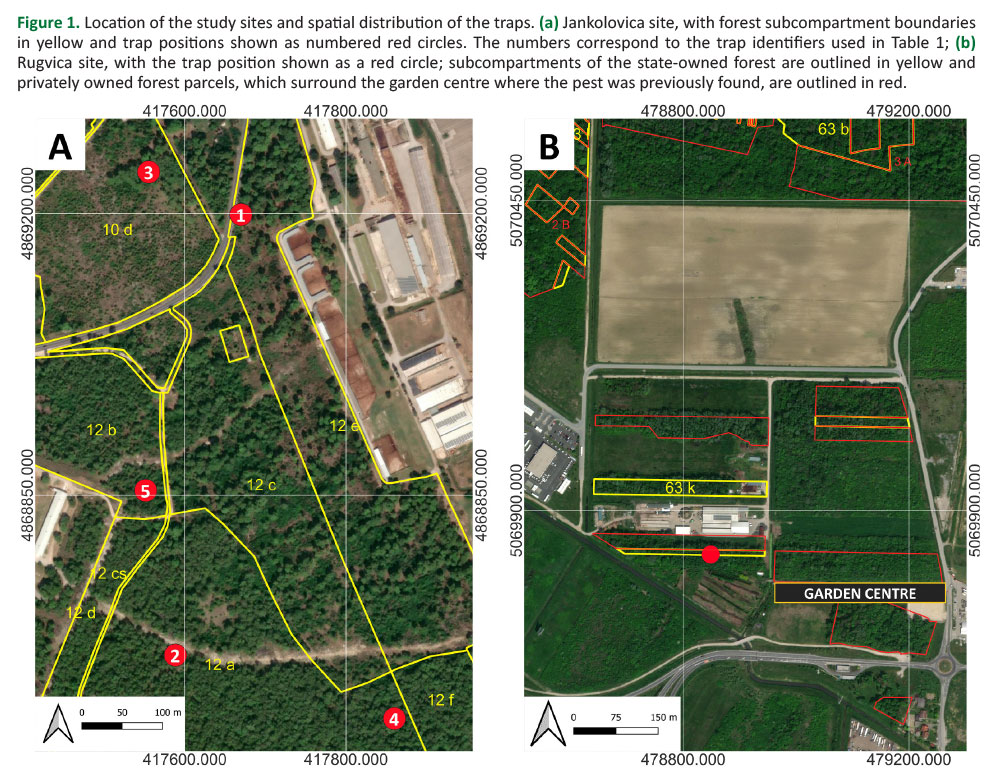
The Jankolovica site (Figure 1a) is situated near Biograd na Moru in coastal Croatia, within the Biograd management unit. The stand is a mixed broadleaved and coniferous forest in which Pinus halepensis forms the upper canopy, while Quercus pubescens, Fraxinus ornus and Carpinus orientalis dominate the broadleaved component.
The Rugvica site (Figure 1b) is located near a garden centre in inland Croatia, within the state-owned management unit Črnovščak. The stand is dominated by Fraxinus angustifolia and Populus alba in the canopy, with Quercus robur, Carpinus betulus, Ulmus spp., Alnus glutinosa and Salix alba occurring as scattered admixture.
Trap Deployment and Monitoring
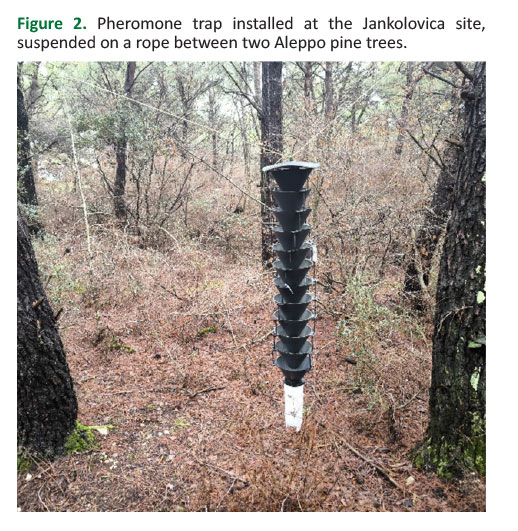
At Jankolovica, we deployed Lindgren multifunnel traps (Synergy Semiochemicals Corp., Delta, Canada) (Figure 2) coated with polytetrafluoroethylene (PTFE; Insect-a-Slip, BioQuip, Rancho Dominguez, USA) to increase capture efficiency (Graham et al. 2010, 2012, Dong et al. 2023). Each trap was baited with a CLB alcohol lure (Synergy Semiochemicals Corp.) containing 175 µL (≈160 mg) of 4-(n-heptyloxy) butan-1-ol and a GLV Plus lure (Witasek, Feldkirchen in Kärnten, Austria) as a green leaf volatile host attractant. Traps were suspended on a rope at a height of 1.5 m above ground and were checked at intervals of 14–20 days. CLB alcohol and GLV Plus lures were replaced every 6–8 weeks, following manufacturer recommendations (Table 1).
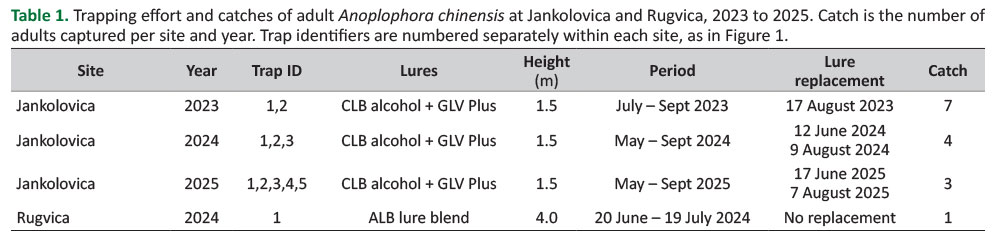
Trapping at Jankolovica began in July 2023 with two traps and was expanded in 2024 to three traps and again in 2025 to five traps (Table 1). In 2023 traps were active from July to September with one lure replacement, and in 2024 and 2025 they were active from May to September with two lure replacements. Traps were monitored regularly, at intervals of 14 to 20 days, which corresponds to about five checks in 2023 and about ten checks in each of 2024 and 2025. Over the three seasons this amounted to ten trap-seasons and 28 lure sets at Jankolovica, and to one trap operated for one month at Rugvica.
At Rugvica, a cross-vane trap (Synergy Semiochemicals Corp.) targeting Anoplophora glabripennis was installed on 20 June 2024 in the canopy of a host tree at approximately 4 m above ground (Figure 1b). The trap was baited with a commercial ALB lure (Synergy Semiochemicals Corp.) consisting of the male-produced pheromone components 4-(n-heptyloxy) butan-1-ol (ALB alcohol) and 4-(n-heptyloxy) butanal (ALB aldehyde), together with a plant kairomone blend. The manufacturer does not disclose the loading of the individual components. The trap was checked at 14-day intervals and was removed on 19 July 2024.
Monitoring was carried out within routine official surveillance rather than as a designed experiment, so trap type, lure combination, deployment height and trapping effort differed between the two sites and among years (Table 1). The consequences of this design for the interpretation of the data are addressed in the Discussion.
Morphological Identification
Adult beetles captured in traps were preserved in 70% ethanol and examined in the Entomological Laboratory of the Division for Forest Protection and Wildlife Management, Croatian Forest Research Institute. Morphological identification followed the EPPO diagnostic protocol for Anoplophora glabripennis and A. chinensis (EPPO 2021). Specimens were handled using standard entomological tools (forceps, needles) and examined under a stereomicroscope (Olympus macroscope equipped with an Olympus XC30 camera). Diagnostic characters were documented photographically to support species determination. All specimens were identified as CLB, and these identifications were independently confirmed by the Croatian Agency for Agriculture and Food (HAPIH), the accredited national reference laboratory.
Molecular Identification
In addition to morphological identification, molecular analysis was performed on two representative adult samples to genetically confirm the identity of the collected specimens. Genomic DNA was extracted from partial body tissue of two insects morphologically identified as CLB using the Monarch® Genomic DNA Purification Kit (New England Biolabs Inc.). A fragment of the mitochondrial cytochrome c oxidase subunit I (COI) gene was amplified using the universal primer pair LCO1490 and HCO2198, following Folmer et al. (1994). The rationale for analysing two representative specimens was to confirm the morphological diagnosis of the collected adults rather than to sequence every individual.
Polymerase chain reaction (PCR) was carried out using a PCRmax™ Alpha Cycler 1 Thermal Cycler (Fisher Scientific) with a touch-up cycling protocol: an initial denaturation at 94°C for 5 min; four cycles of 94°C for 30 s, 45°C for 60 s, and 72°C for 1 min; followed by 35 cycles of 94°C for 30 s, 51°C for 30 s, and 72°C for 1 min; with a final extension at 72°C for 10 min.
The resulting PCR products were sequenced in both directions using the same primers (LCO1490/HCO2198) by Macrogen Europa (Amsterdam, the Netherlands). After sequence editing, the edited COI fragments, 632 bp (PV037568) and 635 bp (PV382397) long, were compared with the NCBI GenBank database using BLAST, which assigned both sequences to A. chinensis. The sequences were submitted to GenBank and are available under accession numbers PV037568 and PV382397.
RESULTS
Monitoring conducted between 2023 and 2025 confirmed the presence of citrus longhorned beetle in the forested demarcated area at Jankolovica and recorded a single adult at Rugvica (Table 1). Before 2023, no symptoms or captures indicative of the species had been observed in these forest stands. At Jankolovica, suspicious external symptoms of infestation (exit holes and sawdust) were first noted at the base of Carpinus orientalis trunks in February 2023.
Trap Catches at Jankolovica
During the 2023 trapping period, seven adult CLB were captured in the two Lindgren multifunnel traps and were noted on 8 August 2023. In 2024, trapping effort was increased to three traps and four adults were captured with catches occurring on 17th and 30th of July; in 2025, five traps were operated and three adults were captured on 23rd of July (Table 1). In total, 14 adults of CLB were trapped at Jankolovica over the three years, an average of 1.4 adults per trap-season. Captures were distributed across the trapping season from July to early September, with seven adults in 2023, four in 2024 and three in 2025.
Detection at Rugvica
At Rugvica, a single adult CLB was captured on 19 July 2024 in a canopy-mounted cross-vane trap baited with an A. glabripennis lure (Table 1). Following this detection, the surrounding area was inspected visually for symptoms of CLB and no further infested trees were detected. Phytosanitary measures in line with Implementing Regulation (EU) 2022/2095 were implemented. No additional trap captures were obtained at Rugvica during the study period.
Identification of the Captured Specimens
All trapped adults were examined morphologically and identified as CLB. Molecular analysis of two representative specimens using COI barcoding confirmed this identification, with sequences matching A. chinensis reference entries in GenBank (see Materials and Methods).
DISCUSSION
The present study shows that semiochemical-baited flight-intercept traps can detect adult citrus longhorned beetles in forested demarcated areas of Croatia and can complement visual inspection where dense vegetation and stand structure limit the observation of external symptoms. Because the monitoring was carried out within routine official surveillance, the catches should be regarded as operational detections rather than as a formal estimate of trap efficacy or detection sensitivity; the resulting constraints are set out under Limitations of the Study.
The captures obtained under these heterogeneous field conditions indicate that traps can contribute useful information to surveillance programmes. This interpretation is consistent with recent semiochemical research: male‑produced components such as 4‑(n‑heptyloxy) butan‑1‑ol and related aldehydes have been identified, and a three‑component blend has shown attractiveness to females in laboratory assays (Hansen et al. 2015, Crook et al. 2024), yet field validation still remains limited and trap performance appears to depend strongly on trap design and deployment position (Marchioro et al. 2022). Under such conditions, semiochemical‑baited traps are best viewed as a supplementary tool that may increase the probability of detection in high‑risk areas, rather than as a stand‑alone solution.
For a plant health service, the relevant question is not only whether traps catch beetles, but whether the catches justify the resources consumed. At Jankolovica, ten trap-seasons over three years, requiring about 20 to 25 site visits and 28 lure sets, yielded 14 adults, an average of 1.4 adults per trap-season. This is a low return per unit of effort in absolute terms, but it has to be weighed against the alternative. In this stand, dense understorey vegetation made a systematic inspection of trunks and root collars impractical: the initial symptoms found in February 2023 were restricted to a few accessible stems, and in the following three seasons the traps provided the only evidence of continued presence. Each servicing visit also created an opportunity for opportunistic visual inspection of the stand. In accessible plantings, nurseries or urban greenery, where visual inspection is feasible and where reporting by the public contributes substantially to detection (Branco et al. 2022), the same effort is likely to be better invested elsewhere. Trapping for CLB therefore appears to pay off in a specific niche, namely forested parts of demarcated areas in which the standard method cannot be applied effectively.
The record from Rugvica illustrates this point. The single adult CLB was caught in a canopy‑mounted cross‑vane trap baited with an Anoplophora glabripennis lure. Given partial overlap in semiochemical cues within the genus Anoplophora (Hansen et al. 2015), such incidental cross‑attraction is biologically plausible. The result supports the potential value of traps placed in suitable host canopies but does not, by itself, justify changes to lure recommendations for CLB surveillance.
The detections at and near previously managed areas are consistent with several alternative scenarios, including incomplete eradication of earlier infestations, reinfestation from infested plant material moved into the area, or persistence of previously undetected low-density populations. These scenarios cannot be distinguished with the present data. Existing risk assessments suggest predominantly local spread with an average maximum natural spread of around 194 m per year under European conditions, albeit with broad uncertainty (EFSA 2019, EPPO 2020), and our findings are compatible with such patterns without providing additional quantitative evidence.
From an operational perspective, the results emphasise the importance of integrating semiochemical‑baited traps into broader, risk‑based surveillance frameworks rather than using them in isolation. Standardised survey design, such as that recommended in the EFSA general guidelines and the pest‑specific survey card for CLB (EFSA 2019, 2020), would allow explicit definition of target populations, design prevalence, confidence levels and trap effort, and would facilitate more robust comparisons of trap type, lure combination and deployment height. Applying such standardised approaches in demarcated areas, while maintaining structured visual inspections and laboratory confirmation, would strengthen early‑detection capacity for this quarantine pest.
Practical Next Steps at the Croatian Sites
Two practical steps follow for the Croatian demarcated areas. First, trapping should continue at Jankolovica and be extended to comparable forest stands at the margins of the demarcated areas, using a harmonised protocol with a single trap type, a single lure combination, a defined number of traps per unit area and a fixed servicing interval, so that catches from successive seasons become comparable and can be related to a defined trapping effort. Second, the specimens already collected provide material that visual surveillance rarely yields: intact adults suitable for genetic analysis. Population genetic and genomic approaches have been used to reconstruct the origin and the number of introduction events in Anoplophora outbreaks, and can resolve the invasion history of single outbreaks at a fine scale (Carter et al. 2010, Tsykun et al. 2019). Applying such analyses to the Croatian material, and comparing it with material from Italian and other European outbreaks, would help to determine whether the detections at Jankolovica and Rugvica represent new introductions, for example through the trade in ornamental plants, or the persistence of earlier populations that were not successfully eradicated. The distinction has direct management consequences, because it determines whether effort should be directed primarily at pathway controls or at more intensive local eradication.
Wider Implications for CLB Surveillance
Three points from this experience may be transferable to other surveillance programmes. First, semiochemical-baited traps produced repeated detections of CLB in forest stands in a situation where the standard method, visual inspection for exit holes and frass at the root collar, was severely constrained by stand structure; trapping therefore deserves consideration specifically for the forested parts of demarcated areas, which are usually the parts least amenable to inspection. Second, the Rugvica record shows that a trap deployed for A. glabripennis can detect A. chinensis, so existing ALB trapping networks may already provide incidental surveillance value for CLB, and catches from such traps should be examined with both species in mind. Third, because catches are low even where the pest is known to be present, operational trapping data are interpretable only if trapping effort, trap type, lure and deployment height are reported in full. We therefore report these parameters for every trap and encourage other surveillance programmes to publish them as well, since the accumulation of such operational records is currently the most realistic route to an evidence-based assessment of trapping for this pest.
Limitations of the Study
Several limitations should be kept in mind. Monitoring was carried out as part of routine official surveillance rather than as a designed experiment, so trap type, lure combination, deployment height and trapping effort differed between the two sites and among years. The data therefore describe operational detections and do not support a quantitative comparison of trap or lure performance, an estimate of detection sensitivity, or inference about the dispersal capacity or the spread rate of A. chinensis in Croatia. Only one trap was operated at Rugvica, and for a single month, so the absence of further captures at that site cannot be interpreted as evidence of absence. Finally, trap catches were not accompanied by a systematic assessment of infested trees around each trap, so the relationship between the number of adults captured and the local population density remains unknown.
CONCLUSIONS
This study documents trap-based detections of citrus longhorned beetle, Anoplophora chinensis, in forested demarcated areas of Croatia. Semiochemical-baited flight-intercept traps captured 15 adults over three years and showed that traps can complement visual inspection where dense vegetation and stand structure constrain direct observation of external symptoms. Because trap types, lure blends and trapping effort differed between sites and years, these catches represent operational detections and do not permit conclusions on trap or lure efficacy, nor do they distinguish between incomplete eradication, reinfestation and persistence of low-density populations; resolving the latter will require population genetic analysis of the specimens collected. Future monitoring in demarcated areas should combine structured visual inspection with harmonised trap protocols and explicit reporting of trapping effort, in line with risk-based survey guidelines. Where forest stands cannot be inspected effectively, trapping offers a practical and repeatable means of confirming the continued presence of this quarantine pest.
Author Contributions
NZ and DM conceived and designed the research, NZ, TK, FC and AJ carried out the field measurements, TK and NC performed laboratory analysis, ID secured the research funding, NZ and DM wrote the manuscript.
Funding
This research was funded by the Ministry of Agriculture, Forestry and Fisheries through the Survey for Quarantine Pests in the Republic of Croatia and co-financed by the European Commission through the EU Phytosanitary Programme for surveillance of quarantine pests.
Conflicts of Interest
The authors declare no conflict of interest.
REFERENCES
Alramadan Y, Mamay M, Farooq S, 2025. Increased spread risk of citrus long-horned beetle [Anoplophora chinensis (Coleoptera: Cerambycidae)] under climate change in Türkiye: Implications for management. Crop Prot 190: 107090. https://doi.org/10.1016/j.cropro.2024.107090.
Bebber DP, 2015. Range-expanding pests and pathogens in a warming world. Annu Rev Phytopathol 53(1): 335–356. https://doi.org/10.1146/annurev-phyto-080614-120207.
Branco S, Faccoli M, Brockerhoff EG, Roux G, Jactel H, Desneux N, Gachet E, Mouttet R, Streito JC, Branco M, 2022. Preventing invasions of Asian longhorn beetle and citrus longhorn beetle: are we on the right track? J Pest Sci 95(1): 41–66. https://doi.org/10.1007/s10340-021-01431-x.
Brockerhoff EG, Corley JC, Jactel H, Miller DR, Rabaglia RJ, Sweeney J, 2023. Monitoring and Surveillance of Forest Insects. In: Allison JD, Paine TD, Slippers B, Wingfield MJ (eds) Forest Entomology and Pathology. Springer, Cham, Switzerland, pp 669–705. https://doi.org/10.1007/978-3-031-11553-0_19.
Carter M, Smith M, Harrison R, 2010. Genetic analyses of the Asian longhorned beetle (Coleoptera, Cerambycidae, Anoplophora glabripennis), in North America, Europe and Asia. Biol Invasions 12(5): 1165–1182. https://doi.org/10.1007/s10530-009-9538-9.
Crook D, Maynard E, Furtado M, 2024. Verification and evaluation of male-produced pheromone components from the citrus long-horned beetle, Anoplophora chinensis (Forster) (Insecta: Coleoptera: Cerambycidae). Insects 15(9): 692. https://doi.org/10.3390/insects15090692.
Dong Y, Xie P, Zheng K, Gu Y, Fan J, 2023. Teflon Coating and Anti-Escape Ring Improve Trapping Efficiency of the Longhorn Beetle, Monochamus alternatus. Appl Sci 13(3): 1664. https://doi.org/10.3390/app13031664.
EFSA (European Food Safety Authority), Schrader G, Camilleri M, Diakaki M, Vos S, 2019. Pest survey card on Anoplophora chinensis. EFSA Supporting Publications 16(12): EN-1749. https://doi.org/10.2903/sp.efsa.2019.EN-1749.
EFSA (European Food Safety Authority), Lázaro E, Parnell S, Vicent A, Schans J, Schenk M, Cortiñas Abrahantes J, Zancanaro G, Vos S, 2020. General guidelines for statistically sound and risk-based surveys of plant pests. EFSA Supporting Publications 17(9): EN-1919. https://doi.org/10.2903/sp.efsa.2020.EN-1919.
EPPO, 2011. Eradication of Anoplophora chinensis in Croatia. EPPO Reporting Service 2011/238. Available online: https://gd.eppo.int/reporting/Rse-2011-11 (29 July 2026).
EPPO, 2020. EPPO datasheet on Anoplophora chinensis. EPPO, Paris, France. Available online: https://gd.eppo.int/taxon/ANOLCN/download/datasheet_pdf (15 April 2026).
EPPO, 2021. PM 7/149 (1) Anoplophora glabripennis and Anoplophora chinensis. EPPO Bull 51(3): 568–586. https://doi.org/10.1111/epp.12797.
EPPO, 2025. Update on the situation of Anoplophora chinensis in Croatia. EPPO Reporting Service 2025/262. Available online: https://gd.eppo.int/reporting/article-8277 (16 April 2026).
European Commission, 2022. Commission Implementing Regulation (EU) 2022/2095 of 28 October 2022 establishing measures to prevent the introduction into, establishment and spread within the Union territory of Anoplophora chinensis (Forster) and repealing Decision 2012/138/EU. Off J Eur Union L 281: 53–71. Available online: https://eur-lex.europa.eu/eli/reg_impl/2022/2095/oj (22 April 2026).
European Commission, 2025. Commission Implementing Regulation (EU) 2025/2461 of 29 September 2025 amending Implementing Regulation (EU) 2022/2095 as regards measures to prevent the introduction into, establishment and spread within the Union territory of Anoplophora chinensis (Forster). Off J Eur Union L 2025/2461. Available online: https://eur-lex.europa.eu/eli/reg_impl/2025/2461/oj (22 April 2026).
European Parliament and Council, 2016. Regulation (EU) 2016/2031 of 26 October 2016 on protective measures against pests of plants. Off J Eur Union L 317: 4–104. Available online: https://eur-lex.europa.eu/eli/reg/2016/2031/oj (22 April 2026).
Folmer O, Black M, Hoeh W, Lutz R, Vrijenhoek R, 1994. DNA primers for amplification of mitochondrial cytochrome c oxidase subunit I from diverse metazoan invertebrates. Mol Mar Biol Biotechnol 3(5): 294–299.
Graham EE, Mitchell RF, Reagel PF, Barbour JD, Millar JG, Hanks LM, 2010. Treating panel traps with a fluoropolymer enhances their efficiency in capturing cerambycid beetles. J Econ Entomol 103(3): 641–647. https://doi.org/10.1603/EC10013.
Graham EE, Poland TM, McCullough DG, Millar JG, 2012. A comparison of trap type and height for capturing cerambycid beetles (Coleoptera). J Econ Entomol 105(3): 837–846. https://doi.org/10.1603/EC12053.
Haack RA, Hérard F, Sun J, Turgeon JJ, 2010. Managing invasive populations of Asian longhorned beetle and citrus longhorned beetle: a worldwide perspective. Annu Rev Entomol 55: 521–546. https://doi.org/10.1146/annurev-ento-112408-085427.
Hansen L, Xu T, Wickham J, Chen Y, Hao D, Hanks LM, Millar JG, Teale SA, 2015. Identification of a Male-Produced Pheromone Component of the Citrus Longhorned Beetle, Anoplophora chinensis. PLoS One 10(8): e0134358. https://doi.org/10.1371/journal.pone.0134358.
Hérard F, Maspero M, 2019. History of discoveries and management of the citrus longhorned beetle, Anoplophora chinensis, in Europe. J Pest Sci 92(1): 117–130. https://doi.org/10.1007/s10340-018-1014-9.
Liebhold AM, Brockerhoff EG, Garrett LJ, Parke JL, Britton KO, 2012. Live plant imports: the major pathway for forest insect and pathogen invasions of the US. Front Ecol Environ 10(3): 135–143. https://doi.org/10.1890/110198.
Lingafelter SW, Hoebeke ER, 2002. Revision of the genus Anoplophora (Coleoptera: Cerambycidae). Entomological Society of Washington, Washington, DC, USA, 236 p.
Marchioro M, Bianchi A, Ciampitti M, Faccoli M, 2022. Testing trapping protocols for detecting the Citrus Longhorn Beetle, Anoplophora chinensis (Coleoptera: Cerambycidae). J Appl Entomol 146(5): 607–614. https://doi.org/10.1111/jen.12978.
Ministarstvo poljoprivrede, šumarstva i ribarstva, 2024. Odluka o uspostavljanju demarkiranih područja u kojima se provode mjere iskorjenjivanja azijske strizibube Anoplophora chinensis (Forster). Narodne novine 108/2024: 1856. Available online: https://narodne-novine.nn.hr/clanci/sluzbeni/full/2024_09_108_1856.html (18 April 2026).
Ministarstvo poljoprivrede, šumarstva i ribarstva, 2026. Odluka o uspostavljanju demarkiranih područja u kojima se provode mjere iskorjenjivanja azijske strizibube Anoplophora chinensis (Forster). Narodne novine 28/2026: 327. Available online: https://narodne-novine.nn.hr/clanci/sluzbeni/full/2026_03_28_327.html (18 April 2026).
Tsykun T, Javal M, Hölling D, Roux G, Prospero S, 2019. Fine-scale invasion genetics of the quarantine pest, Anoplophora glabripennis, reconstructed in single outbreaks. Sci Rep 9(1): 19436. https://doi.org/10.1038/s41598-019-55698-3.
Zhou Y, Ge X, Liu J, Zou Y, Guo S, Wang T, Zong S, 2022. Climate change effects on the global distribution and range shifts of citrus longhorned beetle Anoplophora chinensis. J Appl Entomol 146(5): 473–485. https://doi.org/10.1111/jen.12996.
© 2026 by the author(s). License: Croatian Forest Research Institute. This article is an open access article distributed under the terms and conditions of the Creative Commons Attribution 4.0 International License (CC BY 4.0).