

SEEFOR 17(2): 26021
Article ID: 26021
DOI: https://doi.org/10.15177/seefor.26-021
ORIGINAL SCIENTIFIC PAPER
Productivity Analysis of Fully Mechanised Thinning in Broadleaf Stand
Dinko Vusić1, Marijo Plantak2, Ivica Papa1, Marko Juratović1, Branko Ursić1,*
Addresses:
(1) University of Zagreb, Faculty of Forestry and Wood Technology, Institute of Forest Engineering, Svetošimunska cesta 23, HR-10000 Zagreb, Croatia;
(2) MC Consulting, Trg Petra Zrinskog 27, HR-10340 Vrbovec
*Correspondence: e-mail: bursic@sumfak.unizg.hr
Citation: Vusić D, Plantak M, Papa I, Juratović M, Ursić B, 2026. Productivity Analysis of Fully Mechanised Thinning in Broadleaf Stand. South-east Eur for 17(2): 26021. https://doi.org/10.15177/seefor.26-021.
Received: 3 Jun 2026; Revised: 9 Aug 2026; Accepted: 10 Aug 2026; Published online: 9 Oct 2026
Cited by: Google Scholar
Abstract
Despite the traditional forwarder usage in Croatia since 1971, the first experimental application of a harvester as a second machine in a fully mechanized system was in 2001, and the first harvester in the state company Croatian Forests Ltd was bought in 2018. Fully mechanized harvesting systems were avoided mostly because of close-to-nature forest management principles, as well as applying buck-to-quality processing method for high-value roundwood. Faced with labour shortages of skilled and motivated forest workers, the application of fully mechanised harvesting systems cannot be avoided. The conducted study dealt with aspects of harvester (Timberjack 1470D)-forwarder (Timberjack 1710D) system efficiency in an 80-year-old broadleaf harvesting site that consisted of two adjacent subcompartments. One European hornbeam dominated (84%) stand (harvesting density 98 trees·ha-1 and 40 m3·ha-1, 21.7 cm average diameter at breast height (DBH) of marked trees, average primary transport distance 250 m) and one European beech dominated (50%) stand (harvesting density 62 trees·ha-1 and 49 m3·ha-1, 26.4 cm average DBH of marked trees, average primary transport distance 550 m). Felled trees were processed applying the buck-to-quality method to produce sawlogs according to the Croatian HRN standard and 4-meter-long round energy wood by a cut-to-length method. Energy wood was forwarded separately from the sawlogs. UmtPlus software was used to record time consumption directly on the field during forwarder work and in the office to analyse harvester work from video recorded footages. In total, 795 trees were felled, and 41 forwarding cycles were recorded. In addition, the quality of processing and the quantity of 94 felled trees were recorded to determine the net volume vs DBH equation and to validate the stem data recorded by the harvester. Since differences in time consumption for felling between the two subcompartments were not found and differences for processing stemwood and crowns were minimal, a single productivity model was developed. Including delays, productivity ranged from 3.9 m3·h-1 (DBH 12.5 cm) to 16.8 m3·h-1 (DBH 42.5 cm). Forwarder productivity (including delays) ranged from 11.1 m3·h-1 (100 m) to 7.3 m3·h-1 (800 m), with an average load of 13.28 m3. The significant difference was found between the harvester and manually measured quantity of produced assortments because of multiple handling of energy wood that were produced mostly from crowns.
Keywords: harvester; forwarder; productivity; hardwood; European hornbeam; European beech
INTRODUCTION
Timber harvesting in Croatia still mostly relies on motor-manual felling and processing followed by skidding or forwarding of roundwood. The choice of the applied harvesting technology is influenced by factors related to the work site conditions, economic possibilities, and occupational safety (Garland et al. 2020, Mederski et al. 2022, Bustos-Letelier et al. 2023, Labelle et al. 2024, Diniz et al. 2024). The design of present harvesting systems, especially the ones used in broadleaf stands, was strongly influenced by close-to-nature forest management principles and buck-to-quality processing of high-value roundwood. However, driving factors behind the stronger implementation of mechanised harvesting systems in broadleaf stands identified in France by Bigot and Cuchet (2003) recently emerged in Croatian forestry as well. Labour shortages of skilled and motivated forest workers prompted the introduction of mechanised felling and processing in Croatia beyond the coniferous plantations, where these operations had been introduced a decade earlier and successfully applied. New solutions and patents for mechanized felling are also important due to increasing safety, regardless of productivity (Knobloch et al. 2024).
First, experimental application of harvesters in Croatia at the turn of the century was well documented by scientific research (Krpan and Poršinsky 2001, 2002, 2004a, 2004b, Krpan et al. 2004, Poršinsky et al. 2004). The knowledge gained in the aforementioned studies resulted in the commercial application of harvesters in the following years. Thinning of coniferous plantations affirmed harvesters as the only suitable option (Vusić 2013) in this demanding operational surrounding that was barely harvestable (at a reasonable harvesting cost) with traditional motor-manual harvesting.
Natural disturbances, especially in Croatian continuous cover forest (Đuka et al. 2025), in recent years fostered the application of more productive harvesting systems that could cope with a larger amount of wood that had to be harvested in limited time and in demanding work safety conditions. Harvester proved to be a key part of many systems applied in this effort. Mederski et al. (2021) stated that altered stand conditions in Croatian forestry represent new challenges from the operational point of view (harvesting systems, work safety and workforce) as well as from the economic perspective.
However, as the high capital investment requires high productivity and high annual use of machines (Moskalik et al. 2017), the limited area of forest plantations and irregular patterns of natural disturbances cannot provide solid ground for further investment in mechanised harvesting systems. Therefore, the next logical step, after positive experiences in previous application of harvesters, is their greater application in natural forests.
Due to the composition of species in Croatian natural forests, harvesters are expected to face challenges already recognised by researchers who investigated their application in broadleaf stands and additional ones related to the diversity of Croatian forests and specific management conditions, as well as country-specific legislation in the timber procurement chain.
Higher wood density and generally more complicated stem and crown architecture of hardwood trees can present more pronounced challenges compared to softwood mechanised harvesting (Labelle and Windisch 2016). In beech stands, Slugeň et al. (2014) identify numerous and thick branches and frequent presence of trees with multiple tree tops as the most important factor leading to the reduction in harvesting productivity. Labelle and Windisch (2016) stress the same problem in the processing phase especially in the case when the product recovery (from crown) is of high importance, adding tree size as a limiting factor requiring a back-cut to be performed on larger trees thus increasing the felling time. Presence of forks has been identified as a limiting factor of harvester productivity in poplar plantations (Danilović et al. 2011), as well as in coniferous plantations (Vusić and Rukavina 2010). Although significant improvement in delimbing knives design and setup reported by Cacot et al. (2016) and ongoing work on improvement of harvester technology in broadleaves is promising, currently most harvester operators in Croatia use conventional harvesting heads for softwoods (with special adjustments on the pressure and speed of rolls and knives). Using this equipment in broadleaf stands, apart from the productivity and cost related challenges, raises a question of accurate measurement of produced timber.
Efficient and accurate measurement of harvested timber is required in all stages of timber harvesting. It is important in determining the production rate of the used harvesting system (Rosińska et al. 2025), determining timber quantity and quality (Nocetti and Brunetti 2024), and for timber trade (Tomczak et al. 2024). Depending on the place where timber measurements were conducted, three main places (at the felling site, at the landing site, and at the sawmill entrance), and two methods (conventional and automatic) can be distinguished in terms of timber measurement (Ucar et al. 2024). Modern harvesters are equipped with technical components and software that allow simultaneous tree processing and timber measuring. The accuracy and influencing factors of harvester head measurements during timber measurement have been well documented. Hohmann et al. (2017) investigated the accuracy of harvester head measurements and found that the volume measured by harvester head on average was 0.45% lower (ranging from 2.08% to -3.05%) than the volume determined based on the Archimedes principle, while the volume determined using calliper and measuring tape together with Huber’s formula resulted in 7.53% lower determined volume on average (ranging from -3.05% to -12.73%). In addition to the used calculation algorithm (Löwe et al. 2019) and the frequency of calibration (Nieuwenhuis and Dooley 2006), the accuracy of measurement is also affected by log irregularities, e.g. large branches, which are particularly common in broadleaved species (Strandgard 2009, Löwe et al. 2019).
Therefore, the aim of this study was set to determine the productivity model for a mechanised harvester – forwarder harvesting system working in a broadleaf thinning site, in order to validate harvester stem data against the reference manual measurement of log volume.
MATERIALS AND METHODS
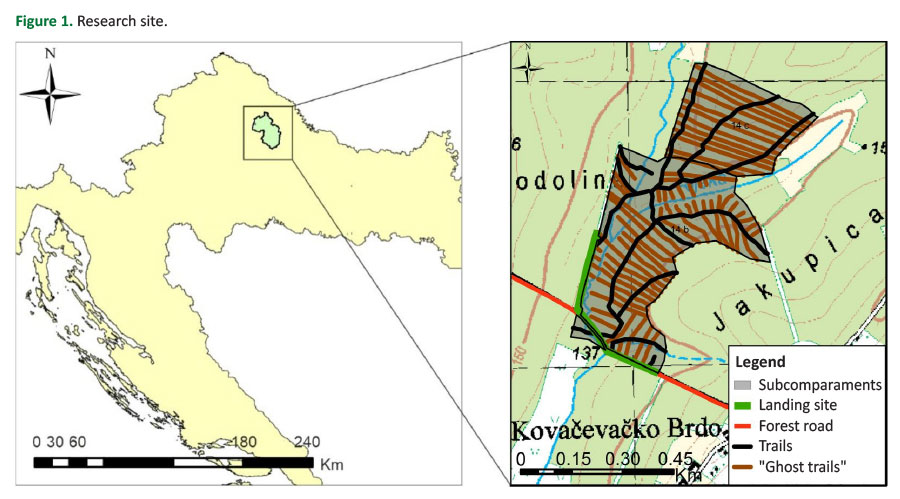
The study was conducted in an 80-year-old broadleaf harvesting site to investigate the application of fully mechanized timber harvesting by a harvester-forwarder system. The harvesting site consisted of two adjacent subcompartments located in Management Unit Bjelovarska Bilogora in central part of Croatia (between φ 45°59′59″N and 45°59′31″N and between λ 16°44′05″E and 16°43′38″E). One subcompartment was a European hornbeam dominated stand (14b) and the other one was a European beech dominated stand (14c). The description of the worksite is shown in Table 1.
 Table 1. Description of the worksite.
In both subcompartments, the trees were marked prior to harvesting in accordance with the prescribed intensity and silvicultural goals. Possible ghost trails were identified in the planning phase, and marking of trees was modified to enable the work of a harvester – forwarder system (Figure 1). Ghost trails are temporary working trails created by felling trees with a harvester to enable access for harvesters to all selected trees for felling and to load the produced assortments with a forwarder. In both subcompartments European hornbeam trees prevailed among marked trees; both in number (92 trees·ha-1 and 47 trees·ha-1) and volume (38 m3·ha-1 and 29 m3·ha-1).
Felling and processing of timber assortments was performed by a Timberjack 1470D harvester (180 kW engine power; 1250 Nm maximum torque; 18800 kg mass). The harvester was equipped with a Timberjack 758 harvesting head with a declared maximum cutting diameter of 65 cm. Roundwood extraction was done using a Timberjack 1710D forwarder (160 kW engine power; 1090 Nm maximum torque; 19000 kg mass) equipped with hydraulic crane Boom CF885 (8500 mm maximum reach; 151 kNm declared lifting moment 41 kNm torque). Due to good soil conditions both machines did not use additional traction equipment.
Marked trees on ghost trails and between the ghost trails were felled and processed into roundwood assortments. Stemwood of higher quality and of suitable dimensions was bucked-to-quality to produce sawlogs (according to national standards), while the rest of the stemwood and crown were processed into 4-meter round energy wood by cut-to-length method. Energy wood was forwarded separately from the sawlogs.
The harvester’s work was digitally recorded on video using a camera mounted on the harvester’s cabin. Time consumption of individual work elements was later analysed on tree level by UmtPlus software. The same software was directly applied in the study of forwarder’s work, which was analysed on cycle level. Prior to the study, 50 m long trail segments were measured and marked at the nearest tree and used for the determination of forwarding distance for both loaded and unloaded travel while Trupulse 200 was used to measure the forwarding distance on harvesting trails and landing site. Productive and non-productive time was recorded and analysed to construct the productivity models.
Prior to harvesting, DBH of marked trees was re-measured and inscribed in a visible place on the stem, thus enabling the relation of time consumption for felling and stem/crown processing vs. DBH to be established by regression analyses. Multiple regression, denoting the subcompartment with a dummy variable, was used to test the influence of the subcompartment on time consumption for felling, stemwood and crown processing. Other recorded productive time elements (analysed and reported as average time consumption per tree) were: landing – felling site travel, in-site relocation, positioning, tree pulling and bunching.
Forwarder work cycle was divided to unloaded and loaded drive, in-site relocation, bunching, loading, unloading and landing relocation). All time elements, except in-site driving (which was analysed by regression analyses), are reported as average values per cycle.
Recorded delays, both in harvesting and forwarding, were analysed providing delay factors to be used in the productivity models.
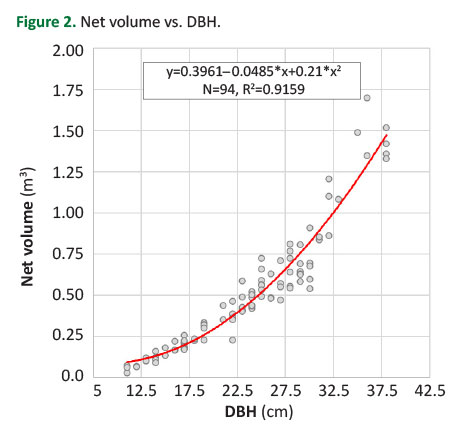
During the research, 795 trees were felled and 41 forwarding cycles were recorded. A sub-sample of 94 felled and processed trees (on two ghost trails – each in one subcompartment) was manually measured to construct net volume vs. DBH equation (Figure 2) to be used in the harvester’s productivity model. The same sub-sample was used to determine the quality of processing the roundwood (presence of forks, branches, etc.) and to validate the stem data recorded by harvester, i.e. to test the accuracy of harvester measurement and volume calculation. A Chi-square test was conducted to determine whether there is higher probability of non-recording logs in the crown or stem. The Bland-Altman plots together with root square mean error and t-test were used to test whether harvester measured volume is statistically significant compared to manual measurement.
RESULTS AND DISCUSSION
The efficiency of thinning broadleaf stands by mecha-nised harvesting system is reported in terms of harvester and forwarder productivity (including delays). The structure of recorded working time for both machines is shown in Figure 3. In addition, the possibility to use harvester data as a reliable product quantity record was reported based on the stem data validation.
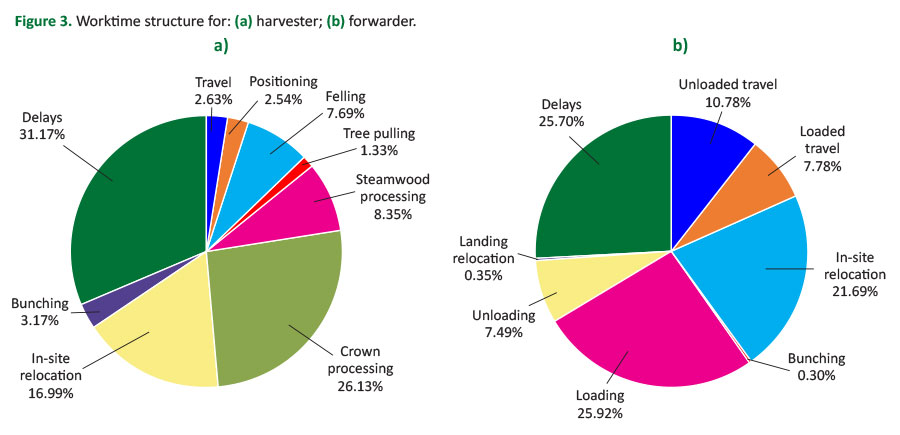 Figure 3. Worktime structure for: (a) harvester; (b) forwarder.
Productivity
Differences in time consumption for felling were not found (t=-0.6242; p=0.5327), and differences for processing stemwood (t=-2.3038; p=0.02155) and for processing crowns (t=-2.5176.; p=0.0121) between two subcompartments were minimal and resulted mainly from different DBH range (although the characteristics of the harvesting head balanced the sample leaving mainly European beech trees with DBH over 52 cm for motor-manual felling and processing). Therefore, a single productivity model was developed. The model consisted of mathematical formulae for calculating felling time (Figure 4a), stem (Figure 4b) and crown (Figure 5a) processing time consumption vs. DBH, while other productive time included average time consumption for landing – felling site travel (2 × 0.04 min·tree-1), in-site relocation (0.56 min·tree-1), positioning (0.08 min·tree-1), tree pulling (0.04 min·tree-1) and bunching (0.10 min·tree-1). Effective time was increased using the actual delay factor (1.33) to calculate the number of trees processed per hour. By using the actual net volume vs. DBH equation (Figure 2) productivity was calculated ranging from 3.9 m3·h-1 for DBH of 12.5 cm to 16.8 m3 h-1 for DBH of 42.5 cm (Figure 5b).
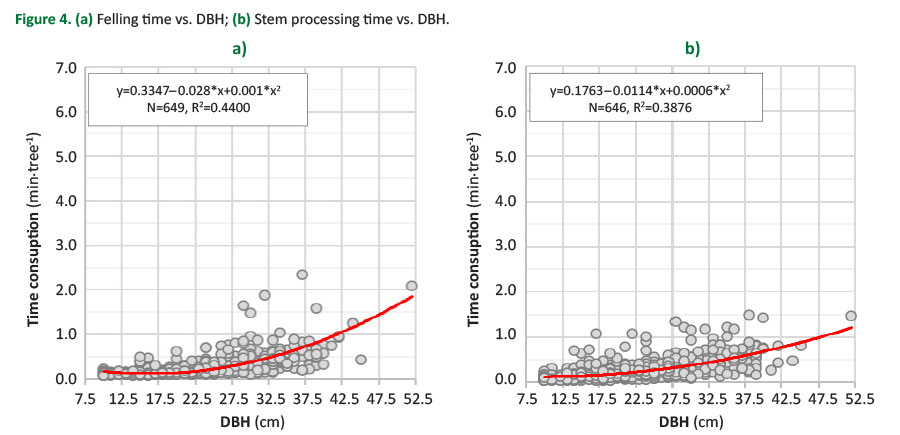 Figure 4. (a) Felling time vs. DBH; (b) Stem processing time vs. DBH.
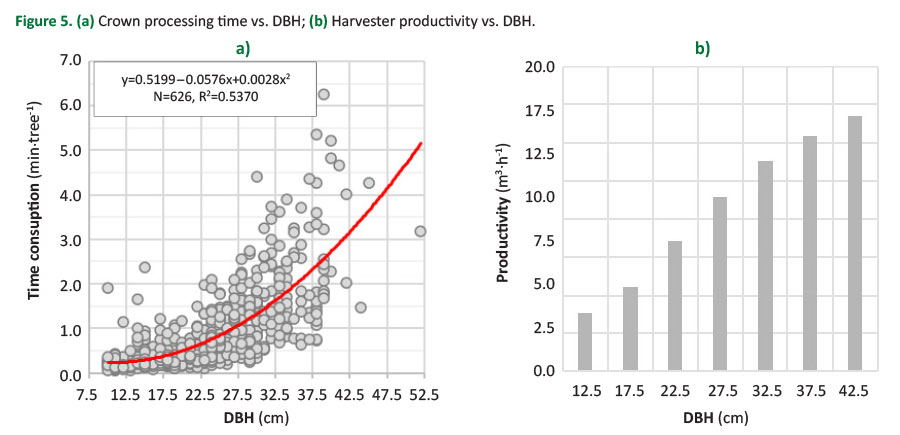 Figure 5. (a) Crown processing time vs. DBH; (b) Harvester productivity vs. DBH.
Key factors influencing the productivity (apart from the DBH) were identified as the time to process the crown (in average 75% of the total processing time) and a high delay time of 33% of the total effective time (as a result of the increased mechanical delay). The results of this study confirm the results of previous studies. Higher (crown) processing time in broadleaves compared to the expected time (in conifers) is well documented (Slugeň et al. 2014, Cacot et al. 2016, Labelle and Windisch 2016). Since the crown processing time had a higher share compared to the stem processing time, an option to process only the stem (and process the crown by chipping) to decrease the processing time per tree could be considered. On the other hand, since crown volume accounted for up to 68% of the tree's net volume, this would consequently strongly decrease harvester productivity (m3·h-1). Therefore, the productivity model included both processing times.
Chain maintenance together with other technical delays, accounts for 46.11% of the total delay time (Figure 6), confirming a previously reported higher incidence of mechanical delays (Bigot and Cuchet 2003) in broadleaf and natural stands compared with softwood and short rotation plantations (Spinelli and Visser 2008). This is particularly the case when working with older equipment (Slugeň et al. 2014), as was expected in the present study. Quite high in-site relocation time, also identified by Slugeň et al. (2014) and Labelle and Windisch (2016) as a limiting factor in broadleaf thinning and selective-cut, contributed to lowering the harvester productivity.
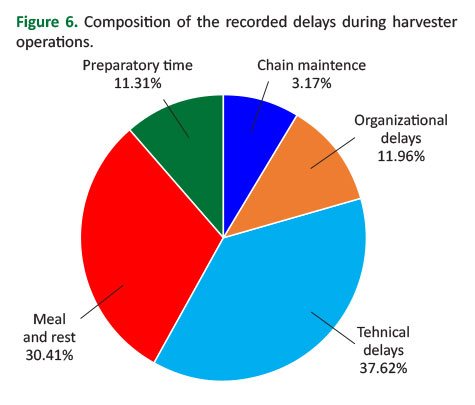 Figure 6. Composition of the recorded delays during harvester operations.
The model for calculating forwarding productivity included felling site travel times expressed by equations (Table 2) in order to enable calculation of the productivity in the span of forwarding distances and average time consumption for all other effective time consumptions (1.80 min·cycle-1 for unloaded landing travel, 22.90 min·cycle-1 for loading, 19.16 min·cycle-1 for loading travel, 0.26 min·cycle-1 for bunching, 1.02 min·cycle-1 for loaded landing travel, 6.61 min·cycle-1 for unloading and 0.31 min·cycle-1 for relocation while unloading). The maximum forwarding distance was 770 m, while the average unloaded and loaded forwarding distance at the felling site was 353 m ± 205 m and 253 m ± 189 m, respectively. At the landing site, the average unloaded and loaded forwarding distance was 70 m ± 95 m and 34 m ± 26 m, respectively. Effective time consumption per cycle was increased by applying the actual delay factor (1.26). The number of achievable cycles per hour was multiplied by the average load to express the productivity in the span of forwarding distance from 100 m to 800 m (Figure 7). The productivity ranged from 11.1 m3·h-1 to 7.3 m3·h-1 and was strongly influenced by ideal weather conditions, which led to excellent soil bearing capacity allowing the average load of 13.28 m3, and bunching of roundwood by harvester that lowered the time of loading in comparison to the results of forwarder’s work in similar conditions after motor-manual processing.
 Table 2. Forwarder travel time consumption on the felling site.
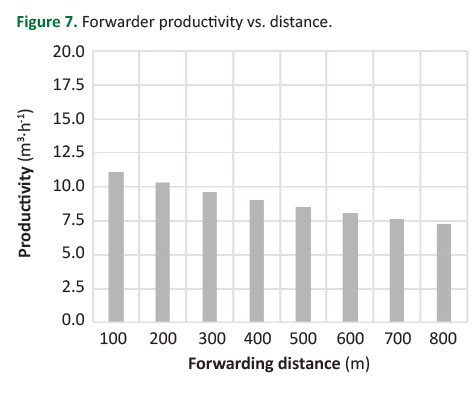 Figure 7. Forwarder productivity vs. distance.
Stem Data Validation
Differences in stem file data volume and the number of manual recorded logs resulted in 106 unrecorded logs and 27.08% lower recorded log volume compared to manual measurement, as a consequence of frequent multiple handling and measuring of energy wood processed in the crown. A Chi-square test of independence additionally revealed that the data missing rate is statistically significantly higher during the crown processing compared to the stem processing (p<0.001).
This work method, while being beneficial in terms of productivity, also resulted in a nonstandard form of 15% of the produced number of roundwood assortments. This nonstandard form is a consequence of not bucking the fork properly (due to the presence of large fork branches), leaving its lowest part attached to one of the two roundwood assortments produced (Figure 8b). Considering that energy wood assortments were mostly produced as a result of this method of crown handling, those occurrences can also be regarded as positive in terms of increasing the amount of biomass transformed to energy wood instead of being left unprocessed on the forest floor.
More detailed analyses of volume differences (manually measured volume – stem data volume) on the level of individual timber assortments (Figure 8a) indicate the reasons for relatively large volume differences on sample tree level. It is evident that most differences arise when measuring roundwood produced in the crown. The analysis of the percentage differences, apart from the need for regular calibration of harvester measurement, clearly identifies two reasons that differences arise from 1) the absence of recorded roundwood volume (a positive percentage difference of 100%) as a consequence of (not)registering the volume of roundwood whose harvester-measured length is shorter than the nominal length (set by the machine operator); and 2) recording greater roundwood volume (negative difference) in multiple handling and cross-cutting of several pieces of roundwood (measuring larger diameter with simultaneous absence of one or more pieces in the record, which also contributes to the creation of positive differences mentioned under point 1).
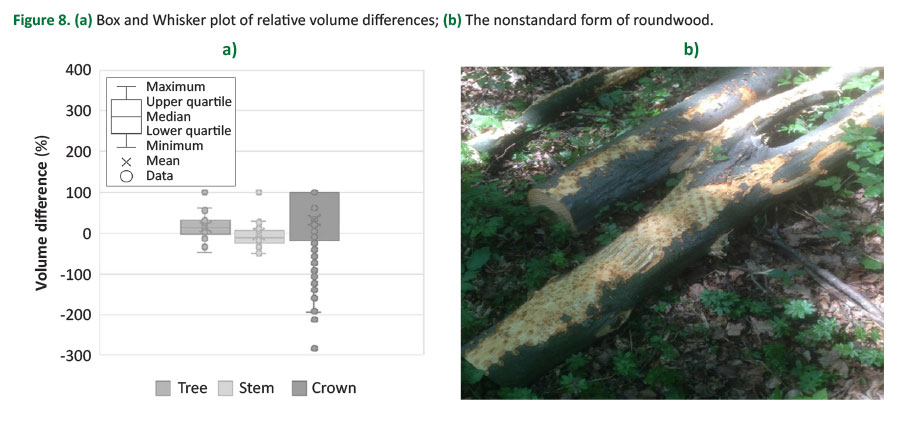
It is interesting to note that the discrepancies for stem-wood have a slightly negative average result (harvester measurement results in a higher volume than the prescribed manual method of measurement), confirming the results of previous studies (Dvořák et al. 2016). On the other hand, the opposite result on the tree level is primarily related to not recording a large number of roundwood pieces due to the multiple handling during the crow processing or due to the length smaller than the nominal.
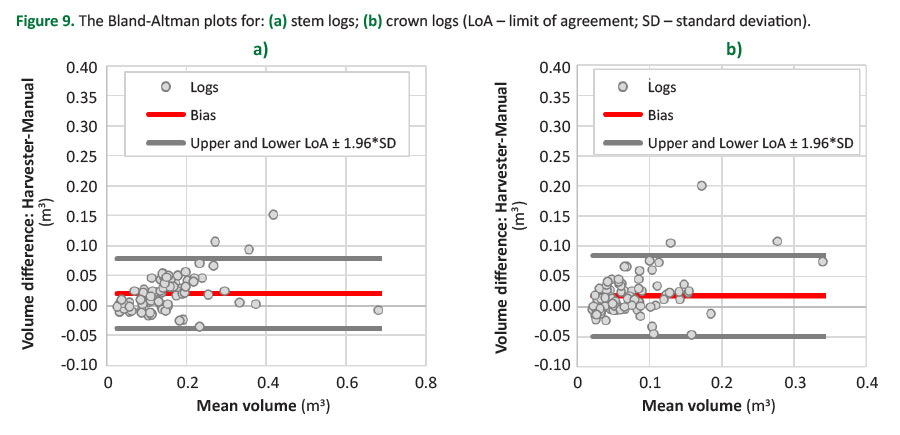
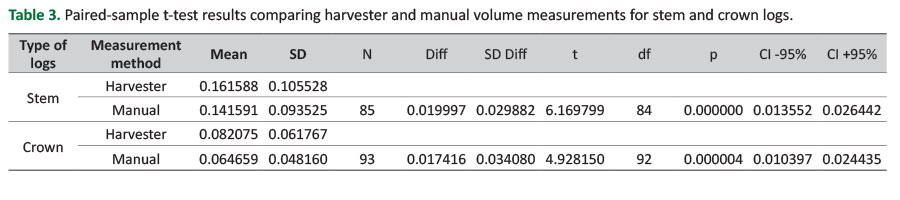
The accuracy of log measurement at the level of a single log is shown in Figure 9a for logs produced from the stem and in Figure 9b for logs produced from the crown. Only recorded logs by the harvester were included in the analysis. For both stem logs and crown logs, the calculated bias was positive (0.020 m3 and 0.017 m3, respectively), confirming an overestimation of harvester measurement. The mean relative bias reported in this study (14.12% for stem logs and 26.82% for crown logs) indicate a much lower harvester accuracy than previously reported.
In addition, the calculated root mean square error (RMSE) together with the upper and lower limit of agreement, revealed slightly higher accuracy in measuring logs produced from the stem (RMSE = 0.0358 m3) compared to logs produced from the crown (RMSE = 0.0381 m3). For both stem and crown logs, statistical t-test showed statistically significant differences between harvester and manual measurement (Table 3).
CONCLUSIONS
The application of new technology in close-to-nature managed forests requires certain stand adaptations to create conditions suitable for its operation, such as planning ghost trails, which in this study involved modifying the original tree-marking scheme initially designed for skidder extraction. Furthermore, the unknown productivity of introduced technology requires determination of productivity but also determination of weaknesses of the new technology under the aimed conditions. Thus, this study aimed to determine the productivity of a fully mechanised harvesting system (harvester+forwarder) in the thinning of two broadleaf stands with an accent on the harvester application. The conducted time study reveals a higher time consumption for crown processing than for stem processing, together with a high delay time that was mostly influenced by mechanical delay. In addition, the production of sawlogs from the stem and wood chips from the crown could increase overall system productivity indicating a further direction of research.
The determination of harvester head measurement accuracy during stem and crown processing revealed higher accuracy for measured logs produced from stem, but still not as accurate as the prescribed manual measurement. Furthermore, at the stand level, a high number of non-recorded logs (especially crown logs) together with non-recorded volume indicate that a manual measurement is still required.
The increased use of harvesters in the forests of Croatia is expected for several reasons. Firstly, the ongoing labour shortage in motor-manual felling positions harvesters as the most practical choice to achieve the planned annual cut. Secondly, the ongoing climate change, together with recent extreme events in Croatian forests, has changed the working conditions in terms of work safety, but also in terms of the work dynamics that could be improved by increased application of mechanized harvesting systems.
Author Contributions
DV conceived and designed the research, DV, MP, and IP carried out the field measurements, DV, MP and BU processed the data and performed the statistical analysis, DV secured the research funding, supervised the research and helped to draft the manuscript, DV, MJ, and BU wrote the manuscript.
Funding
The research was funded by the Ministry of Agriculture of the Republic of Croatia with the funds for the compensation for the use of non-market forest functions (OKFŠ) within the Project “Optimization of timber harvesting systems and forest traffic infrastructure on strategic-tactical planning level”.
Conflicts of Interest
The authors declare no conflict of interest.
REFERENCES
Bigot M, Cuchet E, 2003. Mechanized harvesting system for hardwoods. In: Iwarsson Wide M, Baryd B (eds) 2nd Forest Engineering Conference, Växjö, Sweden, 12–15 May 2003. SkogForsk, Uppsala, Sweden, Arbetsrapport 537, pp 57-66.
Bustos-Letelier O, Mena C, Santelices-Moya R, Cabrera-Ariza A, 2023. The Influence of Harvesting Systems on Productivity, Costs, and Soil Compaction in Small-Scale Forestry. Small-scale For 22: 193-211. https://doi.org/10.1007/s11842-022-09522-y.
Cacot E, Fauroux JC, Peuch D, Bouvet A, Chakroun M, 2016. New delimbing tool for hardwood trees: feedback on new ribbed knives after one year experience. In: Gendek A, Moskalik T (eds) Proceedings of the 49th FORMEC Symposium, Warsaw, Poland, 4–7 September 2016. Faculty of Forestry Department of Forest Utilization, Warsaw University of Life Sciences, Warszawa, Poland, pp 37-43.
Danilović M, Tomašević I, Gačić D, 2011. Efficiency of John Deere 1470D ECOIII Harvester in Poplar Plantations. Croat J For Eng 32(2): 533-548.
Diniz C, Timofeiczyk JRJ, Garzel JC, Robert RCG, Sessions J, da Silva Lopes E, 2024. Comparing Different Replacement Policies for Logging Machines in Brazil. Croat J For Eng 45(1): 57-70. https://doi.org/10.5552/crojfe.2024.2243.
Đuka A, Franjević M, Tomljanović K, Popović M, Ugarković D, Teslak K, Barčić D, Žagar K, Palatinuš K, Papa I, 2025. A Decade of Sanitary Fellings Followed by Climate Extremes in Croatian Managed Forests. Land 14(4): 766. https://doi.org/10.3390/land14040766.
Dvořák J, Natov P, Kašpar J, Szewczyk G, Kormanek M, 2016. Comparison of Standing Timber Sorting with Bucking by Harvesters. In: Gendek A, Moskalik T (eds) Proceedings of the 49th FORMEC Symposium, Warsaw, Poland, 4–7 September 2016. Warsaw University of Life Sciences, Faculty of Forestry Department of Forest Utilization, Warszawa, Poland, pp 13-18.
Garland J, Cedergren J, Eliasson L, van Hensbergen H, McEwan A, Wästlund D, 2020. Occupational safety and health in forest harvesting and silviculture – A compendium for practitioners and instructors. Forestry Working Paper No. 14. FAO, Rome, Italy, 110 p. https://doi.org/10.4060/ca8773en.
Hohmann F, Ligocki A, Frerichs L, 2017. Harvester measuring system for trunk volume determination: comparison with the real trunk volume and applicability in the forest industry. Bulletin of the Transilvania University of Braşov 10(59): 27-33.
Knobloch C, Erler J, Pfanzelt P, Richter L, 2024. Development and Evaluation of a Felling Head for a Light Forest Crawler. Croat J For Eng 45(1): 1-14. https://doi.org/10.5552/crojfe.2024.2048.
Krpan APB, Poršinsky T, 2001. Harvester Timberjack 1070 u Hrvatskoj. Šumar list 125(11-12): 619-624.
Krpan APB, Poršinsky T, 2002. Proizvodnost harvestera Timberjack 1070 pri proredi kulture običnoga bora. Šumar list 126(11-12): 551-561.
Krpan APB, Poršinsky T, 2004a. Djelotvornost strojne sječe i izrade u sastojinama tvrdih i mekih listača – 1. dio: Promišljanje struke o strojnoj sječi i izradbi drva. Šumar list 128(3-4): 127-136.
Krpan APB, Poršinsky T, 2004b. Djelotvornost strojne sječe i izrade u sastojinama tvrdih i mekih listača – 2. dio: Djelotvornost harvestera u kulturi mekih listača. Šumar list 128(5-6): 233-244.
Krpan APB, Poršinsky T, Stankić I, 2004. Djelotvornost strojne sječe i izrade u sastojinama tvrdih i mekih listača – 3. dio: Djelotvornost harvestera u prirodnoj prorednoj sastojini tvrdih listača. Šumar list 128(9-10): 495-508.
Labelle ER, Borchert H, Aurenhammer PK, Breinig L, Spinelli R, Magagnotti N, 2024. Effect of Season and Machine Type on Performance of Semi- and Fully Mechanized Harvesting Systems in Beech-Dominated Stands. Croat J For Eng 45(2): 237-249. https://doi.org/10.5552/crojfe.2024.2281.
Labelle ER, Windisch J, 2016. Productivity of a single-grip TimberPro 620 harvester with a LogMax 7000 harvesting head in a beech dominated stand. In: Gendek A, Moskalik T (eds) Proceedings of the 49th FORMEC Symposium, Warsaw, Poland, 4–7 September 2016. Warsaw University of Life Sciences, Faculty of Forestry Department of Forest Utilization, Warszawa, Poland, pp 77-82.
Löwe R, Sedmíková M, Natov P, Jankovský M, Hejcmanová P, Dvořák J, 2019. Differences in Timber Volume Estimates Using Various Algorithms Available in the Control and Information Systems of Harvesters. Forests 10(5): 388. https://doi.org/10.3390/f10050388.
Mederski PS, Borz SA, Đuka A, Lazdiņš A, 2021. Challenges in Forestry and Forest Engineering – Case Studies from Four Countries in East Europe. Croat J For Eng 42(1): 117-134. https://doi.org/10.5552/crojfe.2021.838.
Mederski PS, Schweier J, Đuka A, Tsioras P, Bont LG, Bembenek M, 2022. Mechanised Harvesting of Broadleaved Tree Species in Europe. Curr Forestry Rep 8: 1-19. https://doi.org/10.1007/s40725-021-00154-7.
Moskalik T, Borz SA, Dvořák J, Ferencik M, Glushkov S, Muiste P, Lazdiņš P, Styranivsky O, 2017. Timber Harvesting Methods in Eastern European Countries: a Review. Croat J For Eng 38(2): 231-241.
Nieuwenhuis M, Dooley T. 2006. The Effect of Calibration on the Accuracy of Harvester Measurements. Int J Forest Eng 17(2): 25-33. https://doi.org/10.1080/14942119.2006.10702533.
Nocetti M, Brunetti M, 2024. Advancements in Wood Quality Assessment: Standing Tree Visual Evaluation—A Review. Forests 15(6): 943. https://doi.org/10.3390/f15060943.
Poršinsky T, Krpan APB, Stankić I, 2004. Djelotvornost strojne sječe i izrade u sastojinama tvrdih i mekih listača – 4. dio: Okolišna pogodnost strojne sječe u prirodnim sastojinama. Šumar list 128(11-12): 655-669.
Rosińska M, Bembenek M, Picchio R, Karaszewski Z, Borz SA, Mederski PS, 2025. Harvester Efficiency During Thinning Operations in Alder Planted Stands with Some of Coppice Origin. Croat J For Eng 46(1): 19-31. https://doi.org/10.5552/crojfe.2025.2507.
Slugeň J, Peniaško P, Messingerová V, Jankovský M, 2014. Productivity of a John Deere Harvester Unit in Deciduous Stands. Acta Univ Agric Silvic Mendelianae Brun 62(1): 231-238. https://doi.org/10.11118/actaun201462010231.
Spinelli R, Visser R, 2008. Analyzing and Estimating Delays in Harvester Operations. Int J Forest Eng 19(1): 36-41. https://doi.org/10.1080/14942119.2008.10702558.
Strandgard M, 2009. Evaluation of Manual Log Measurement Errors and Its Implications on Harvester Log Measurement Accuracy. Int J Forest Eng 20(2): 9-16. https://doi.org/10.1080/14942119.2009.10702578.
Tomczak K, Mederski PS, Naskrent B, Tomczak A, 2024. Accuracy of Photo-Optical Timber Measurement Using a Stereo Camera Technology. Croat J For Eng 45(1): 157-167. https://doi.org/10.5552/crojfe.2024.2268.
Ucar Z, Eker R, Bilici E, Akay AE, 2024. Evaluating the Use of Smartphone Applications for Log Stacks Volume Measurement in Turkish Forestry Practices. Croat J For Eng 45(2): 263-276. https://doi.org/10.5552/crojfe.2024.2398.
Vusić D, 2013. Pogodnost sustava pridobivanja drvne biomase u smrekovoj šumskoj kulturi. PhD Thesis, University of Zagreb, Faculty of Forestry, Zagreb, Croatia, 174 p.
Vusić D, Rukavina N, 2010. Utjecaj rašljavosti stabala crnoga bora na proizvodnost harvestera. Nova mehanizacija šumarstva 31: 37-43.
© 2026 by the author(s). License: Croatian Forest Research Institute. This article is an open access article distributed under the terms and conditions of the Creative Commons Attribution 4.0 International License (CC BY 4.0).