

SEEFOR 17(2): 26024
Article ID: 26024
DOI: https://doi.org/10.15177/seefor.26-024
ORIGINAL SCIENTIFIC PAPER
Modelling Annual Basal Area Increment of Individual Pedunculate Oak Trees in Natural Mixed Stands
Vladimir Novotny1, Stjepan Dekanić2, Anamarija Jazbec2,*, Mario Božić2, Luka Novotny3
Addresses:
(1) Croatian Forest Research Institute, Division for Forest Management and Forestry Economics, Trnjanska cesta 35, HR-10000 Zagreb, Croatia;
(2) University of Zagreb, Faculty of Forestry and Wood Technology, Svetošimunska cesta 23, HR-10000 Zagreb, Croatia;
(3) CROATEL Ltd, Pantovčak 265, HR-10000 Zagreb, Croatia
* Correspondence: e-mail: jazbec@sumfak.hr
Citation: Novotny V, Dekanić S, Jazbec A, Božić M, Novotny L, 2026. Modelling Annual Basal Area Increment of Individual Pedunculate Oak Trees in Natural Mixed Stands. South-east Eur for 17(2): 26024. https://doi.org/10.15177/seefor.26-024.
Received: 16 Jul 2026; Revised: 08 Sep 2026; Accepted: 15 Sep 2026; Published: 3 Nov 2026
Cited by: Google Scholar
Abstract
Annual basal area increment is an important indicator of individual-tree growth and stand development, and its modelling provides a better understanding of the factors associated with the growth of pedunculate oak (Quercus robur L.). The aim of this study was to identify the most important tree size, competition, crown and site factors associated with the annual basal area increment of individual pedunculate oak trees and to develop a regression model for its estimation. The analysis was based on 892 observations of annual basal area increment obtained from successive tree measurements on 28 permanent sample plots in natural mixed stands of pedunculate oak and common hornbeam in continental Croatia. Annual basal area increment of individual trees was used as the dependent variable, while mean diameter at breast height, competition indices, crown characteristics and selected soil properties were analysed as independent variables. Due to deviations from a normal distribution, annual basal area increment was square-root transformed, and modelling was performed using multiple linear regression with multicollinearity control. The final model explained 61.18% of the variability in the transformed annual basal area increment (R² = 0.6118). Mean diameter at breast height was the predictor with the largest individual contribution to explaining the variability (partial R² = 0.389), while the competition indices BAB, CAB_H and PkH_ha were negatively associated with annual basal area increment. Humus content was positively associated with increment, whereas the proportion of silt and clay fractions was negatively associated with increment. The results indicate that the annual basal area increment of individual pedunculate oak trees is primarily associated with tree size, with additional contributions from competitive relationships, crown characteristics and selected soil properties. The developed regression model provides a basis for further development of individual-tree growth models for pedunculate oak in natural mixed stands. However, the results should be interpreted in the context of the hierarchical and longitudinal structure of the data used in the analysis.
Keywords: pedunculate oak (Quercus robur L.); annual basal area increment; multiple linear regression; growth model; tree competition; permanent sample plots; natural mixed stands
INTRODUCTION
Basal area, defined as the sum of the cross-sectional areas of tree stems at breast height, is one of the important structural indicators of a forest stand. It is related to stand density, growing stock, increment and productivity, and is frequently used to assess stand condition and monitor changes during stand development. Since its value can be relatively easily determined through field measurements, basal area plays an important role in forest management planning and silviculture.
The importance of basal area for stand growth and development was recognized as early as the beginning of the 20th century. Schwappach (1911) investigated the relationships between basal area and the productivity of beech stands, while Wiedemann (1936) conducted similar research in oak stands. Assmann (1961) made a significant contribution to understanding the relationship between stand density and increment by distinguishing maximum, optimal and critical basal area, and pointing out that the highest stand density does not necessarily ensure the highest increment. These studies laid important foundations for understanding the relationships between stand density, growth and productivity, as well as for determining the intensity and timing of silvicultural interventions.
In Croatian forestry, the development of basal area and increment in pedunculate oak stands has been the subject of numerous studies (Špiranec 1975, Klepac 1976, Kovačić and Hren 1984, Bezak 1992, Benko et al. 1999, Antonić et al. 2000, 2003, Ostrogović Sever et al. 2010). Most of these studies have focused on the stand level, i.e. on describing changes in total stand basal area and increment throughout stand development. The development of computer technologies and statistical methods has enabled the application of growth models in which changes in stand characteristics can be described and simulated based on the characteristics of individual trees, their growth and their interactions (Vanclay 1994, Pretzsch 2009).
In recent decades, increasing attention has been devoted to individual-tree growth models (Pretzsch 2020, Lamonica et al. 2020). Such models enable a more detailed description of the relationships between tree dimensions, competitive relationships, crown characteristics and site factors, and may represent an important component of models for assessing forest stand development under different conditions and management scenarios (Pretzsch 2009, Forrester and Pretzsch 2015, West 2024). In Croatia, Božić (2003) and Božić et al. (2006) modelled basal area increment of individual silver fir trees, whereas studies of individual-tree increment in pedunculate oak are considerably less common.
Pedunculate oak is one of the economically and ecologically most important tree species of lowland forests in Croatia, and its stands are characterized by complex relationships between individual-tree growth, stand structure and site conditions. Despite a long tradition of research on the growth and increment of pedunculate oak at the stand level, available data and models that directly relate annual basal area increment of individual trees to their tree size, competitive position, crown characteristics and soil properties are still limited. In particular, the relative contribution of individual groups of factors to individual-tree increment in natural mixed stands of pedunculate oak and common hornbeam remains insufficiently investigated.
Therefore, the aim of this study was to determine which tree size and competition factors, as well as crown and site factors, are associated with the annual basal area increment of individual pedunculate oak trees and to quantify their relative contribution to explaining the variability in increment. For this purpose, a multiple regression model was developed to analyse the relationships between annual basal area increment and tree size characteristics, competition indices, crown characteristics and selected soil properties. Particular attention was given to assessing the relative importance of individual predictors and their contribution to explaining the variability in annual increment.
Since the data were collected on permanent sample plots and included repeated measurements of a subset of trees, the results were interpreted with consideration of the hierarchical and longitudinal structure of the data. Therefore, the aim of this study was not to provide a final or universally applicable growth model, but rather to identify patterns of association between individual-tree increment and selected tree size, competition and site factors, and to provide a basis for further development of individual-tree growth models for pedunculate oak in natural mixed stands.
MATERIALS AND METHODS
Study Area and Permanent Sample Plots
The study was conducted on 28 permanent sample plots (PSPs) established between 1991 and 1998 in the forest management units of the Karlovac, Koprivnica, Bjelovar and Vinkovci Forest Administrations (Figure 1).
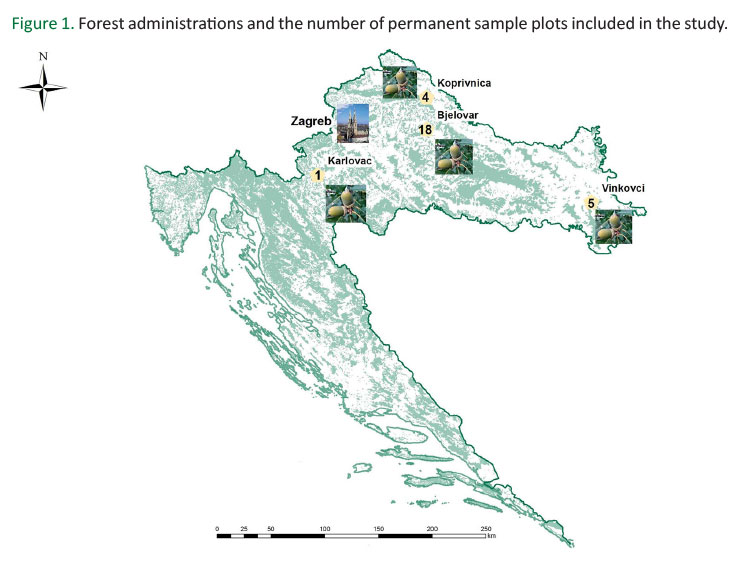 Figure 1. Forest administrations and the number of permanent sample plots included in the study.
The permanent sample plots were established in natural mixed stands of pedunculate oak and common hornbeam (Carpino betuli-Quercetum roboris Anić 1959 ex Rauš 1969) originating from natural regeneration under shelterwood cutting.
When selecting the locations, efforts were made to ensure the greatest possible homogeneity of site and stand conditions within each plot. At the time of plot establishment, stand age ranged from 18 to 140 years, thus covering a wide range of developmental stages and a substantial part of the production period of pedunculate oak stands.
The permanent sample plots were square or rectangular in shape. A subplot (strip) was established in the most homogeneous part of each plot, where all trees were permanently numbered. The size of the plots and subplots was determined according to stand age. The subplot area was 0.01 ha in stands belonging to the first and second age classes, 0.05 to 0.10 ha in stands belonging to the third age class, 0.25 ha in stands belonging to the fourth age class, and 0.36 ha in stands belonging to the fifth, sixth and seventh age classes (Dubravac and Novotny 1992, Novotny 1997).
Data Collection and Processing
At the establishment of the permanent sample plots, diameter at breast height was measured in two perpendicular directions, together with total tree height, stem height and horizontal crown projections for all permanently marked trees. In addition to dendrometric measurements, crown layer, crown shape, stem quality, degree of tree damage and crown defoliation were assessed. A soil profile was opened on each permanent sample plot, and laboratory analyses of selected physical and chemical soil properties were conducted.
Following the establishment of the plots, continuous monitoring of the stands was carried out in 1998, 2004 and 2008. Of the total 28 plots, three repeated measurements were conducted on six plots, two repeated measurements on nine plots, and one repeated measurement on thirteen plots.
All measured, assessed and derived data were compiled into a relational database. The database contained a total of 10,477 records comprising different types of data and variables collected during field measurements and their subsequent processing. This number does not represent the number of individual trees included in the study, but rather the total number of records in the database used for storing and processing different types of data from different time periods.
For modelling purposes, observations of pedunculate oak trees for which two consecutive measurements required to calculate annual basal area increment were available were selected. The final modelling dataset comprised a total of 892 observations of annual basal area increment of pedunculate oak trees.
An observation in the analysis represents the annual basal area increment of an individual tree calculated for the time interval between two consecutive measurements. Therefore, the 892 observations do not necessarily represent 892 different trees. On plots with repeated measurements, the same tree could be represented in several time intervals and thus contribute multiple observations of annual basal area increment. Furthermore, multiple trees belonged to the same permanent sample plot and shared some common stand and site conditions.
Such a data structure implies that the observations are not completely independent of one another. This particularly applies to observations within the same permanent sample plot, as well as to repeated observations of the same trees over time. This characteristic was taken into account when interpreting the results and represents one of the limitations of the statistical approach applied.
Dependent Variable
The subject of modelling was the annual basal area increment of individual pedunculate oak trees. The variable igPer represents the mean annual basal area increment of an individual tree between two consecutive measurements and is expressed in m² per year (m²·year⁻¹). It was calculated as the difference in the tree basal area between two consecutive measurements divided by the number of years between the measurements.
The basal area of an individual tree (g) was calculated based on the mean diameter at breast height according to the following equation:
g = πds² / 40 000
where g is basal area of an individual tree (m²), and ds is the mean diameter at breast height (cm).
The annual basal area increment (igPer) was calculated according to the following equation:
igPer = (g₂ − g₁) / Δt
where igPer is mean annual basal area increment of an individual tree (m²·year⁻¹), g₁ is basal area of the tree at the first measurement (m²), g₂ is basal area of the tree at the subsequent measurement (m²), Δt is number of years between two consecutive measurements (years).
In the subsequent statistical analysis, the square root of annual basal area increment, denoted as sqrt_igPer, was used as the dependent variable.
Independent Variables
For modelling annual basal area increment, variables were selected that, based on previous research and the biological characteristics of tree growth, describe tree size, stand and competitive relationships, crown development, and selected soil properties.
The following independent variables were used:
- ds (cm) – mean diameter at breast height of the tree, calculated as the arithmetic mean of two perpendicular measurements of diameter at breast height taken at 1.3 m above ground level;
- G_ha (m²·ha⁻¹) – total stand basal area per hectare, calculated as the sum of the basal areas of all trees on the subplot divided by the subplot area;
- BAB (%) – relative proportion of the basal area of trees larger in diameter than the subject tree in the total basal area of the subplot. This variable represents an indicator of the relative competitive position of the subject tree within the stand (Kiernan et al. 2008);
- BAPBA (%) – relative proportion of the basal area of an individual tree in the total stand basal area per hectare. It was calculated as the ratio of the basal area of the subject tree to the total stand basal area per hectare and represents a measure of the relative size and position of the tree within the stand structure (Božić 2003, Kiernan et al. 2008);
- PkH_ha (m²·ha⁻¹) – total area of the horizontal crown projections of pedunculate oak trees per hectare, calculated as the sum of the crown projection areas of all pedunculate oak trees on the subplot divided by the subplot area;
- CAB_H (%) – proportion of the crown area of pedunculate oak trees with a larger crown than the subject tree in the total crown area of pedunculate oak trees on the subplot. This variable represents an indicator of the relative competitive position of the subject tree in relation to pedunculate oak trees with larger crown areas;
- Humus (%) – humus content in the second soil horizon, determined by laboratory analysis of soil samples;
- PrahGlina (%) – proportion of the silt and clay fraction in the second soil horizon, determined by laboratory analysis of soil samples and used as an indicator of soil textural properties.
The variables Humus and PrahGlina represent soil properties determined at the permanent sample plot level. Therefore, all trees within the same plot share the same or very similar values of these variables, which was taken into account when interpreting their statistical contribution.
Statistical Analysis
For all analysed variables, descriptive statistics were calculated, including the arithmetic mean, standard deviation, minimum, median and maximum. In all statistical analyses, a significance level of 5% was considered statistically significant.
Multiple linear regression analysis was applied to determine the relationships between annual basal area increment and the selected tree size and competition variables, as well as crown and site variables.
Prior to modelling, the distribution of annual basal area increment was examined. Since the distribution of the igPer variable deviated from normality, a square-root transformation was applied. The transformed variable sqrt_igPer was subsequently used as the dependent variable in the analysis.
All previously defined independent variables were included in the initial regression model. Multicollinearity among the predictors was assessed using the Variance Inflation Factor (VIF). A VIF threshold of >5 was used as an indication of potentially problematic collinearity among predictors. Variables showing pronounced multicollinearity were considered for exclusion from the model, while their statistical significance and contribution to the model were also taken into account in the final selection.
The modelling was performed in several steps. In the first step, an initial model including all selected independent variables was estimated. After pronounced multicollinearity was identified, the BAPBA variable was excluded from the model. In the next step, the exclusion of the G_ha variable was considered, as it was not statistically significant in that model. After defining a model that included tree size, competition and crown variables, the Humus and PrahGlina variables were additionally included to assess their contribution to explaining the variability in annual basal area increment.
The relative importance of individual predictors was assessed using the partial coefficient of determination (partial R²). Partial R² was used as an indicator of the individual contribution of a predictor to explaining the variability of the dependent variable while the other predictors were simultaneously included in the model. Partial R² values were not interpreted as mutually additive components of the overall R².
The goodness of fit of the final model was assessed using the coefficient of determination (R²) and adjusted coefficient of determination (adjusted R²), residual analysis, and comparison of measured and model-estimated values of annual basal area increment.
The hierarchical and longitudinal structure of the data was taken into account when interpreting the results. Trees were nested within permanent sample plots, while on a subset of plots the same trees were monitored over several consecutive time intervals. The applied multiple linear regression did not explicitly model random effects of permanent sample plots and individual trees, nor the correlation between repeated observations. Therefore, results related to the statistical significance of individual parameters should be interpreted with caution, particularly for soil variables determined at the plot level. The direction and relative importance of the estimated associations were used primarily for biological interpretation and as a basis for further model development.
Microsoft Excel 2019 was used for data entry and preparation, while Microsoft Access 2019 was used to create the relational database. Statistical analyses and regression modelling were performed using the SAS 9.4 statistical software package (SAS Institute Inc., Cary, NC, USA).
RESULTS
The basic descriptive statistics of the dependent and independent variables included in the modelling are presented in Table 1. The analysis was based on a total of 892 observations of annual basal area increment of individual pedunculate oak trees. An observation represents the annual basal area increment calculated for an individual tree between two consecutive measurements; therefore, it does not necessarily represent a unique tree, as the same trees were monitored over multiple time intervals on some permanent sample plots.
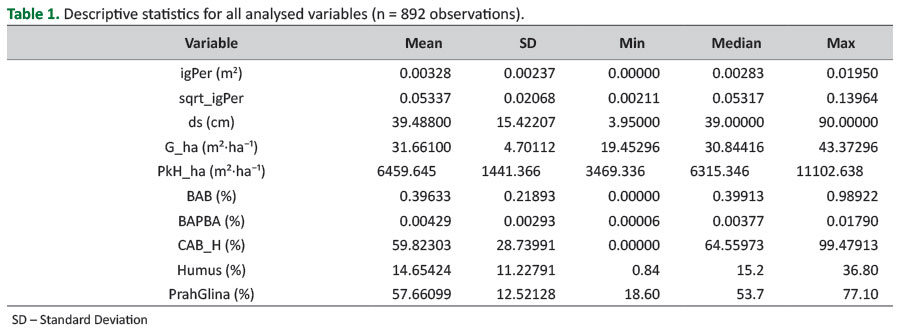 Table 1. Descriptive statistics for all analysed variables (n = 892 observations).
The mean annual basal area increment of pedunculate oak trees was 0.00328 m²·year⁻¹, with a standard deviation of 0.00237 m²·year⁻¹. Values ranged from 0 to 0.01950 m²·year⁻¹, while the median was 0.00283 m²·year⁻¹. The mean diameter at breast height (ds) was 39.49 cm, ranging from 3.95 to 90.00 cm.
The total stand basal area (G_ha) averaged 31.66 m²·ha⁻¹, while the total crown projection area of pedunculate oak trees (PkH_ha) averaged 6459.65 m²·ha⁻¹. The mean values of the competition indices BAB and CAB_H were 39.63% and 59.82%, respectively. The mean humus content in the second soil horizon was 14.65%, while the mean proportion of the silt and clay fraction was 57.66%.
The distribution of annual basal area increment (igPer) deviated from normality, as confirmed by the Kolmogorov–Smirnov test (p < 0.01). Therefore, the dependent variable was square-root transformed (sqrt_igPer). Following transformation, the distribution showed an approximately normal shape, and the deviation from normality was no longer statistically significant according to the Kolmogorov–Smirnov test (p > 0.15).
The distributions of the original and transformed variables are presented in Figure 2.
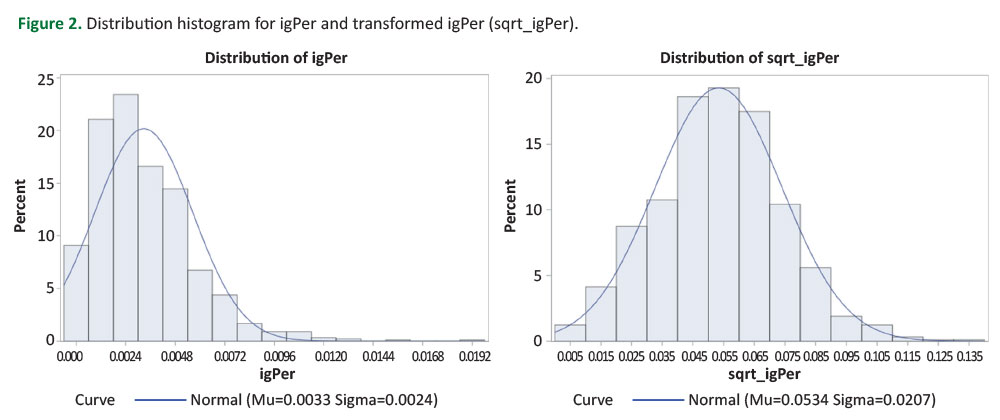 Figure 2. Distribution histogram for igPer and transformed igPer (sqrt_igPer).
The results of the individual steps of the multiple linear regression analysis are presented in Table 2. All previously defined independent variables were included in the initial model. The initial model was statistically significant (F(6,885) = 235.92; p < 0.0001) and explained 61.53% of the variability in transformed annual basal area increment (R² = 0.6153; adjusted R² = 0.6127).
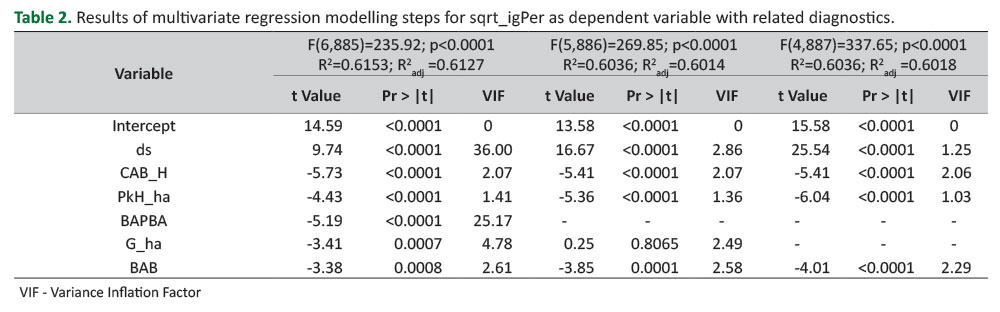
In the initial model, high Variance Inflation Factor (VIF) values were identified for the variables ds (VIF = 36.00) and BAPBA (VIF = 25.17), indicating pronounced multicollinearity. Since BAPBA represented the relative proportion of the basal area of an individual tree in the total stand basal area and was strongly related to tree size, it was excluded from further modelling.
After excluding BAPBA, the model remained statistically significant (F(5,886) = 269.85; p < 0.0001), with R² = 0.6036 and adjusted R² = 0.6014. At this stage, the G_ha variable was not statistically significant (p = 0.8065), and its exclusion did not change the model coefficient of determination. Therefore, G_ha was also excluded from the final model.
The final basic model included the variables ds, CAB_H, PkH_ha and BAB. The model was statistically significant (F(4,887) = 337.65; p < 0.0001) and explained 60.36% of the variability in transformed annual basal area increment (R² = 0.6036; adjusted R² = 0.6018). All variables included in this model were statistically significant (p < 0.0001).
After defining the basic model, the additional contribution of soil properties was analysed by including the variables Humus and PrahGlina. The results of the basic and extended models are presented in Table 3.
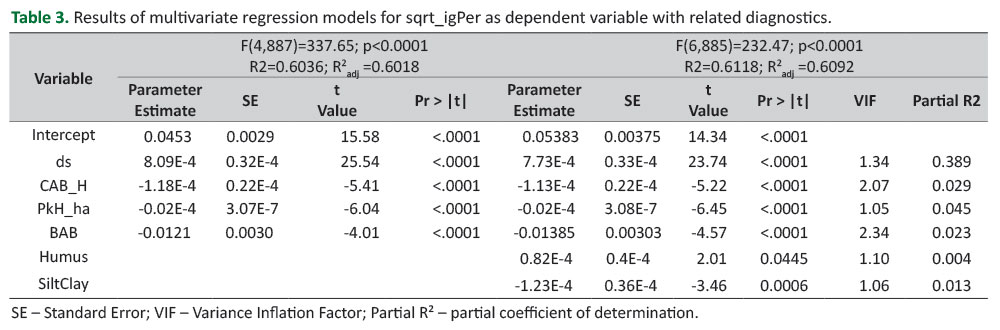
The inclusion of soil properties increased the coefficient of determination from R² = 0.6036 to R² = 0.6118, while the adjusted coefficient of determination increased from 0.6018 to 0.6092. The extended model was statistically significant (F(6,885) = 232.47; p < 0.0001).
In the final model, all included independent variables were statistically significant. Mean diameter at breast height (ds) had a positive estimated parameter (β = 7.73 × 10⁻⁴; p < 0.0001), whereas CAB_H (β = -1.13 × 10⁻⁴; p < 0.0001), PkH_ha (β ≈ -2.0 × 10⁻⁶; p < 0.0001) and BAB (β = -0.01385; p < 0.0001) had negative estimated parameters. Among the soil properties, Humus had a positive estimated parameter (β = 8.2 × 10⁻⁵; p = 0.0445), whereas PrahGlina had a negative estimated parameter (β = -1.23 × 10⁻⁴; p = 0.0006).
The VIF values in the final model ranged from 1.05 to 2.34, indicating that, after excluding variables with pronounced multicollinearity, no problematic level of multicollinearity was identified among the remaining predictors.
Analysis of the partial coefficients of determination showed that ds had the largest individual contribution to explaining the variability in transformed annual basal area increment (partial R² = 0.389). The contributions of the other predictors were smaller: PkH_ha had a partial R² of 0.045, CAB_H 0.029, BAB 0.023, PrahGlina 0.013, and Humus 0.004.
Partial R² values do not represent additive components of the total model R² because the contributions of individual predictors may overlap. Therefore, in this study, they were used as indicators of the relative contribution of individual predictors within the final model, rather than as components that can be directly summed to obtain the overall coefficient of determination.
The final model explained 61.18% of the variability in transformed annual basal area increment (R² = 0.6118), while the adjusted coefficient of determination was 0.6092. Compared with the basic model without soil properties, the inclusion of the Humus and PrahGlina variables resulted in an increase in R² of 0.0082.
Residual analysis showed an approximately normal distribution of residuals and approximately constant variance, with no pronounced deviations indicating serious violations of the assumptions of the linear regression model. Comparison of measured and model-estimated values showed agreement in the general pattern of variability in annual basal area increment, with greater deviations for individual observations, particularly at higher increment values (Figure 3).
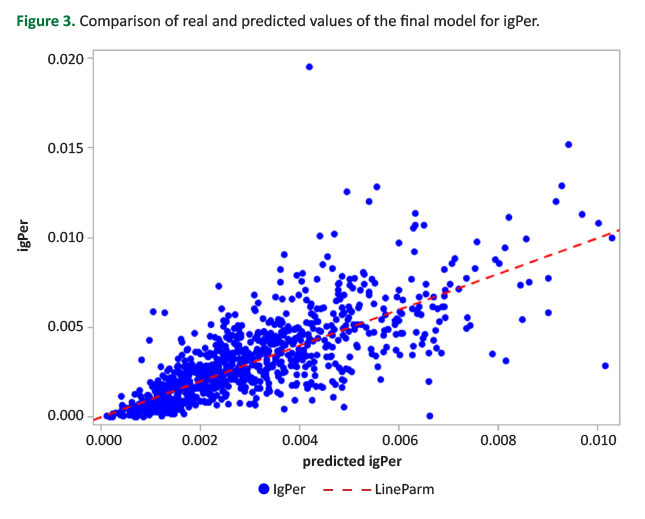 Figure 3. Comparison of real and predicted values of the final model for igPer.
The obtained results, particularly the values of the standard errors and p-values of individual parameters, should be interpreted with consideration of the data structure. Several observations originated from the same permanent sample plot, while on some plots the same trees were monitored over multiple time intervals. Since the applied model did not explicitly include random effects of the plot and individual tree, the observations cannot be considered fully statistically independent. This is particularly important when interpreting the statistical significance of plot-level variables, such as soil properties. Therefore, the statistically significant relationships between soil properties and annual basal area increment identified in this study should be regarded as indicative associations rather than evidence of direct causal effects.
DISCUSSION
The results indicate that the annual basal area increment of individual pedunculate oak trees is associated with a combination of tree size characteristics, competitive relationships, crown development and selected soil properties. However, the analysis of the relative importance of the predictors showed that mean diameter at breast height (ds) had by far the largest individual contribution to explaining the variability in annual basal area increment, whereas the other analysed factors had smaller but statistically identifiable contributions. This result highlights the importance of tree size in describing individual-tree growth of pedunculate oak.
The dominant role of mean diameter at breast height in the model (partial R² = 0.389) is consistent with well-known patterns of individual-tree growth. Tree size is an integrative characteristic associated with developmental status, posi-tion within the stand and the ability to utilize available resources. Larger trees generally have a more developed photosynthetic apparatus and a more favourable position with respect to light resources, which may be associated with greater absolute basal area increment. Similar importance of tree size has been reported in other studies of individual-tree growth, in which tree size represents one of the most important predictors of increment (Pretzsch 2020, Lamonica et al. 2020, Bianchi et al. 2023). The present results therefore support the use of tree size variables as a fundamental component of individual-tree growth models for pedunculate oak.
Among the indicators of competitive relationships, BAB and CAB_H showed negative associations with annual basal area increment. A higher BAB value indicates a greater proportion of the basal area accounted for by trees that are larger in diameter than the subject tree and can therefore be interpreted as an indicator of a less favourable competitive position of the subject tree. The negative sign of this variable thus indicates an association between greater competitive pressure and lower basal area increment. Similarly, CAB_H, which describes the proportion of the crown area of pedunculate oak trees with larger crowns than that of the subject tree, showed a negative relationship with increment. This indicates the importance of crown-level competitive relationships within the pedunculate oak layer. The results are generally consistent with studies emphasizing the importance of competition for individual-tree growth, particularly in stands where light availability represents an important growth factor (Forrester and Pretzsch 2015, Lamonica et al. 2020).
The total crown projection area of pedunculate oak trees per hectare (PkH_ha) also showed a negative association with annual basal area increment. An increase in total crown projection area may reflect greater occupancy of available growing space by tree crowns and more intense inter-tree competition. The result is therefore consistent with the expectation that increased crown density and greater use of available growing space may be associated with reduced individual-tree increment. However, since the analysed data do not allow individual mechanisms of competition to be directly separated, this result should be interpreted as a statistical association rather than as direct evidence of a specific mechanism of action.
Interestingly, total stand basal area (G_ha) was statistically significant in the initial model, but after the removal of BAPBA and subsequently G_ha, its inclusion no longer contributed to the model. The absence of G_ha from the final model may be explained by the fact that other included variables, particularly ds, BAB, CAB_H and PkH_ha, already capture part of the information related to structural and competitive conditions within the stand. In this respect, the result does not mean that total stand basal area is unrelated to tree growth, but rather that, in the presence of the other predictors, it did not provide sufficient additional information to warrant its retention in the final model.
Similarly, the BAPBA variable was excluded because of pronounced multicollinearity with mean diameter at breast height. Since BAPBA represents the relative proportion of an individual tree's basal area in the total stand basal area, its relationship with tree size was expected. Excluding BAPBA therefore allows more stable estimation of the parameters of the final model and reduces the problem of redundant information among the predictors.
In contrast to the competition variables, soil properties made a smaller contribution to the overall explanation of variability.
CONCLUSIONS
The results of this study indicate that the annual basal area increment of individual pedunculate oak trees is associated with a combination of tree size characteristics, competitive relationships, crown development and selected soil properties. Among the analysed predictors, mean diameter at breast height (ds) had the largest individual contribution to explaining the variability in annual basal area increment (partial R² = 0.389), indicating its dominant role in describing individual-tree growth in the analysed dataset.
Indicators of competitive relationships and crown characteristics were also associated with annual basal area increment. The variables BAB, CAB_H and PkH_ha showed negative estimated relationships with increment, which is consistent with the expectation that greater competitive pressure and greater occupancy of available space by tree crowns may be associated with lower individual-tree increment. Total stand basal area (G_ha) and the relative proportion of tree basal area in the stand (BAPBA) were not retained in the final model because of insufficient additional contribution and pronounced multicollinearity, respectively.
Soil properties made a smaller contribution to the overall explanation of increment variability, but showed statistically identifiable associations with annual basal area increment. Higher humus content was associated with greater increment, whereas a higher proportion of the silt and clay fraction was associated with lower increment. These relationships should be regarded as indicative associations rather than evidence of causal effects of individual soil properties, since the corresponding physiological and hydrological mechanisms were not directly investigated.
The final regression model explained 61.18% of the variability in transformed annual basal area increment (R² = 0.6118). This level of explanatory power indicates that a combination of tree size, competition and site variables can describe a substantial proportion of the variability in individual-tree increment of pedunculate oak in the investigated natural mixed stands. Partial R² values should be interpreted as indicators of the relative contribution of individual predictors within the model and not as mutually additive components of the total R².
The structure of the data used should be taken into account when interpreting the results. The model was developed using 892 observations of annual basal area increment, but these observations do not represent 892 statistically independent trees. Multiple trees belonged to the same permanent sample plot and shared some common stand and site conditions, while on some plots the same trees were monitored over several consecutive time intervals. In addition, soil properties were determined at the permanent sample plot level. Since the applied multiple linear regression did not explicitly include random effects of permanent sample plots and individual trees, the standard errors and p-values of individual parameters, particularly those of soil variables, should be interpreted with appropriate caution.
Despite this limitation, the results provide a consistent description of the relationships between tree size, competitive relationships, crown characteristics, soil properties and annual basal area increment. Mean diameter at breast height stands out as the predictor with the largest individual contribution, while competition and site factors provide additional information on differences in individual-tree growth.
The developed model provides a useful basis for further development of individual-tree growth models for pedunculate oak in natural mixed stands of pedunculate oak and common hornbeam. However, since the model was not independently validated and the hierarchical and longitudinal structure of the data was not explicitly modelled, it should not, in its present form, be considered a fully validated tool for direct simulation of stand development or planning of forest management interventions.
Future research should include independent validation of the model and the application of mixed-effects models or other appropriate statistical approaches that would explicitly account for the random effects of permanent sample plots and individual trees. Such an approach would enable more reliable estimation of individual and shared sources of variability and a more accurate assessment of predictor significance. The inclusion of additional climatic, microsite and other ecological variables could further improve the explanation of individual-tree increment and contribute to the development of models applicable in future stand growth and development simulators.
Author Contributions
VN conceived and led the research and wrote the manuscript, AJ assisted with the statistical analyses, LN contributed to data preparation and technical processing, and SD and MB contributed to the conceptual development of the study and helped shape the direction of the research.
Funding
The research was conducted within the project “Ekološko-ekonomske valencije tipova šuma”.
Acknowledgments
The authors would like to acknowledge the staff of the Division for Forest Management and Forestry Economics for their assistance with fieldwork.
Conflicts of Interest
The authors declare no conflict of interest.
REFERENCES
Antonić O, Hatić D, Križan J, Bukovec D, Borović D, 2000. Projektiranje režima podzemne vode kao preduvjeta opstanka nizinskih šuma u području hidrotehničkog zahvata – primjer šume Repaš i HE Novo Virje. Hrvat vode 8(32): 205–223.
Antonić O, Križan J, Hatić D, Bukovec D, Kušan V, 2003. Višenamjenski kanal Dunav-Sava: Šumarska istraživanja, Knjiga 1: Glavni izvještaj. Zagreb, Croatia, 147 p.
Assmann E, 1961. Waldertragskunde. Organische Produktion, Struktur, Zuwachs und Ertrag von Waldbeständen. BLV Verlagsgesellschaft, Munich, Germany, 490 p.
Benko M, Szirovicza L, Lukić N, 1999. A trend in the development of stand basal area of pedunculate oak in the association Genisto elatae-Quercetum roboris and the ecological-management forest type II-G-20. In: Amaro A, Tomé M (eds) Empirical and Process-Based Models for Forest Tree and Stand Growth Simulation, Proceedings of the IUFRO Workshop, Oeiras, Portugal, 21–27 September 1997. Edições Salamandra, Lisbon, Portugal, pp 111–118.
Bezak K, 1992. Prigušene oscilacije fenomena rasta i prirasta praćene Levakovićevim analitičkim izrazima. In: Zbornik o Antunu Levakoviću. HAZU, Centar za znanstveni rad Vinkovci, Vinkovci, Croatia, pp 57–83.
Bianchi S, Siipilehto J, Repola J, Niemistö P, Korhonen KT, Peltoniemi M, Salminen H, Hynynen J, 2023. Individual tree basal area increment models suitable for different stand structures in Finland. For Ecol Manag 549: 121467. https://doi.org/10.1016/j.foreco.2023.121467.
Božić M, 2003. Utjecaj stanišnih i sastojinskih elemenata na prirast obične jele (Abies alba Mill.) u jelovim sastojinama na kršu u Hrvatskoj. PhD Thesis, University of Zagreb, Faculty of Forestry, Zagreb, Croatia, 190 p.
Božić M, Čavlović J, Teslak K, 2006. Modeliranje prirasta jelovih stabala na temelju sastojinskih čimbenika. Glas šum pokuse posebno izdanje 5: 443–454.
Dubravac T, Novotny V, 1992. Metodologija tematskog područja uzgajanje šuma-rast i prirast (primjenjena u multidisciplinarnom projektu Ekološko ekonomske valencije tipova šuma). Rad Šumar Inst Jastrebar 27(2): 157–166.
Forrester DI, Pretzsch H, 2015. Tamm Review: On the strength of evidence when comparing ecosystem functions of mixtures with monocultures. For Ecol Manag 356: 41–53. https://doi.org/10.1016/j.foreco.2015.08.016.
Kiernan DH, Bevilacqua E, Nyland RD, 2008. Individual-tree diameter growth model for sugar maple trees in uneven-aged northern hardwood stands under selection system. For Ecol Manag 256: 1579–1586. https://doi.org/10.1016/j.foreco.2008.06.015.
Klepac D, 1976. Some use of permanent plots in growth and yield research in even-aged pedunculate oak stands in the SR Croatia of SFR Jugoslavija. Research Notes 43. Royal College of Forestry, Department of Forest Yield Research, Stockholm, Sweden, pp 104–105.
Kovačić Đ, Hren V, 1984. Normalna raspodjela stabala po debljinskim stupnjevima i dobnim razredima u ekološko-gospodarskim tipovima II-G-20 i II-G-21. Rad Šumar Inst Jastrebar 61: 1–65.
Lamonica D, Pagel J, Valdés-Correcher E, Bert D, Hampe A, Schurr FM, 2020. Tree potential growth varies more than competition among spontaneously established forest stands of pedunculate oak (Quercus robur). Ann For Sci 77: 80. https://doi.org/10.1007/s13595-020-00981-x.
Novotny V, 1997. Pomak osnovnih sastojinskih elemenata u vremenu između dvije izmjere u zajednici Carpino betuli-Quercetum roboris Anić ex Rauš 1969. MSc Thesis, University of Zagreb, Faculty of Forestry, Zagreb, Croatia, 122 p.
Ostrogović Sever M, Marjanović H, Balenović I, Paladinić E, Indir K, Vuletić D, Benko M, 2010. Unutarsezonska dinamika plošnog prirasta pojedinih vrsta drveća unutar odabrane sastojine hrasta lužnjaka. Šumar list 134(9–10): 451–462.
Pretzsch H, 2009. Forest Dynamics, Growth and Yield: From Measurement to Model. Springer, Berlin, Heidelberg, Germany, 664 p. https://doi.org/10.1007/978-3-540-88307-4.
Pretzsch H, 2020. The course of tree growth. Theory and reality. For Ecol Manag 478: 118508. https://doi.org/10.1016/j.foreco.2020.118508.
Schwappach A, 1911. Die Rotbuche. Wirtschaftliche und statische Untersuchungen der forstlichen Abteilung der Hauptstation des forstlichen Versuchswesens in Eberswalde. J. Neumann, Neudamm, Germany, 231 p.
Špiranec M, 1975. Prirasno-prihodne tablice za hrastove, bukvu, grab i pitomi kesten. Rad Šumar Inst Jastrebar 25: 1–103.
Vanclay JK, 1994. Modelling Forest Growth and Yield: Applications to Mixed Tropical Forests. CAB International, Wallingford, UK, 312 p.
West PW, 2024. A review of the growth behaviour of stands and trees in even-aged, monospecific forest. Ann For Sci 81: 34. https://doi.org/10.1186/s13595-024-01250-x.
Wiedemann E, 1936. Vereinfachung der Höhenermittlung bei den Vorratsaufnahmen. Mitt Forstwirtsch Forstwiss 7(4): 387–412.
© 2026 by the author(s). License: Croatian Forest Research Institute. This article is an open access article distributed under the terms and conditions of the Creative Commons Attribution 4.0 International License (CC BY 4.0).