

SEEFOR 17(2): 26027
Article ID: 26027
DOI: https://doi.org/10.15177/seefor.26-027
ORIGINAL SCIENTIFIC PAPER
A Metapopulation Framework for ex situ Conservation of the Endangered Serbian Spruce
Milan Mataruga1,*, Branislav Cvjetković1
Addresses:
(1) University of Banja Luka, Faculty of Forestry, Department of Forest Genetics and Planted Forests, Bulevar vojvode Petra Bojovića 1A, BA-78000 Banja Luka, Bosnia and Herzegovina
* Correspondence: e-mail: milan.mataruga@sf.unibl.org
Citation: Mataruga M, Cvjetković B, 2026. A Metapopulation Framework for ex situ Conservation of the Endangered Serbian Spruce. South-east Eur for 17(2): 26027. https://doi.org/10.15177/seefor.26-027.
Received: 22 Jun 2026; Revised: 10 Aug 2026; Accepted: 30 Aug 2026; Published online: 5 Nov 2026
Cited by: Google Scholar
Abstract
The conservation of Serbian spruce (Picea omorika (Pančić) Purk.), a rare, protected, and internationally recognised endangered species, is an important responsibility at both local and global levels. Along with numerous, mostly less successful attempts at in situ conservation, the development of effective ex situ conservation measures has become a priority for safeguarding this species. This study introduces a novel metapopulation-based approach for designing ex situ conservation plantations, applied for the first time in Serbian spruce, through the establishment of three plantations containing 70 half-sib lines representing seven endangered natural populations. The planting schemes are based on the concept of metapopulation structure, taking into account previous knowledge of genetic variability, population fragmentation, and patterns of gene flow in this species. Such an arrangement of populations and half-sib lines is expected to ensure not only the preservation of individual genotypes but also the maintenance of evolutionary processes characteristic of the natural range of Serbian spruce. At the same time, plantations organised in this way can serve multiple functions, including genetic resource conservation, progeny testing, future production of reproductive material, and potential application in breeding programmes. The metapopulation structure is expected to support these functions while reducing the negative impacts of environmental variability and climate change. The presented planting schemes provide a practical framework for the long-term ex situ conservation of Serbian spruce and a basis for future research on the adaptive potential, genetic stability, and reproductive biology of this endangered species.
Keywords: endangered and protected species; planting scheme; half-sib lines; populations; ex situ conservation
INTRODUCTION
Serbian spruce (Picea omorika (Pančić) Purk.) is endemic to the Balkan Peninsula and a Tertiary relict that naturally inhabits very small areas in the Republic of Serbia and Bosnia and Herzegovina (Republic of Srpska), in a narrow area around the middle course of the Drina River. The number of Serbian spruce populations and adult trees has declined over time (Mataruga and Milanović 2020, Milanović and Mataruga 2025). In its natural range, it inhabits altitudes from 500 to 1500 m a.s.l. and exclusively colder exposures: northwest, north and northeast (Mataruga 2025). The International Union for Conservation of Nature (IUCN) categorises the species as "Endangered" (EN).
In Bosnia and Herzegovina, the presence of Serbian spruce was recorded in 26 localities, while individual trees were registered in three localities (Mataruga and Milanović 2020). Frequent fires (Mataruga and Milanović 2025), climate change (Ivetić and Aleksić 2016, Dell'Oro et al. 2020), anthropogenic factors (Mataruga and Milanović 2024), as well as numerous other factors contribute to a reduction in the number of populations and individuals of this species in its natural habitat. Their small size makes these populations vulnerable to local environmental pressures, stochastic events, inbreeding and demographic challenges. The species has long been known to exhibit poor natural regeneration (Čolić 1957, Dinić 1989, Ostojić 2005). One of the causes is poor seed germination, especially in natural populations (Prodanović et al. 2007, Cvjetković et al. 2013). Several interacting factors affecting key biological processes contribute to reduced and temporally variable seed germination in Serbian spruce (Mataruga et al. 2025). It does not tolerate complete shading, especially that created by deciduous species (Tucić and Stojković 2001). Serbian spruce has also demonstrated an ability to establish and persist outside its natural range, as evidenced by its successful growth in plantations (Ivetić and Aleksić 2016) and, more recently, by the documented naturalisation of an uneven-aged population in the Brembana Valley in the Italian Alps (Giupponi et al. 2026).
The structure of its small, almost isolated natural populations, with very limited gene flow, can be described as a metapopulation in conservation genetics. According to Levins' descriptions, a metapopulation is: "a set of spatially separated populations of the same species that are interconnected by occasional migration of individuals or gene exchange". In the simplest terms — it is not one large population, but a "network" of smaller populations that live in different localities, but are not completely isolated. This concept can be translated into the design of ex situ plantations, with the aim of preserving broad genetic representation.
Each metapopulation changes continuously by increasing (births and immigration) and decreasing (death and emigration), as well as by the appearance and disappearance of local populations contained in it. Typical characteristics of a metapopulation are: fragmented habitats, small local populations, local extinctions, recolonisation, and gene flow between populations. This concept is important because even if a (sub)population disappears, the species can survive if there are other related populations. This genetic exchange reduces inbreeding and habitat connectivity becomes crucial for the preservation of the species.
Although individual subpopulations have limited lifespans, the metapopulation as a whole is often stable because gene migrants from one population are likely to recolonise habitat left open by extinction. They can also immigrate to a small population and reduce the risk of that population becoming extinct (the so-called "rescue effect"). Such a rescue effect occurs when immigrants from other populations increase the persistence of a declining local population. Although no single population may be able to guarantee the long-term survival of a given species, the combined effect of many populations can do so.
Rojas-Castro and Araya-Crisóstomo (2019) link this concept to practical ex situ conservation measures. They argue that many endangered species today cannot be viewed as one continuous population, but as a system of small, spatially separated local populations — that is, metapopulations. Their central idea is that ex situ conservation can be seen as artificial colonisation of empty "patches" (local populations), that is, when natural colonisation is no longer sufficient, humans can intervene by introducing individuals into empty habitats and thus prevent the collapse of the entire metapopulation. This represents an important conceptual shift, because ex situ measures are no longer understood only as botanical gardens, gene banks or isolated collections, but as an active part of a dynamic system of species conservation. In this context, ex situ conservation represents an important complement to in situ conservation, particularly for fragmented and threatened forest populations for which maintaining evolutionary potential and genetic diversity under changing environmental conditions is a major conservation objective (de Vries et al. 2015, Lefèvre et al. 2020, George et al. 2026).
Along with efforts to provide as many functions as possible for conservation plantations of Serbian spruce, the obligation to preserve the genetic diversity and evolutionary processes of the species through the principle of metapopulation structure is highlighted. The theoretical framework and existing knowledge of the genetic diversity of Serbian spruce were crucial for defining the planting scheme within each plantation, as described in detail below. The presented schemes completely define the arrangement of seedlings in the field, which will allow in the future to easily determine the identity of each genotype, and thus further study, use and preservation of the genetic resources of this valuable species.
The aim of this study was to develop and implement a metapopulation-based framework for the design of ex situ conservation plantations of Serbian spruce and to demonstrate its practical application. This is the first attempt to apply this framework to the design of ex situ conservation plantations of Serbian spruce. We hypothesised that ex situ conservation plantations designed according to metapopulation principles can contribute to the long-term preservation of population structure and genetic diversity in Serbian spruce and other similarly endangered species.
The present study integrates knowledge on population genetics, gene flow and metapopulation ecology into a practical framework for ex situ conservation. The resulting plantation design seeks to preserve both the genetic composition and evolutionary potential of Serbian spruce while simultaneously providing a basis for future breeding, seed production and adaptive research.
MATERIALS AND METHODS — ESTABLISHMENT OF PLANTATIONS
The Serbian spruce conservation plantations were established through the following activities:
- selection of populations in which seeds were collected;
- collection, processing and sowing of seeds - production of seedlings;
- habitat characteristics of locations for the establishment of plantations;
- designing schemes for planting seedlings;
- habitat preparation;
- planting seedlings in the field.
Selection of Populations in which Seeds were Collected
Seven natural populations were selected (Figure 1) according to the following criteria:
- The most endangered populations with only a few dozen trees without natural regeneration: Panjak and Tesla;
- Population almost destroyed by fire in the summer of 2021: Veliki Stolac;
- Marginal populations: Tisovljak - the northernmost and Radomišlja - the southernmost;
- Stable populations within the "Drina" National Park: Šarena bukva and Grad.
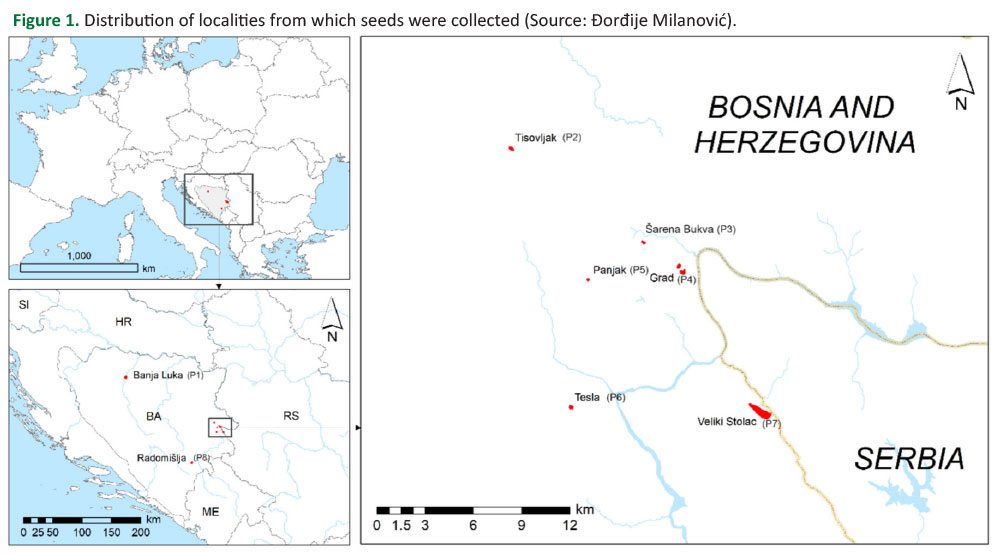 Figure 1. Distribution of localities from which seeds were collected (Source: Đorđije Milanović).
Collection, Processing and Sowing of Seeds – Production of Seedlings
Cones were collected in the autumn–winter period 2022/2023. In total, seeds from 87 maternal trees or half- sib lines were collected, namely: Veliki Stolac – 21; Tisovljak – 17; Grad – 11; Šarena bukva – 10; Tesla – 11; Panjak – 9; and Radomišlja – 8. Seeds could not be extracted from cones collected from 10 mother trees, and that of the most endangered populations, because the cones of some were empty, small or could not be opened (Mataruga et al. 2025). HIKKO V-250 containers were used for seeding, with a total of 280 cells per half-sib line. In the autumn of 2024, labels were placed around the seedlings, on which for each seedling there was a population mark, half-sib line, latitude and longitude of the mother tree and time of seed collection. The procedure for establishing Serbian spruce plantations was fully followed by identification at the level of populations and lines of half-sibs.
Habitat Characteristics of Locations for the Establishment of Plantations
Two key criteria were considered when selecting sites for the conservation plantations: (a) the area should be suitable in terms of climate, soil and site conditions, and (b) it should be able to produce at some point a sufficient quantity of seeds for the reproduction of the next generation. Activities on the selection of the best location for ex situ plantations began at the end of 2023 with the selection of forest management units (FMUs) within the Public Enterprise of Forestry "Šume Republike Srpske". When choosing FMU, the following was taken into account:
- there are natural Serbian spruce populations in the area of the FMU,
- the FMU has suitable areas for afforestation,
- the climatic conditions are similar to those in natural habitats (Mataruga and Milanović 2024),
- there is consent and interest of local foresters and people for the establishment and subsequent maintenance of plantations.
Following the mentioned criteria, three FMUs were selected: "Panos" - Višegrad, "Sjemeć" - Rogatica and "Drina" - Srebrenica. On the selected FMU, potential bare areas were identified using Geographic Information System (GIS), in which the spatial division was made into departments and farm classes. All areas in the "bare" category were singled out with the following selection criteria: (a) areas with northern exposure, (b) altitudes of 700–1500 m a.s.l., where most natural populations occur and (c) areas with deep soil.
Based on GIS analysis combined with the experiences of local forestry engineers, three areas were selected; their characteristics are presented in Table 1. At each location, two soil profiles were excavated, edaphic conditions were determined, and the type of habitat was determined based on the flora and surrounding forest communities.
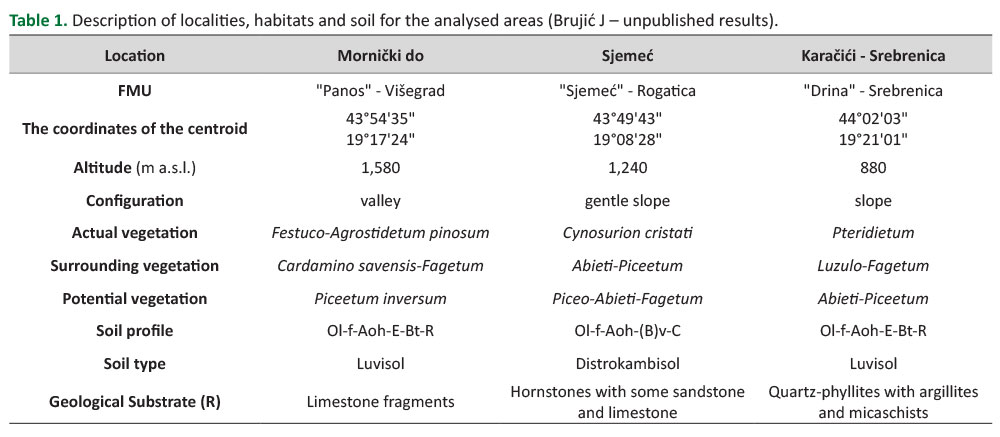
The size of the areas for the establishment of plantations was determined solely by the available space, so the area of the plantations is: in Rogatica – 11,743 m2, in Srebrenica – 30,473 m2 and in Višegrad - 10,435 m2.
Designing Schemes for Planting Seedlings
The surfaces were recorded with a drone and a Global Positioning System (GPS) device, plotting the Digital Terrain Model (DTM). A preliminary planting scheme was created with the positioning of blocks, populations, half-sib lines and the number of seedlings, which are conditional:
- irregular shape of the area for planting and to which the planting scheme should have been adjusted;
- the number of seedlings produced was not the same in all half-sib lines due to the different amount of collected seeds and germination among the half-sib lines;
- the presence of natural Serbian spruce populations. Considering that the plantation in Višegrad is very close to the natural location of the Serbian spruce – Veliki Stolac, only seedlings originating from this population were planted here in order to prevent "genetic contamination" of this natural population.
Habitat Preparation
In order to prepare for planting, the following was done on the sites described above:
- removal of existing vegetation (mowing or mulching and felling and removal of individual trees);
- ploughing, discing and shredding of the soil (in the locations of Sjemeć-Rogatica and Karačići-Srebrenica);
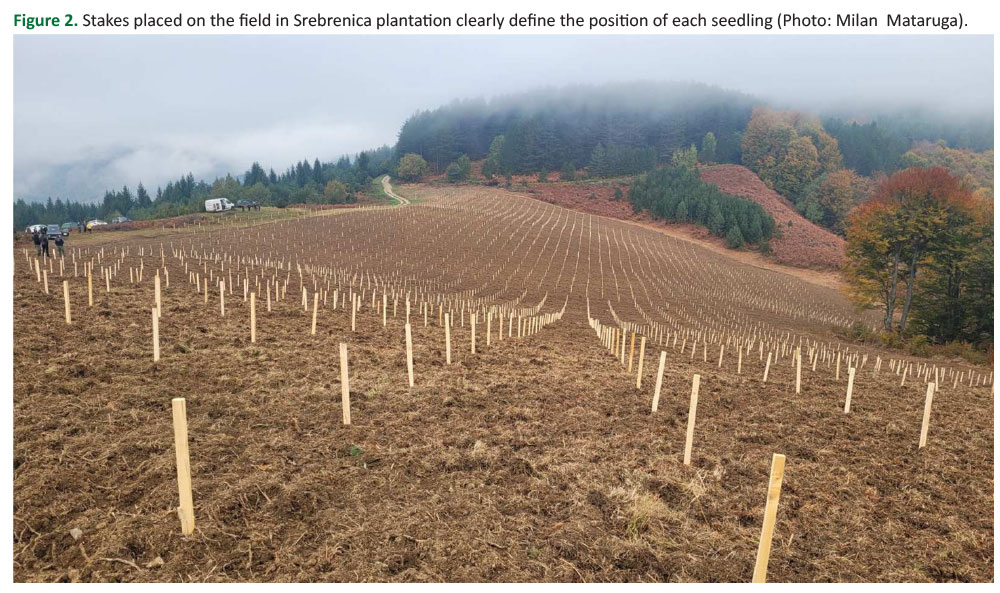
- marking the position for planting each seedling by placing stakes;
- the coordinates of each seedling were recorded in the field and transferred to the scheme.
The direction of the rows in the plantation is determined by the direction of the installation of the potential irrigation system and the movement of the machine in the plantation during their maintenance (Figure 2). The distribution of half-sib lines, populations within the plantation was done in such a way that each line/population has similar habitat conditions in the plantation (equal central or marginal participation of each line). In the Rogatica and Srebrenica plantations, the planting spacing is 3 × 2.5 m, with a distance between blocks of 4 m. In the Višegrad location, the distance between the seedlings is 3 × 3 m with the distance between the blocks 4 m.
Planting Seedlings in the Field
Seedlings were planted in autumn 2024, namely:
- locality Sjemeć - Rogatica – 10 October 2024;
- locality Karačići - Srebrenica, 19 October 2024;
- locality Mornički do - Višegrad, 21 October 2024.
RESULTS AND DISCUSSION
Metapopulation Structure for Gene Pool Conservation
Metapopulation modelling is an important tool in the conservation of endangered species in fragmented regions, especially those that depend on climate-influenced resources. Essentially, a metapopulation comprises a set of interdependent subpopulations, each of which experiences asynchronous extinction and recolonisation (Levins 1969, Hanski 1999). Early models of metapopulations were mathematically comprehensible and intuitive, but probably inadequate to explain the dynamics in most natural systems (Harrison 1991).
The metapopulation concept was initially developed primarily in animal ecology but was subsequently applied widely to plant species, such as: Gentiana pneumonanthe (Oostermeijer 2000, Volis et al. 2005), Silene regia (Menges 1991, Menges and Dolan 1998), Primula veris (Antrobus and Lack 1993, Deschepper et al. 2017) and similar. In woody species, the metapopulation concept is used somewhat more cautiously than in herbaceous plants, mostly indirectly in: Taxus baccata (Dubreuil et al. 2010, Chybicki et al. 2011, Chybicki and Oleksa 2018, Stefanowska et al. 2021, Chybicki et al. 2024) and Pinus albicaulis (Warwell and Shaw 2017). Today, this concept is gaining more and more importance due to: climate change, loss of habitat, anthropogenic pressure or natural relict.
The metapopulation structure was also applied when establishing a black pine seed plantation in Serbia (Tucović and Isajev 1991). This plantation consists of several repeated, more or less related structures (subplantations or blocks) that ensure higher fertility, better economy, genetic diversity, better adaptability to all environmental adversities, as well as stability and the possibility of producing varietal seeds (Mataruga 1998).
When defining planting schemes of Serbian spruce, the following aspects were considered:
- metapopulation design,
- importance of ex situ conservation for endangered Serbian spruce,
- plantings as progeny tests,
- potential function as seed plantations,
- equal number and random planting arrangement within half-sib lines and populations,
- seedling arrangement to promote outcrossing without excluding selfing,
- emphasis on intra-population combinatorial crossing.
Metapopulation Design
The establishment of ex situ conservation plantations is primarily driven by the assumption that the long-term survival of Serbian spruce depends not only on the preservation of individual genotypes, but also on the maintenance of relationships between populations, half-sib lines and gene flow patterns characteristic of the species within its fragmented natural range. Although geographically fragmented, previous studies have shown that these populations cannot be described as completely independent genetic systems because historical and contemporary pollen-mediated gene flow still somewhat connects them (Aleksić and Geburek 2010, Aleksić et al. 2022). Such an organization fits well with the metapopulation concept originally defined by Levins (1969) and later widely applied in the conservation biology of fragmented plant species.
Following this principle, the planting scheme is not designed as a classic ex situ collection with randomly distributed seedlings, but as a structured system intended to mimic the key components of the species' natural metapopulation organization. The primary goal is therefore the preservation of evolutionary and reproductive processes that can contribute to future adaptive potential.
The decision to arrange seedlings in blocks (replicates) within each plantation also reflects one of the central principles of metapopulation theory—reducing the risk of extinction through spatial replication. In practical terms of conservation, the establishment of several subplantations reduces the probability that stochastic disturbances such as drought, fire, pests or unfavourable local conditions will eliminate the included gene pool. Instead, individual blocks may function analogously to local subpopulations within a broader metapopulation system.
Following the distribution of natural populations (Figure 1), taking into account the fact that almost all populations are in a highly interspersed canyon relief, Serbian spruce can be taken as a representative of the concept of metapopulation structure. Its survival after the last ice age in a very limited area can be explained precisely by the fact of the existence of gene flow among these, one would say, completely isolated populations. This is supported by recent research of Aleksić et al. (2022).
The alternation of half-sib lines within populations and the replication of populations across multiple blocks and microhabitats provide both genetic and ecological safeguards for maintaining the species' gene pool. That is why seedlings of the same lines and populations were planted in: Rogatica in three, Srebrenica in eight, and Višegrad in six blocks. Following the dynamics of growth and survival of seedlings in different localities (Srebrenica, Rogatica and Višegrad), as well as microhabitats within one locality, answers will be obtained in the reaction of individual genotypes, half-sib lines and populations.
Importance of ex situ Conservation for Endangered Serbian Spruce
Ex situ plantations represent an important conservation measure for maintaining the genetic resources of this species. Such plantings enable: (a) protection of populations or individuals that are at risk of physical destruction; (b) preservation of populations that are at risk of losing genetic diversity; (c) readily available, continuous supply of reproductive material; (d) commercial improvement of species through breeding activities (FAO 1989). The establishment of a metapopulation structure in several localities (Rogatica, Srebrenica and Višegrad) is precisely aimed at achieving all the goals defined above.
Plantings as Progeny Tests
These plantations, comprising multiple half-sib lines and sub/populations, can serve as progeny tests for assessing parental performance and identifying individuals suitable for breeding populations or seed orchards. They are established from seedlings of known maternal origin. Relationships of half-sib lines are important for determining survival percentage, growth dynamics, variability in habitus, but also for identification of low frequencies or recessive alleles. As in breeding trials, many of these tests are designed to provide genetic information over a short period of time (10–20 years).
Potential Function as Seed Orchards
In addition to preserving the original genetic variability, these plantations can be a source of reproductive material for commercial use. They can preserve or even increase the genetic variability of collections of individual trees or small populations that have an endangered status, insufficient fructification or undesirable pollination in their natural environment (El-Kassaby 2000). Collecting a sufficient number of half-sib lines scattered over a large, but ecologically similar area, in this case will represent a new population that will produce seeds with high genetic diversity through crossing.
Comparative analyses of seeds, planting material, and genetic composition from these plantations will support the selection of superior parent trees. Selected individuals will possess high general and specific combining ability. They will serve as the basis for establishing second-generation seed plantations or specialised clonal seed plantations. The best mother trees will be used to ensure the production of genetically superior seed and high-quality planting material. The selected planting scheme ensures the possibility to clearly define what genotype "variety" we want to create already at the beginning of the production of seeds or seedlings.
Equal Number and Random Planting Arrangement within Half-Sib Lines and Populations
It is very important that the number of planted individuals should be large to ensure a sufficient number of representatives even in the case of seedling mortality due to a series of biotic and abiotic factors. Therefore, each half-sib line is presented with a larger number of seedlings planted in different microhabitat conditions so that the influence of the external environment is equally distributed.
Current findings support the unequal participation of Serbian spruce trees in seed distribution and pollen dispersion (Aleksić et al. 2022), which at this moment cannot be known until the moment of fructification of the incorporated genotypes. By representing each half-sib line with the same number of seedlings, each line has an approximately equal opportunity to contribute to future generations through open pollination. That is why each half-sib line is represented by the same number (seven) of seedlings (genotypes) in one row, and the rows as lines of half-sib alternate within one population in equal numbers. The number of repetitions (blocks) is defined by the area on which the plantation is established. At the Višegrad location, only half-sib lines originating from Veliki Stolac with a larger number of seedlings were planted.
Seedling Arrangement to Promote Outcrossing without Excluding Selfing
The quantity and quality of seeds, as well as success in breeding through the effect of selection, largely depends on the fertilisation system, i.e. methods of propagation of parent trees. Kuittinen and Savolainen (1992) indicate that Serbian spruce is a self-pollinated and cross-pollinated species, while Aleksić (2008) indicates a negligible share of self-pollinated seedlings. Seed quantity and quality are characterised by annual, population and individual oscillation (Jevtić 1960, Mataruga et al. 2025). The results so far in the study of the effects of self-fertilisation of Serbian spruce test trees (Tucović and Isajev 1982), as well as the knowledge of the full importance of inbreeding as a strategy in plant breeding, allow a closer understanding of the genetic potential of this species. Contrary to the advantages of inbreeding, a number of facts are presented in favour of the promotion of outcrossing among unrelated individuals (allogamy), which leads to the effect of increasing heterozygosity.
Completely preventing inbreeding in small ex situ populations is neither realistic nor necessarily desirable, especially when considering the preservation of rare alleles and local genetic structures. Therefore, the applied design attempts to favour pollen flow among unrelated half-sib lines while preserving the natural reproductive flexibility characteristic of the species. Seven seedlings of the same line in one row and the alternation of rows of different half-sib lines within the same population leave "room" for further study of the nature of the structure and functionality of the crossbreeding system in Serbian spruce.
Emphasis on Intra–Population Combinatorial Crossing
Special emphasis is placed on preserving the integrity of individual populations through the principle of "one population–one genetic conservation unit (GCU)". Previous genetic studies have revealed significant differentiation among Serbian spruce populations, despite their relatively narrow geographic distribution (Šijačić-Nikolić 2001, Ballian et al. 2006, Aleksić 2008, Nasri et al. 2008, Aleksić and Geburek 2010, Mataruga et al. 2020). Some geographically distant populations showed strong genetic similarity, while others, separated by only short spatial distances, showed marked differentiation, probably as a consequence of historical bottlenecks, founder effects and long-term demographic isolation. Therefore, extensive mixing of populations within a planting design could potentially mask locally differentiated gene pools. At the same time, the metapopulation framework applied in this study does not imply strict isolation between populations. Replication across several localities and environmental conditions was intended to preserve opportunities for future pollen exchange and adaptive responses under changing environmental conditions. Such an approach follows the concept of dynamic conservation, where evolutionary processes are allowed to continue under controlled but ecologically realistic conditions.
Planting Schemes in Plantations as a Result of the Above Principles
The planting plan should be viewed as a dynamic conservation framework rather than a static plantation design. Its main value lies in integrating the principles of conservation genetics, metapopulation ecology and practical advantages. The planting scheme is an attempt to transfer the metapopulation structure from natural populations to three conservation plantations (Figure 3).
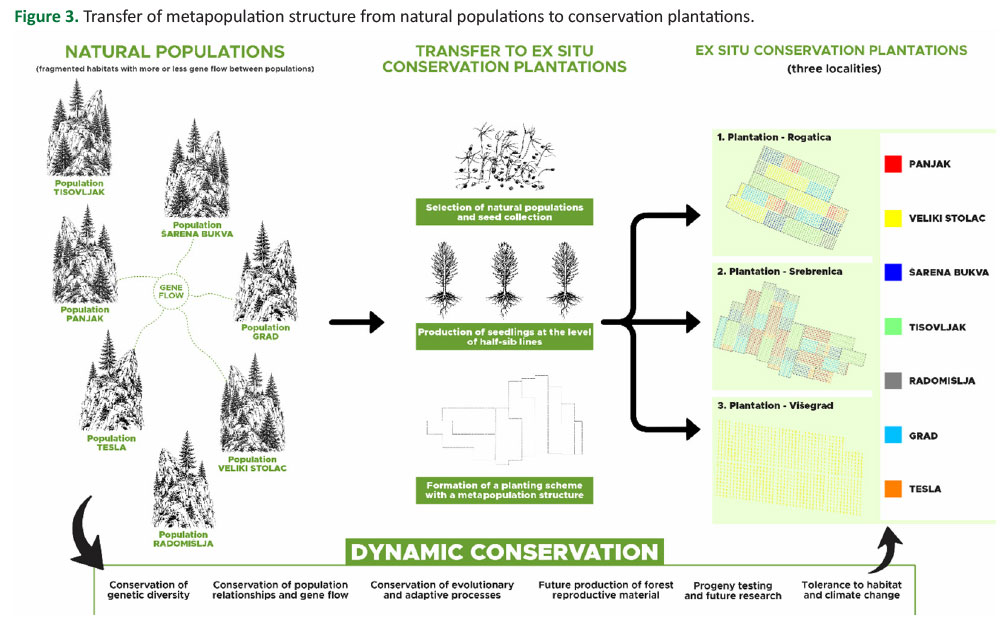 Figure 3. Transfer of metapopulation structure from natural populations to conservation plantations.
Plantation in Rogatica
The number of planted seedlings is shown in Table 2. Characteristic of this scheme is that each line is represented by seven seedlings in three blocks (repetitions), which means that the largest number of half-sib lines is represented by 21 seedlings (Supplementary Material S1). In Rogatica, 1,500 seedlings of 70 half-sib lines from 7 endangered populations were planted on an area of 11,743 m2.
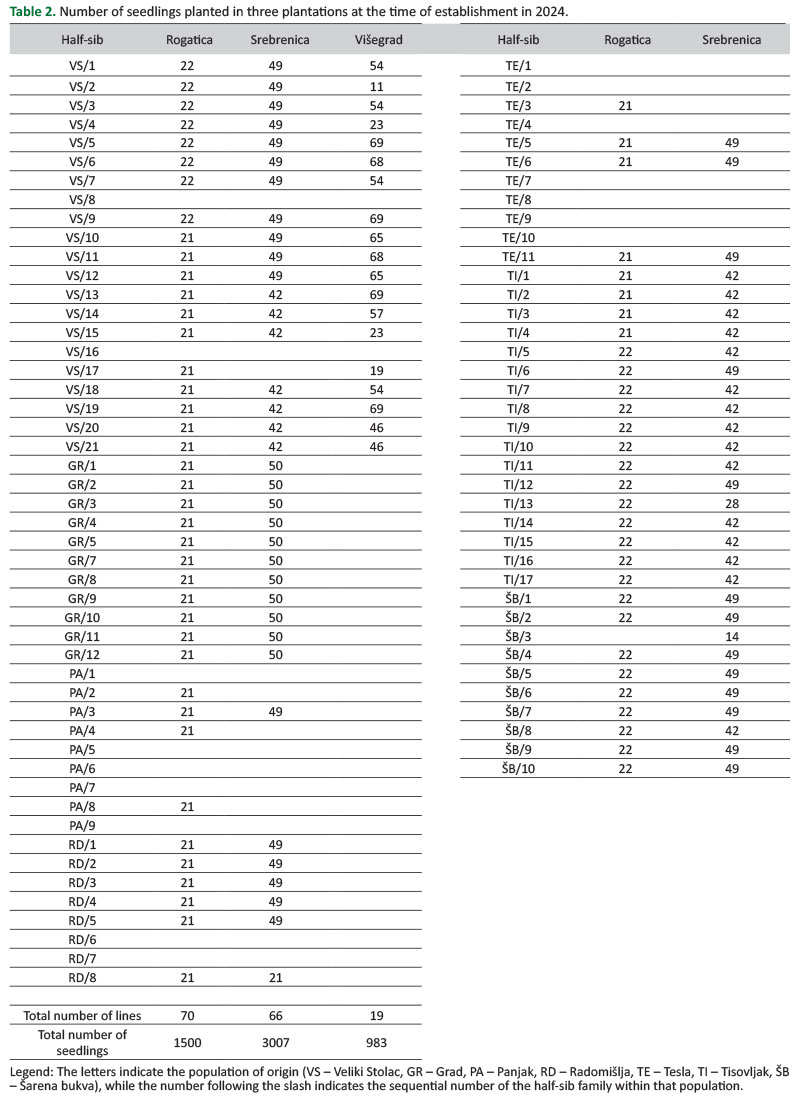 Table 2. Number of seedlings planted in three plantations at the time of establishment in 2024.
Plantation in Srebrenica
The number of seedlings planted by half-sib lines is shown in Table 2. The limited space on the field caused the first and eighth repetitions to be with a reduced number of half-sib lines. Also due to the insufficient number of seedlings in certain lines (Radomišlja 8; Tisovljak 13; Šarena bukva 3 and 8), the scheme was adjusted in such a way that these lines are not present in every repetition. The scheme of planted seedlings by lines is shown in Supplementary Material S2. In Srebrenica, 3,007 seedlings of 66 half-sib lines from 7 populations were planted on an area of 30,473 m2.
Plantation in Višegrad
The number of seedlings planted per line is shown in Table 2, and the scheme of the planting in Supplementary Material S3. In Višegrad, 983 seedlings from 19 half-sib lines, all from the Veliki Stolac population, were planted on an area of 10,435 m2.
CONCLUSIONS
The establishment of ex situ conservation plantations for endangered endemic species with restricted and disjunct distributions represents both a priority and a significant challenge. Serbian spruce occurs in a network of spatially isolated populations linked by limited gene flow, where long-term species persistence depends on the interplay between local extinction and recolonisation dynamics. Such a population structure provides a strong theoretical foundation for the application of the metapopulation concept in the design of ex situ conservation strategies. The transfer of the concept of natural metapopulation structure to the design of conservation plantations is based on the assumption that the long-term preservation of Serbian spruce does not depend exclusively on the number of preserved genotypes, but also on the preservation of functional relationships between populations. Applying this principle in planting schemes attempts to preserve not only the existing genetic variability, but also the potential of future evolutionary and adaptive processes. Thus, ex situ plantations become a dynamic system of preserving the gene pool, and not just a static collection of reproductive material. The applied approach enables combining the conservation of genetic resources with progeny tests, future production of reproductive material and the study of adaptive responses of the species to different habitat and climate conditions. At the same time, the spatial replication of populations and half-sib lines can contribute to reducing the risk of loss of genetic diversity due to stochastic disturbances or climate changes. Such an approach can be widely used in other rare, relict and fragmented conifer species.
Author Contributions
MM conceived and designed the research and wrote the manuscript, BC carried out the field measurements and text corrections.
Funding
This research was funded by UNDP in B&H, through the project "Sustainability of Protected Areas - SPA", financed by the Global Environment Facility (GEF) and Ministry of agriculture, forestry and water management in the Government of Republic of Srpska.
Acknowledgments
Gratitude to colleagues from the Public Enterprise "Šume Republike Srpske", for their support during field work.
Conflicts of Interest
The authors declare no conflict of interest.
Supplementary Materials
Supplementary Material S1. Planting scheme in the plantation – FMU "Sjemeć" Rogatica.
Supplementary Material S2. Planting scheme in the plantation – FMU "Drina" Srebrenica.
Supplementary Material S3. Planting scheme in the plantation – FMU "Panos" Višegrad.
REFERENCES
Aleksić JM, 2008. Genetic structure of natural populations of Serbian spruce (Picea omorika [(Panč.) Purk.]). PhD Thesis, University of Natural Resources and Applied Life Sciences, Vienna, Austria, 126 p.
Aleksić JM, Geburek T, 2010. Mitochondrial DNA reveals complex genetic structuring in a stenoendemic conifer Picea omorika [(Panč.) Purk.] caused by its long persistence within the refugial Balkan region. Plant Syst Evol 285(1–2): 1–11. https://doi.org/10.1007/s00606-009-0250-0.
Aleksić JM, Mataruga M, Daničić V, Cvjetković B, Milanović Đ, Vendramin GG, Avanzi C, Piotti A, 2022. High pollen immigration but no gene flow via seed into a Genetic Conservation Unit of the endangered Picea omorika after disturbance. For Ecol Manage 510: 120115. https://doi.org/10.1016/j.foreco.2022.120115.
Antrobus S, Lack AJ, 1993. Genetics of colonizing and established populations of Primula veris. Heredity 71(3): 252–258. https://doi.org/10.1038/hdy.1993.133.
Ballian D, Longauer R, Mikić T, Paule L, Kajba D, Gömöry D, 2006. Genetic structure of a rare European conifer, Serbian spruce (Picea omorika (Pančić) Purk.). Plant Syst Evol 260(1–2): 53–63. https://doi.org/10.1007/s00606-006-0431-z.
Chybicki IJ, Robledo-Arnuncio JJ, Bodziarczyk J, Widlak M, Meyza K, Oleksa A, Ulaszewski B, 2024. Disrupted connectivity within a metapopulation of a wind-pollinated declining conifer, Taxus baccata L. For Ecosyst 11: 100240. https://doi.org/10.1016/j.fecs.2024.100240.
Chybicki IJ, Oleksa A, 2018. Seed and pollen gene dispersal in Taxus baccata, a dioecious conifer in the face of strong population fragmentation. Ann Bot 122(3): 409–421. https://doi.org/10.1093/aob/mcy081.
Chybicki IJ, Oleksa A, Burczyk J, 2011. Increased inbreeding and strong kinship structure in Taxus baccata estimated from both AFLP and SSR data. Heredity 107(6): 589–600. https://doi.org/10.1038/hdy.2011.51.
Čolić D, 1957. Neki pionirski karakteri Pančićeve omorike i njena uloga u sukcesiji biljnih zajednica. Arch Sci Biol 9(1–4): 51–60.
Cvjetković B, Mataruga M, Isajev V, Lević J, Lučić A, Trkulja V, Kremenović Ž, 2013. Variability in germination and germination dynamics of differently treated seeds of Serbian spruce (Picea omorika Pančić/Purkynĕ). Genetika 45(1): 109–119. https://doi.org/10.2298/gensr1301109c.
de Vries SMG, Alan M, Bozzano M, Buriánek V, Collin E, Cottrell J, Ivanković M, Kelleher C, Koskela J, Rotach P, Vietto L, Yrjänä L, 2015. Pan-European strategy for genetic conservation of forest trees and establishment of a core network of dynamic conservation units. European Forest Genetic Resources Programme (EUFORGEN), Bioversity International, Rome, Italy, xii + 40 p.
Dell’Oro M, Mataruga M, Sass-Klaassen U, Fonti P, 2020. Climate change threatens an endangered relict Serbian spruce. Dendrochronologia 59: 125651. https://doi.org/10.1016/j.dendro.2019.125651.
Deschepper P, Brys R, Fortuna MA, Jacquemyn H, 2017. Analysis of spatial genetic variation reveals genetic divergence among populations of Primula veris associated to contrasting habitats. Sci Rep 7: 8847. https://doi.org/10.1038/s41598-017-09154-9.
Dinić A, 1989. The influence of tree root system and the whortleberry (Vaccinium myrtillus L.) on the seed germinability of the Serbian spruce (Picea omorika (Pančić) Purkynĕ) in the relict forest of Norway and Serbian spruce, common silver fir and beech on the Tara. Arh Biol Nauka 41(1–2): 1P–2P.
Dubreuil M, Riba M, González-Martínez SC, Vendramin GG, Sebastiani F, Mayol M, 2010. Genetic effects of chronic habitat fragmentation revisited: Strong genetic structure in a temperate tree, Taxus baccata (Taxaceae), with great dispersal capability. Am J Bot 97(2): 303–310. https://doi.org/10.3732/ajb.0900148.
El-Kassaby YA, 2000. Effect of forest tree domestication on gene pools. In: Young A, Boshier D, Boyle T (eds) Forest Conservation Genetics: Principles and Practice. CABI Publishing, Oxon, United Kingdom, pp 197–213. https://doi.org/10.1079/9780851995045.0197.
FAO, 1989. Plant genetic resources: their conservation in situ for human use. FAO of the United Nations, Rome, Italy, 38 p.
George JP, Kelleher C, Desgroux A, Scholzen E, Muheim L, Fundova I, Bozič G, Cottrell J, Grivet D, Liepe K, Vanden Broeck A, Heinze B, Piotti A, Hrafnkelsdóttir B, Niinemets Ü, Bozzano M, Farsakoglou AM, 2026. Dynamic and static ex situ conservation: Minimum requirements, data standards and indicators for monitoring. European Forest Institute, European Forest Genetic Resources Programme (EUFORGEN), 78 p. https://doi.org/10.36333/rs17.
Giupponi L, Alberto A, Sala S, Giorgi A, 2026. Picea omorika (Pinaceae): an endangered endemic species from Serbia and Bosnia-Herzegovina, locally naturalised in the Brembana Valley (Orobic Alps, Italy). Italian Botanist 21: 59–79. https://doi.org/10.3897/italianbotanist.21.178574.
Hanski I, 1999. Metapopulation Ecology. Oxford University Press, Oxford, UK, 313 p. https://doi.org/10.1093/oso/9780198540663.001.0001.
Harrison S, 1991. Local extinction in a metapopulation context: an empirical evaluation. Biol J Linn Soc 42(1–2): 73–88. https://doi.org/10.1111/j.1095-8312.1991.tb00552.x.
Ivetić V, Aleksić J, 2016. Response of rare and endangered species Picea omorika to climate change: The need for speed. Reforesta 1(2): 81–99. https://doi.org/10.21750/refor.2.09.24.
Jevtić J, 1960. Neka zapažanja o urodu semena Pančićeve omorike na Tari. Šumarstvo 1–2:79–85.
Kuittinen H, Savolainen O, 1992. Picea omorika is a self-fertile but outcrossing conifer. Heredity 68(2): 183–187. https://doi.org/10.1038/hdy.1992.27.
Lefèvre F, Alía R, Bakkebø Fjellstad K, Graudal L, Oggioni SD, Rusanen M, Vendramin GG, Bozzano M, 2020. Dynamic conservation and utilization of forest tree genetic resources: Indicators for in situ and ex situ genetic conservation and forest reproductive material. European Forest Genetic Resources Programme (EUFORGEN), European Forest Institute, 33 p.
Levins R, 1969. Some demographic and genetic consequences of environmental heterogeneity for biological control. Bull Entomol Soc Am 15(3): 237–240. https://doi.org/10.1093/besa/15.3.237.
Mataruga M, 1998. Međuzavisnost osobina i razvoj sadnica crnog bora (Pinus nigra Arn.) u sjemenskoj plantaži na Jelovoj Gori. MSc Thesis, Šumarski fakultet Univerziteta u Beogradu, Beograd, Serbia, 122 p.
Mataruga M, Milanović Đ, 2020. Prirodne populacije Pančićeve omorike u Republici Srpskoj (Bosna i Hercegovina). Glas Šum Fak Univ Banjoj Luci 30: 77–113. https://doi.org/10.7251/gsf2030005m.
Mataruga M, Piotti A, Daničić V, Cvjetković B, Fussi B, Konnert M, Vendramin GG, Aleksić J, 2020. Towards the dynamic conservation of Serbian spruce (Picea omorika) western populations. Ann For Sci 77(1): 1. https://doi.org/10.1007/s13595-019-0892-1.
Mataruga M, Milanović Đ, 2024. Smjernice za očuvanje Pančićeve omorike in situ. Republički zavod za zaštitu kulturno-istorijskog i prirodnog nasljeđa, Banja Luka, Bosnia and Herzegovina, 82 p.
Mataruga M, 2025. Pančićeva omorika (Picea omorika /Pančić/Purk.) – Serbian spruce. Šumarski fakultet Univerziteta u Banjoj Luci, Banja Luka, Bosnia and Herzegovina, 400 p.
Mataruga M, Milanović Đ, 2025. Požari tokom 2021–2024. godine u najvećim sastojinama Pančićeve omorike u Republici Srpskoj i njihove posljedice. Glas Šum Fak Univ Banjoj Luci 36: 193–208. https://doi.org/10.63356/gsf.2025.004.
Mataruga M, Bosančić B, Cvjetković B, 2025. Cone and seed variability in Serbian spruce – indicators of population endangerment. Šum List 149(11–12): 531–544. https://doi.org/10.31298/sl.149.11-12.3.
Menges ES, 1991. Seed germination percentage increases with population size in a fragmented prairie species. Conserv Biol 5(2): 158–164. https://doi.org/10.1111/j.1523-1739.1991.tb00120.x.
Menges ES, Dolan RW, 1998. Demographic viability of populations of Silene regia in midwestern prairies: relationships with fire management, genetic variation, geographic location, population size and isolation. J Ecol 86(1): 63–78. https://doi.org/10.1046/j.1365-2745.1998.00234.x.
Milanović Đ, Mataruga M, 2025. Prirodna nalazišta Pančićeve omorike u Srbiji. Glas Šum Fak Univ Banjoj Luci 36:31–92. https://doi.org/10.63356/gsf.2025.005.
Nasri N, Bojović S, Vendramin GG, Fady B, 2008. Population genetic structure of the relict Serbian spruce, Picea omorika, inferred from plastid DNA. Plant Syst Evol 271(1–2): 1–7. https://doi.org/10.1007/s00606-007-0594-2.
Oostermeijer JGB, 2000. Population viability analysis of the rare Gentiana pneumonanthe: the importance of genetics, demography and reproductive biology. In: Young AG, Clarke GM (eds) Genetics, Demography and Viability of Fragmented Populations. Cambridge University Press, Cambridge, UK, pp 313–334. https://doi.org/10.1017/CBO9780511623448.022.
Ostojić D, 2005. Ekološki činioci prirodnog održavanja i obnove cenopopulacija Pančićeve omorike u NP Tara. PhD Thesis, Šumarski fakultet Univerziteta u Beogradu, Beograd, Serbia.
Prodanović O, Prodanović R, Bogdanović Pristov J, Mitrović A, Milosavić N, Radotić K, 2007. Antioxidative enzymes during germination of two lines of Serbian spruce [Picea omorika (Panč.) Purk.]. Arch Biol Sci 59(3): 209–216. https://doi.org/10.2298/abs0703209p.
Rojas-Castro H, Araya-Crisóstomo S, 2019. Ex situ conservation measures: A metapopulation approach based on the classic Levins model. Gayana 83(1): 46–56. https://doi.org/10.4067/s0717-65382019000100046
Stefanowska S, Meyza K, Iszkuło G, Chybicki IJ, 2021. Trunk perimeter correlates with genetic bottleneck intensity and the level of genetic diversity in populations of Taxus baccata L. Ann For Sci 78: 63. https://doi.org/10.1007/s13595-021-01080-1.
Šijačić-Nikolić M, 2001. Analiza genetskog potencijala generativne semenske plantaže omorike (Picea omorika [Panč.] Purkyne) primenom kontrolisane hibridizacije linija polusrodnika. PhD Thesis, Šumarski fakultet Univerziteta u Beogradu, Beograd, Serbia.
Tucić B, Stojković B, 2001. Shade avoidance syndrome in Picea omorika seedlings: a growth-room experiment. J Evol Biol 14(3): 444–455. https://doi.org/10.1046/j.1420-9101.2001.00291.x.
Tucović A, Isajev V, 1982. Uticaj različitih tipova oprašivanja na neka svojstva šišarica i semena omorike. Glas Šum Fak, Ser C Pejzažna Arhitektura 59: 59–65.
Tucović A, Isajev V, 1991. Metapopulaciona strategija osnivanja generativnih semenskih plantaža drveća. In: Zbornik radova "Prošlost, sadašnjost i budućnost srpskog šumarstva kao činioca razvoja Srbije", Beograd, Srbija, pp 313–323.
Volis S, Bohrer G, Oostermeijer G, Van Tienderen P, 2005. Regional consequences of local population demography and genetics in relation to habitat management in Gentiana pneumonanthe. Conserv Biol 19(2): 357–367. https://doi.org/10.1111/j.1523-1739.2005.00564.x.
Warwell MV, Shaw RG, 2017. Climate-related genetic variation in a threatened tree species, Pinus albicaulis. Am J Bot 104(8): 1205–1218. https://doi.org/10.3732/ajb.1700139.
© 2026 by the author(s). License: Croatian Forest Research Institute. This article is an open access article distributed under the terms and conditions of the Creative Commons Attribution 4.0 International License (CC BY 4.0).