


SEEFOR 17(1): 26003
Article ID: 26003
DOI: https://doi.org/10.15177/seefor.26-003
ORIGINAL SCIENTIFIC PAPER
The Influence of Genotype and Morphological Characteristics of Rowan (Sorbus aucuparia) Leaves on the Development of Gymnosporangium cornutum
Aleksandar Vemić1, Sanja Lazić1, Aleksandar Lučić1, Ljubinko Rakonjac1, Marina Vukin2, Milivoje Ćosić1, Vladan Popović1,*
Addresses:
(1) Institute of Forestry, Kneza Viseslava Street 3, RS-11030, Belgrade, Serbia;
(2) Faculty for Applied Ecology "Futura", Požeška 83a, RS-11000 Belgrade, Serbia
Citation: Vemić A, Lazić S, Lučić A, Rakonjac Lj, Vukin M, Ćosić M, Popović V, 2026. The Influence of Genotype and Morphological Characteristics of Rowan (Sorbus aucuparia) Leaves on the Development of Gymnosporangium cornutum. South-east Eur for 17(1): 26003. https://doi.org/10.15177/seefor.26-003.
Received: 15 Dec 2025; Revised: 2 Feb 2026; Accepted: 3 Feb 2026; Published online: 16 Feb 2026
Cited by: Google Scholar
Abstract
Rust caused by Gymnosporangium cornutum Arthur ex F. Kern is one of the most common diseases of rowan (Sorbus aucuparia L.). Currently, there is little information on the development of this disease in forestry literature. In order to eliminate this deficiency, the examination of the influence of Sorbus aucuparia genotype and leaf dimensions on the occurrence and abundance of aecia of Gymnosporangium cornutum was carried out. The genotype had a statistically significant influence on aecia occurrence, while leaf length, width, circumference, and area had a statistically significant influence on aecia abundance. About 10% of Sorbus aucuparia genotypes showed greater tolerance to Gymnosporangium cornutum, with a nearly 4-fold lower probability of aecia occurring on leaves. Larger leaves of Sorbus aucuparia sensitive genotype had a greater Gymnosporangium cornutum aecia abundance compared to smaller leaves. The results obtained for the first time indicate the possibility of selecting and producing reproductive material of Sorbus aucuparia tolerant to Gymnosporangium cornutum.
Keywords: aecial stage; plant breeding; gene pool; protection measures
INTRODUCTION
Rowan or mountain ash (Sorbus aucuparia L.) is one of the most widespread tree species in Europe, except for the southernmost parts and large islands (Räty et al. 2016). This tree species has significant ecological importance in forest ecosystems (Cvjetićanin et al. 2016). Moreover, it represents a source of antioxidants, tocopherols, and pigments (Šavikin et al. 2017).
So far, the variability of characteristics of Sorbus aucuparia has been determined. First of all, there is a difference in the morphological parameters of different Sorbus aucuparia half-sib families (Sæbø and Johnsen 2000), while the size of anatomical elements differed between certain genotypes (Umarov et al. 2024). There was a difference in time and degree of fruit bearing between different Sorbus aucuparia genotypes (Munilla and Guitián 2014), and seeds from different Sorbus aucuparia populations showed differences in germination (Raeisi et al. 2021). In addition, the fruits of Sorbus aucuparia had different colours, pH values, antioxidant activities, and contents of vitamin C, organic acids, sugars, and phenolic components depending on the genotype of the trees (Bozhuyuk 2021).
Genus Gymnosporangium consists of significant fungal parasites of trees and shrubs, whereby there is a small number of scientific publications related to this genus and its species (Lâce 2017). Rust caused by Gymnosporangium cornutum Arthur ex F. Kern causes great damage to Sorbus aucuparia (Karadžić and Milijašević 2003). The pathogen is a heteroecious rust fungus with an incomplete life cycle: spermagonia and aecia are formed on Sorbus aucuparia, whereas the primary host is juniper (Juniperus spp.), on which telia and basidia are produced (Ellis and Ellis 1985, Karadžić and Milijašević 2003). The characteristic of rust is pronounced yellow-orange aecia of relatively large dimensions on Sorbus aucuparia leaves (Karadžić and Milijašević 2003).
When controlling rust on forest species, there are many challenges, including insufficient efficacy in removing the alternative host and the consequences of applying chemical measures (Hamelin 2013). The genetic control of rust pathogens was recognized more than a hundred years ago, and recently this method of protection has been primarily strived for (Oliver 2024).
In accordance with the above, the objective of this research was to examine whether genotypic and morphological variability of Sorbus aucuparia leaves influences the development of rust caused by Gymnosporangium cornutum. The tested null hypotheses were: I) Sorbus aucuparia genotype does not influence the occurrence of Gymnosporangium cornutum aecia; II) Sorbus aucuparia leaf dimensions do not affect the occurrence of Gymnosporangium cornutum aecia; III) In the case of the sensitive genotype of Sorbus aucuparia, there is no difference in abundance of Gymnosporangium cornutum aecia on leaves of different dimensions.
MATERIAL AND METHOD
Plant Material
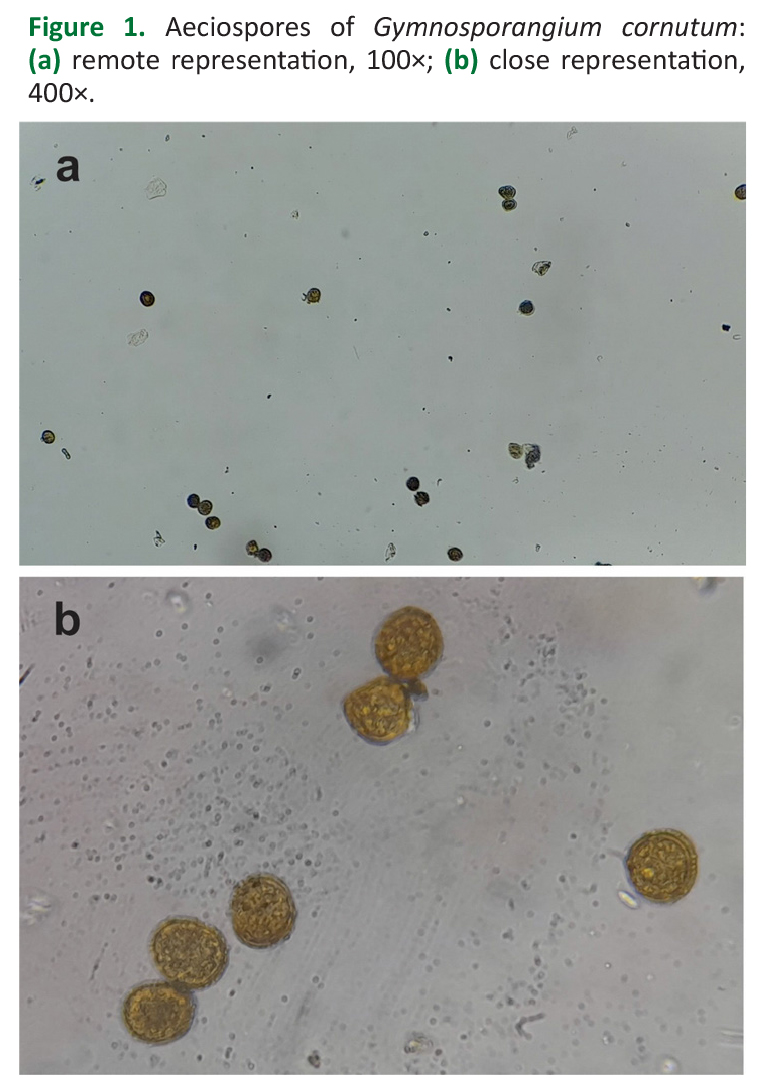
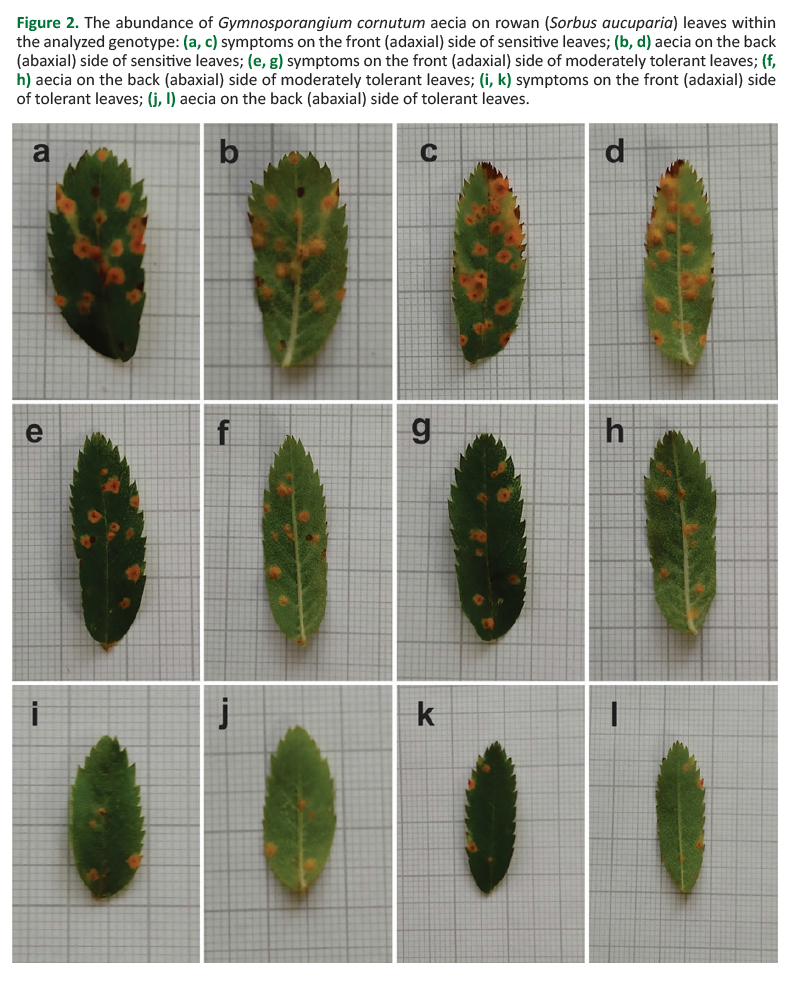
Ten rowan (Sorbus aucuparia) trees, 7-8 years old, were sampled on the site Bukovica, Montenegro. The distance between the trees was 20 m. The presence of rust caused by Gymnosporangium cornutum was confirmed by the presence of aecia. The aeciospores were 20-30 × 18-25 µm, and the aecia were 4-5 mm, within standard dimensions (Figure 1, Figure 2), matching the description of Ellis and Ellis (1985).
For the analysis of the occurrence of aecia, from each tree, 35 leaves were collected at breast height from the middle of the crown by completely random selection. From the tree with a visually pronounced occurrence of aecia, an additional 100 leaves were collected for the analysis of the abundance of aecia. The analysis of aecia abundance was conducted on leaves collected from a single selected tree with pronounced infection in order to assess within-genotype relationships between leaf morphology and the number of aecia. Moreover, leaves were collected from a single tree to avoid potential genotype effects on leaf abundance. Due to a large number of variables, the genotype was excluded from the analysis of aecia abundance.
The leaves were packed in plastic bags and transported to the Institute of Forestry's laboratory in Belgrade. Until the moment of measurement, they were stored in the refrigerator for 24 hours.
Aecia were counted on the underside of leaves. Immediately afterwards, the leaves were scanned, and leaf blade length, width, leaf circumference, and area were calculated using LAMINA software (Umea University) (Table 1).
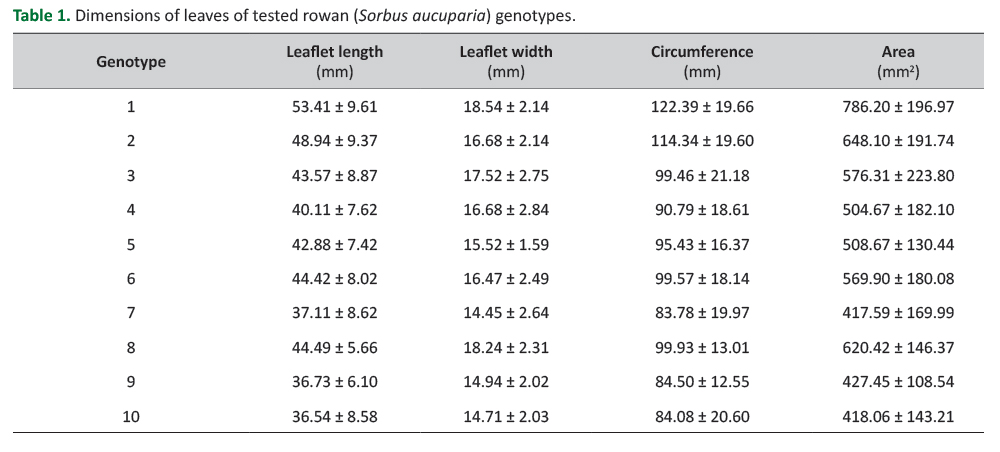 Table 1.Dimensions of leaves of tested rowan (Sorbus aucuparia) genotypes.
Statistical Methods
Binary logistic regression was used for testing the influence of genotype, leaf blade length, leaf blade width, leaf circumference, and leaf area of Sorbus aucuparia on the occurrence of Gymnosporangium cornutum aecia. The exponential parameter estimates were used to calculate the probability of aecia occurrence.
A general linear model (GLM) was used to test differences in the average Gymnosporangium cornutum aecia values across Sorbus aucuparia leaf dimensions. Pearson’s correlation was used for the analysis of a link between the Sorbus aucuparia leaf dimension and the number of Gymnosporangium cornutum aecia.
RESULTS
Occurrence of Gymnosporangium cornutum Aecia
Binary logistic regression showed statistically significant influence of genotype (Table 2, Figure 2, Figure 3) on the occurrence of Gymnosporangium cornutum aecia on Sorbus aucuparia leaves. Genotype 1 had the highest probability of occurrence of Gymnosporangium cornutum aecia (Exp(B) = 20.503, Figure 2). Genotype 7 had the highest probability of absence of Gymnosporangium cornutum aecia (Exp(B) = 3.713, Figure 3). The remaining 80% of genotypes were at the transition between the lowest and highest tolerance to Gymnosporangium cornutum (Figure 2).
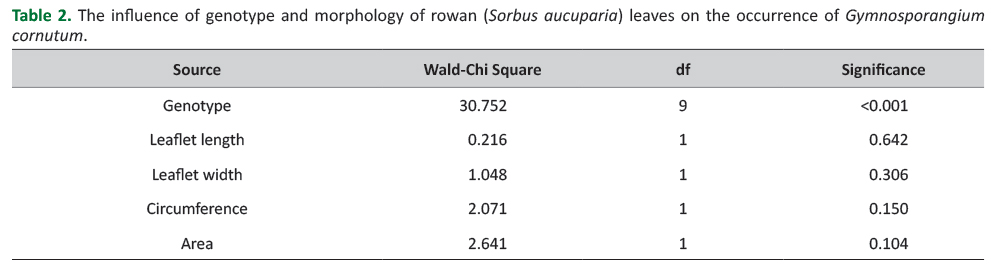
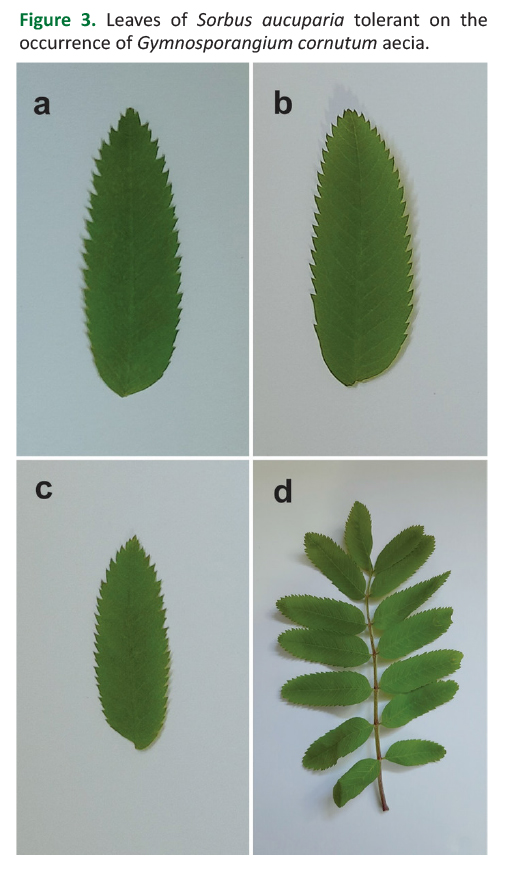 Figure 3. Leaves of Sorbus aucuparia tolerant on the occurrence of Gymnosporangium cornutum aecia.
Abundance of Gymnosporangium cornutum Aecia
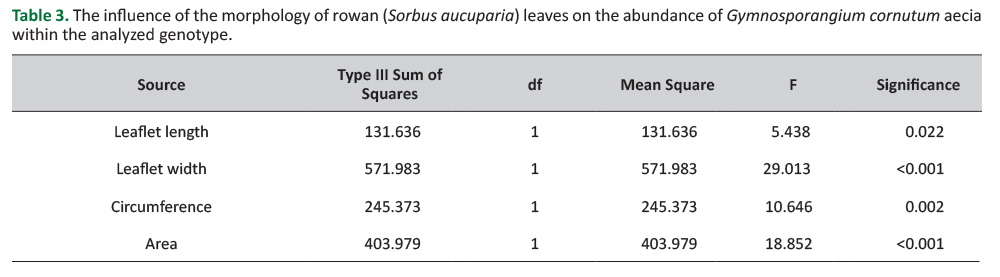
The general linear model showed that, within the analysed genotype, the number of Gymnosporangium cornutum aecia on leaves was influenced by leaf length, width, circumference, and area (Table 2, Figure 2). Pearson’s correlation showed statistically significant and positive correlation between leaf length and number of aecia (r = 0.229, p = 0.022), leaf width and number of aecia (r = 0.478, p ˂ 0.001), leaf circumference and number of aecia (r = 0.313, p = 0.002), and leaf area and number of aecia (0.402, p ˂ 0.001) within the analyzed Sorbus aucuparia genotype. The number of aecia ranged between 1 and 21 per leaf.
DISCUSSION
The genotype of Sorbus aucuparia showed great significance, while the dimensions of leaves did not show an influence on the occurrence of Gymnosporangium cornutum symptoms. The first null hypothesis is rejected. The alternative hypothesis is accepted that the Sorbus aucuparia genotype influences the occurrence of Gymnosporangium cornutum aecia. On the other hand, the second null hypothesis that Sorbus aucuparia leaf dimensions do not affect the occurrence of Gymnosporangium cornutum aecia was accepted. A limitation of this study is that the analysis of aecia abundance in relation to leaf morphology was conducted on a single Sorbus aucuparia genotype. Consequently, the observed relationships describe within-genotype variation and should not be generalised to the species level without further multi-genotype validation. Monitoring the health of trees is necessary to ensure long-term resistance to rust, prevent or limit pathogen spread, and reduce the risk of pathogen evolution and the breakdown of host resistance (Hamelin 2022). Genotypes were not genetically verified. In this sense, it would be interesting in the future to monitor, over several years, the influence of micro-locality conditions and ontogenetic factors on the health status of Sorbus aucuparia seedlings that exhibited less pronounced symptoms caused by Gymnosporangium cornutum. Moreover, the proximity of both hosts required for the spread of Gymnosporangium cornutum, primarily common juniper (Juniperus communis L.), may interact strongly with the aforementioned factors under increased infection pressure. Therefore, these phenomena should be studied jointly. In this sense, we consider that increasing Sorbus aucuparia's tolerance (i.e., mitigating the harmful effects of infection) based on the results of this study provides a stable approach to controlling Gymnosporangium cornutum.
For the increase in the representation of Sorbus aucuparia-tolerant trees, it is necessary to adjust the methods of regeneration of this species. Examples of the introduction of wild service tree (Sorbus torminalis (L.) Crantz), a species belonging to the same genus, showed a positive effect on biodiversity, resistance, and ecosystem functions (Višnjić et al. 2025). Fruit bearing of Sorbus aucuparia trees is stimulated by tree diameter and light availability, while competition has a negative effect (Kondrat et al. 2024). The mentioned factors must be considered during natural regeneration. The largest production of Sorbus aucuparia seeds happens just before the die-back of trees (Pesendorfer et al. 2019). Therefore, in the case of artificial regeneration, it is recommended to wait for an abundant yield of trees with weak rust symptoms to increase the amount of collected high-quality seed. To determine which part of the Sorbus aucuparia crown is most susceptible to Gymnosporangium cornutum, we recommend the application and analysis of mixed-effects models. Furthermore, to improve the use of tolerant seedlings across different sites, it is necessary to consider the microclimatic characteristics of habitats, which may be more favorable to this type of reproductive material.
Within the sensitive genotype of Sorbus aucuparia, a larger number of Gymnosporangium cornutum aecia was recorded on larger leaves. Thus, the third null hypothesis was rejected. The alternative hypothesis is accepted: in the case of a sensitive genotype of Sorbus aucuparia, there is a difference in the abundance of Gymnosporangium cornutum aecia on leaves of different sizes. However, we consider that it is not useful to favour the development of the smaller leaves of Sorbus aucuparia. Especially because the effect of leaf size was examined within the genotype susceptible to Gymnosporangium cornutum. Larger leaves have several advantages, among which better survival in the shade, greater photosynthesis, more efficient use of water and nutrients, faster acclimatisation, and larger ecosystem productivity stand out (Murphu et al. 2012, Milla and Matesanz 2017, Wright et al. 2017, Song et al. 2018, Lusk et al. 2019, Li et al. 2020). Therefore, the obtained results should primarily be used as a recommendation that Sorbus aucuparia trees with small leaves, which are usually a consequence of phenotype or unfavourable habitat conditions, should not be removed from stands affected by Gymnosporangium cornutum.
To preserve Sorbus aucuparia populations at the edges of the distribution area, it is necessary to connect trees through habitat restoration or the introduction of genetic material (Yousefzadeh et al. 2021). We consider that both approaches can be used for the protection of Sorbus aucuparia trees on the edges of the distribution area from Gymnosporangium cornutum. During habitat restoration, the focus should be on encouraging the development of trees with less pronounced symptoms, while during the introduction of genetic material, preference should be given to reproductive material obtained from such trees.
Individual mother trees are more important than the population for progeny quality (Sæbø and Johnsen 2000). Therefore, Sorbus aucuparia's high tolerance to Gymnosporangium cornutum, determined at the individual level, enables an easier initial material selection process with greater flexibility in selecting trees.
CONCLUSIONS
This study demonstrated the significance of genotype and leaf morphology of Sorbus aucuparia for the aecial stage of the development of rust caused by Gymnosporangium cornutum fungus. The tree genotype influenced the occurrence of Gymnosporangium cornutum aecia on Sorbus aucuparia leaves, whereas leaf dimensions influenced aecia abundance. For the first time, this study provides a basis for the selection of Sorbus aucuparia mother trees with reduced susceptibility to Gymnosporangium cornutum, which may contribute to slowing pathogen spread. Future research should focus on progeny tests to obtain the most tolerant reproductive material, which will also be suitable for other forestry needs.
Author Contributions
AV and VP conceived the idea and designed the study, conducted fieldwork, and performed statistical analyses. SL, AL, and LJR performed laboratory analyses. VP, MV, and MĆ performed data curation and visualisation of results. AV, AL, and VP wrote the manuscript.
Funding
This study was carried out under the Agreement on the Realization and Funding of Scientific Research Activity of Scientific Research Organizations in 2025, funded by the Ministry of Education, Science, and Technological Development of the Republic of Serbia, No. 451-03-136/2025-03/200027 from February 04, 2025.
Acknowledgements
The authors thank Mijoljub Vemić, Bachelor of Science in Forestry, for help in collecting and transporting material for analyses.
Conflict of Interest
The authors declare no conflict of interest.
REFERENCES
Bozhuyuk MR, 2021. Morphological and Biochemical Diversity in Fruits of Rowanberry (Sorbus aucuparia L.) Genotypes. Appl Fruit Sci 63: 431-435. https://doi.org/10.1007/s10341-021-00603-4.
Cvjetićanin R, Brujić J, Perović M, Stupar S, 2016. Dendrology. University of Belgrade, Faculty of Forestry, Belgrade, Serbia, 557 p. [in Serbian].
Ellis MB, Ellis JP, 1985. Microfungi on land plants. Croom Helm, London & Sidney, 818 p.
Hamelin RC, 2013. Tree Rusts. In: Gonthier P, Nicolotti G (eds) Infectious Forest Diseases. CAB International. London, UK, pp. 547-566. https://doi.org/10.1079/9781780640402.0547.
Hamelin RC, 2022. Rust diseases of forest trees. In: Asiegbu FO, Kovalchuk A, (eds) Forest Microbiology Volume 2: Forest Tree Health. Academic Press, Amsterdam, The Netherlands, New York, USA, pp. 201-213. https://doi.org/10.1016/B978-0-323-85042-1.00028-8.
Karadžić D, Milijašević T, 2003. The most important rust fungi on trees and shrubs in Serbia. Bulletin of the Faculty of Forestry 88: 77-101. https://doi.org/10.2298/GSF0388077K.
Kondrat K, Bogdziewicz M, Szarek-Łukaszewska G, Ledwoń M, Gazda M, Żywiec M, 2024. Drivers of intraspecific variation in fecundity in rowan (Sorbus aucuparia). Eur J For Res 143: 875-885. https://doi.org/10.1007/s10342-024-01661-5.
Lâce B, 2017. Gymnosporangium species – an important issue of plant protection. Proceedings of the Latvian academy of sciences Section B, 71(3): 95-102. https://doi.org/10.1515/prolas-2017-0017.
Li Y, Reich PB, Schmid B, Shrestha N, Feng X, Lyu T, Maitner BS, Xu X, Li Y, Zou D, Tan Z-H, Su X, Tang Z, Guo Q, Feng X, Enquist BJ, Wang Z, 2020. Leaf size of woody dicots predicts ecosystem primary productivity. Ecology Letters 23(6): 1003-1013. https://doi.org/10.1111/ele.13503.
Lusk CH, Grierson ERP, Laughlin DC, 2019. Large leaves in warm, moist environments confer an advantage in seedling light interception efficiency. New Phytol 223(3): 1319-1327. https://doi.org/10.1111/nph.15849.
Milla R, Matesanz S, 2017. Growing larger with domestication: a matter of physiology, morphology or allocation? Plant Biol 19(3): 475-483. https://doi.org/10.1111/plb.12545.
Murphu MRC, Jordan GJ, Brodribb TJ, 2012. Differential leaf expansion can enable hydraulic acclimation to sun and shade. Plant Cell Environ 35(8): 1407-1418. https://doi.org/10.1111/j.1365-3040.2012.02498.x.
Munilla I, Guitián J, 2014. Long-term individual-level variation of reproductive features in Sorbus aucuparia, a fleshy-fruited tree. Trees 28: 1489-1496. https://doi.org/10.1007/s00468-014-1052-8.
Oliver RP, 2024. Diseases caused by fungi. In: Oliver RP (ed) Agrios' plant pathology. Academic Press, UK, US, pp. 339-427. https://doi.org/10.1016/B978-0-12-822429-8.00013-3.
Pesendorfer MB, Bogdziewicz M, Koenig WD, Ledwoń M, Żywiec M, 2019. Declining fruit production before death in a widely distributed tree species, Sorbus aucuparia L. Ann For Sci 76: 11. https://doi.org/10.1007/s13595-018-0791-x.
Raeisi S, Yousefzadeh H, Jalali GhA, Esmailzadeh O, 2021. Morphological variation in leaf & seed germination characteristics of Rowan tree (Sorbus aucuparia L.) in the Hyrcanian forest. Iran J For 13(1): 15-29. https://doi.org/10.22034/ijf.2021.223377.1698.
Räty M, Caudullo G, de Rigo D, 2016. Sorbus aucuparia in Europe: distribution, habitat, usage and threats. In: San-MiguelAyanz J, de Rigo D, Caudullo G, Houston Durrant T, Mauri A, (Eds) European Atlas of Forest Tree Species. Publ. Off. EU, Luxembourg, pp. e0179de+.
Šavikin KP, Zdunić GM, Krstić-Milošević DB, Šircelj HJ, Stešević DD, Pljevljakušić DS, 2017. Sorbus aucuparia and Sorbus aria as a Source of Antioxidant Phenolics, Tocopherols, and Pigments. Chem Biodivers 14(12): e1700329. https://doi.org/10.1002/cbdv.201700329.
Song J, Yang D, Niu CY, Zhang WW, Wang M, Hao GY, 2018. Correlation between leaf size and hydraulic architecture in five compound-leaved tree species of a temperate forest in NE China. For Ecol Manag 418: 63-72. https://doi.org/10.1016/j.foreco.2017.08.005.
Sæbø A, Johnsen Ø, 2000. Growth and Morphology Differ between Wind-Exposed Families of Sorbus aucuparia (L.). J Arbor 26(5): 255-263.
Umarov MU, Chavchavadze ES, Shchekalev RV, Romanova VO, 2024. Variability of Anatomical Characteristics of the Wood of Mountain Ash (Sorbus aucuparia L.) in the Conditions of the North Caucasus. Russian Forestry Journal 6: 78-89. https://doi.org/10.37482/0536-1036-2024-6-78-89.
Višnjić Ć, Balić B, Čilaš M, Vojniković S, 2025. Wild Service Tree (Sorbus torminalis (L.) Crantz): A Review of Autecology, Silviculture, Dispersal Potential, and Response to Climate Change. South-East Eur For 16(1): 85-94. https://doi.org/10.15177/seefor.25-05.
Yousefzadeh H, Raeisi S, Esmailzadeh O, Jalali G, Nasiri M, Walas Ł, Kozlowski G, 2021. Genetic Diversity and Structure of Rear Edge Populations of Sorbus aucuparia (Rosaceae) in the Hyrcanian Forest. Plants 10(7): 1471. https://doi.org/10.3390/plants10071471.
Wright IJ, Dong N, Maire V, Prentice IC, Westoby M, Díaz S, Gallagher RV, Jacobs BF, Kooyman R, Law EA, Leishman MR, Niinemets Ü, Reich PB, Sack L, Villar R, Wang H, Wilf P, 2017. Global climatic drivers of leaf size. Science 357: 917-921. https://doi.org/10.1126/science.aal4760.
© 2026 by the author(s). License: Croatian Forest Research Institute. This article is an open access article distributed under the terms and conditions of the Creative Commons Attribution 4.0 International License (CC BY 4.0).