


SEEFOR 17(1): 26012
Article ID: 26012
DOI: https://doi.org/10.15177/seefor.26-012
ORIGINAL SCIENTIFIC PAPER
Climatic Drivers of Vegetation Activity and Radial Growth in Mediterranean Pinus sylvestris from Central Albania
Arben Q. Alla1,*, Edmond Pasho1
Addresses: (1) Agricultural University of Tirana, Faculty of Forestry Sciences, Kodër Kamëz, AL-1029 Tirana, Albania
Citation: Alla AQ, Pasho E, 2026. Climatic Drivers of Vegetation Activity and Radial Growth in Mediterranean Pinus sylvestris from Central Albania. South-east Eur for 17(1): 26012. https://doi.org/10.15177/seefor.26-012.
Received: 25 Feb 2026; Revised: 3 Apr 2026; Accepted: 13 Apr 2026; Published: 1 Jun 2026
Cited by: Google Scholar
Abstract
Sustainable management of Pinus sylvestris L. plantations under changing climatic conditions requires a comprehensive understanding of how climate variability and drought influence tree growth. This study investigates vegetation activity assessed via the Normalised Difference Vegetation Index (NDVI) and Enhanced Vegetation Index (EVI), and radial growth variability, (EW – earlywood width, LW – latewood width, TRW – tree-ring width, and BAI – basal area increment), in a P. sylvestris plantation in central Albania. This is the first such study conducted in Albania, addressing a significant geographical gap in the southernmost natural range of this species in the Balkans. Climate-growth relationships were explored using Pearson correlation analysis with temperature, precipitation, and drought indices (SPI – Standardised Precipitation Index and SPEI – Standardised Precipitation Evapotranspiration Index). August NDVI and EVI correlated positively with LW and BAI. Both vegetation indices were positively associated with spring and autumn temperatures, while EVI with June and September precipitation. NDVI was most responsive to the 7-month SPI and SPEI in April, whereas EVI was sensitive to the 7-month SPI in September and the 4-month SPEI in June. Summer temperatures negatively impacted LW and BAI. July precipitation strongly enhanced LW, TRW, and BAI. EW showed the highest positive correlation with the 4-month SPI in August but was negatively correlated at scales longer than 14 months, in winter and spring. LW and TRW demonstrated remarkable positive associations with SPI and SPEI in July (1-month). BAI was most drought-sensitive in August (4-month for SPEI and 6-month for SPI). These findings provide critical insights into the climate sensitivity of P. sylvestris and offer a scientific basis for adaptive forest management in Mediterranean regions increasingly affected by drought and warming trends.
Keywords: vegetation indices; tree-ring; temperature; precipitation; drought
INTRODUCTION
Mediterranean forests represent ecosystems of exceptional ecological and socio-economic significance, delivering a range of crucial services such as carbon sequestration, biodiversity conservation, hydrological regulation, and soil stabilisation (Schueler et al. 2014, Fyllas et al. 2017, Güner and Makineci 2017, Sidor et al. 2018). However, their functional integrity is increasingly undermined by the multifaceted impacts of climate change, particularly rising temperatures and prolonged drought episodes (Lévesque et al. 2014). These climatic stressors pose substantial threats to forest health, growth and productivity, especially within the southern and eastern sectors of the Mediterranean basin, where ecosystems are already operating near the limits of their ecological tolerance (Herguido et al. 2016, Sidor et al. 2018, Herrero et al. 2023). Among these climatically vulnerable areas, the Balkans occupy a distinctive position due to the climatic heterogeneity and transitional ecological nature, situated at the confluence of continental and Mediterranean climate regimes (MedECC 2020, IPCC 2023).
The broader Mediterranean region is recognised as a global climate change hotspot, with models projecting pronounced temperature increases (currently approximately 1.5°C above pre-industrial levels, potentially reaching 3.8°C by 2100) and substantial reductions in precipitation (10–15% currently, with projections of up to 30% decline by 2100) (MedECC 2020, IPCC 2023). These shifts are anticipated to exacerbate drought frequency and severity, elevate wildfire risk, and prolong dry spells, thereby imposing mounting hydrological stress on forest ecosystems with direct consequences for tree growth, regeneration, and ecosystem resilience (Sánchez-Salguero et al. 2015, Senf et al. 2018). Mountainous and orographically complex landscapes, such as those characteristics of the Balkans, are particularly susceptible to such climatic perturbations, which are predicted to substantially alter forest functioning (Sánchez-Salguero et al. 2015, Herguido et al. 2016, Fyllas et al. 2017). Tree species at the limits of their distribution are especially vulnerable due to heightened exposure to microclimatic extremes, including increased radiation, elevated temperatures, and reduced humidity relative to forest interiors (Herguido et al. 2016, Herrero et al. 2023). These edge effects intensify physiological stress, inducing earlier stomatal closure, reduced photosynthetic capacity, and, in some cases, long-term carbon depletion (Sánchez-Salguero et al. 2015, Römer et al. 2025).
Within this context, elucidating the sensitivity and resilience of key forest species such as Pinus sylvestris L. is essential for anticipating climate change impacts and informing adaptive management strategies (Taeger et al. 2013, Lévesque et al. 2014). P. sylvestris ranks among the most extensively distributed and ecologically plastic coniferous species in the Northern Hemisphere (Camarero et al. 2021, Waszak et al. 2021, Römer et al. 2025). Within Europe, its distribution spans a wide climatic gradient, from boreal forests in Scandinavia to arid mountainous regions in the Mediterranean basin (Houston Durrant et al. 2016; see also Figure 1). In the Balkans and Eastern Europe, P. sylvestris predominantly occupies upland and mountainous habitats, frequently forming pure or mixed stands with broadleaf species (Passayiannes et al. 1998, Gurcay et al. 2025). These forests often occur on steep slopes, dry ridges, and nutrient-poor acidic soils, where the species’ pioneer character, drought tolerance, and low nutrient requirements facilitate persistence in environmentally extreme habitats (Sidor et al. 2018). However, its productivity and vitality are increasingly affected by reduced precipitation and rising temperatures, with greater vulnerability to heatwaves and soil moisture deficits leading to lower growth rates (Candel-Pérez et al. 2012, Sánchez-Salguero et al. 2015, Herguido et al. 2016, Sidor et al. 2018, Brichta et al. 2024).

Remote sensing techniques offer powerful means to monitor forest productivity and health over broad spatial and temporal scales (Pasho et al. 2011b, Vicente-Serrano et al. 2012). Vegetation indices such as the Normalised Difference Vegetation Index (NDVI) and Enhanced Vegetation Index (EVI) provide robust proxies for canopy greenness and primary production, correlating closely with chlorophyll content and photosynthetic activity (Alla et al. 2017, 2025, Buras et al. 2023, Mašek et al. 2023). While NDVI reliably captures seasonal and inter-annual vegetation dynamics, EVI enhances sensitivity within dense canopies by mitigating atmospheric and background interference, thereby facilitating a more comprehensive characterisation of photosynthetic dynamics (Huete et al. 2002, Alla et al. 2025). Complementing remote sensing, dendroecology enables detailed reconstruction of tree growth and vitality through annual tree-ring analysis (Lévesque et al. 2014, Römer et al. 2025). Dissecting tree-ring width (TRW) into earlywood (EW) and latewood (LW) components affords seasonal resolution of growth responses to climate, with EW formation reflecting spring moisture availability and LW growth correlating with summer climatic conditions (Tabakova et al. 2020). This differentiation illuminates physiological mechanisms, such as the reliance of EW on carbohydrate reserves from the previous year and LW dependence on current photosynthetic carbon assimilation (Camarero et al. 2021).
Although the integration of dendrochronology and remote sensing is well recognised, research on P. sylvestris in the Balkans remains limited (Passayiannes et al. 1998, Fyllas et al. 2017), with no research conducted to date in Albania, its southernmost natural range. While a recent multi-species dendroecological study across central and eastern Europe combined tree-ring and remotely sensed vegetation data to map annual forest growth (Jevšenak et al. 2024), Albanian populations of P. sylvestris were not included, leaving the southern part of the species’ European range underrepresented. This knowledge gap is of particular concern given the species’ ecological relevance and increased sensitivity at its southern range margins, where climate stress responses often emerge first (Misi and Náfrádi 2017, Herrero et al. 2023, Gurcay et al. 2025, Römer et al. 2025). Findings from southern Iberia show that P. sylvestris forests are increasingly impacted by drought and warming, leading to defoliation, reduced radial growth, and higher mortality rates (Herguido et al. 2016, Royo-Navascues et al. 2021, Herrero et al. 2023). Although local adaptation may offer partial resilience, the species’ overall ability to cope with increasingly severe hot droughts remains uncertain (Taeger et al. 2013, Matías et al. 2017, Nechita et al. 2022). These threats jeopardise both forest sustainability and the ecological integrity of vulnerable Mediterranean ecosystems (Matías et al. 2017, Shestakova et al. 2017).
Addressing this critical research gap, the present study aims to characterise the sensitivity and growth response of P. sylvestris to climatic variability and drought stress within the Mediterranean region of Albania. The study objectives were to: (i) assess temporal variability in canopy-level vegetation activity (NDVI and EVI) and radial growth (EW, LW, TRW, BAI) of P. sylvestris in central Albania and examine their interrelations; and (ii) evaluate the impacts of climatic variables (temperature, precipitation) and drought indices (SPI, SPEI) on primary (NDVI, EVI) and secondary (EW, LW, TRW, BAI) growth dynamics. By integrating high-resolution dendrochronological analyses with satellite-derived vegetation monitoring, this work seeks to deepen the understanding of P. sylvestris growth dynamics and its adaptive capacity under climate perturbations within a climatically sensitive Mediterranean environment (MedECC 2020, IPCC 2023).
MATERIALS AND METHODS
Study Area and Species
The study area is situated in central Albania, within the Tirana municipality (Figure 1).
Topographically, the study site is positioned at geographical coordinates 41°20'14"N, 20°07'35"E, at a mean elevation of 1270 metres above sea level, facing west and with a mean slope of 27%. The climate is characterised as pre-mountainous Mediterranean, featuring dry summers and cold winters (IHM 1975), with a mean annual temperature of 10.4°C and total annual precipitation of 931 mm (Harris et al. 2020). Vegetation is predominantly composed of pure P. sylvestris plantations. In this region, P. sylvestris was established in the late 1970s as part of soil conservation efforts to mitigate high erosion risks.
Field Sampling, Variables Measurement and Dendrochro-nological Methods
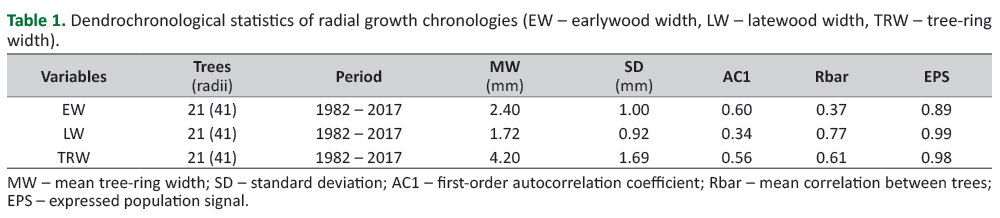
In mid-spring 2018, radial wood cores were extracted at breast height (1.3 m) from opposite sides of each sampled tree using a Pressler increment borer. Sample preparation followed standard dendrochronological procedures, including air-drying, mounting, and progressive sanding to enhance ring boundary visibility (Fritts 1976). Each core was visually cross-dated and measured to 0.001 mm precision using a stereomicroscope coupled with a LINTAB measuring system and TSAP software (Rinntech, Heidelberg, Germany). EW and LW were distinguished based on density and colour contrast. The accuracy of visual cross-dating was assessed with the COFECHA program (Holmes 1983). To remove long-term growth trends unrelated to climate, ring-width series were detrended using a double-detrending approach (Cook and Peters 1981, 1997). Each ring-width series was first detrended using either a negative exponential or a linear function, depending on the form of the age-related growth trend. In a second step, a cubic smoothing spline with a 50% frequency response was applied to remove the remaining medium- and low-frequency variability not directly related to climate. Standardisation involved transforming raw values into dimensionless indices, facilitating inter-series comparison. Following detrending, autoregressive modelling was applied to eliminate first-order autocorrelation, and the resulting indexed residuals were averaged using a biweight robust mean to produce site-level chronologies for EW, LW, and total ring width (TRW). These analyses were carried out using the ARSTAN software (Cook 1985). Chronology quality was assessed via dendrochronological statistics (Briffa and Jones 1990), including mean ring width, standard deviation (SD), first-order autocorrelation (AC1), expressed population signal (EPS), and mean inter-series correlation (Rbar) (Table 1). Only periods with EPS values above the 0.85 threshold, typically from 1985 to 2016, were included in further analyses to ensure statistical reliability and adequate sample replication (Wigley et al. 1984).
To reduce the influence of age and stem geometry on tree-ring width data, raw series were converted to basal area increment (BAI), which more accurately represents radial growth, climatic sensitivity, and tree responses to environmental factors, particularly drought (Gea-Izquierdo et al. 2015). This transformation assumes a concentric distribution of tree rings and was conducted from the pith towards the bark using the equation (1):
BAIn= π(R2n-R2n-1) (1)
where Rn and Rn-1 represent the radius at breast height (1.3 m) at the end and the beginning of the annual tree-ring, respectively. For cores lacking a visible pith, a concentric circle model with known radii was applied to the innermost rings to estimate the missing pith distance and infer the number of absent rings (Norton et al. 1987). Following transformation, BAI series were pre-whitened using first-order autoregressive modelling to remove temporal autocorrelation and normalise variance (Gea-Izquierdo et al. 2015). This procedure preserves growth variability attributable to climatic drivers while filtering out non-climatic, age-related trends.
Remote Sensing Data
Vegetation dynamics were evaluated using time series of the Normalised Difference Vegetation Index (NDVI) and the Enhanced Vegetation Index (EVI) over the period 2000–2016. These indices were derived from LANDSAT 7 and 8 satellite imagery obtained via the United States Geological Survey (USGS) Earth Explorer platform (https://earthexplorer.usgs.gov/). Only scenes with low cloud cover (<10%) were selected to ensure data quality and temporal consistency. To minimize the influence of atmospheric artefacts, cloud contamination and snow, the quality assurance bands provided with Landsat surface reflectance products were used to mask clouds, cloud shadows, and snow pixels prior to calculating NDVI and EVI. The resulting time series were then visually inspected, and any anomalous values were removed before computing monthly averages. NDVI was calculated as (NIR–RED)/(NIR+RED), while EVI was computed using the formula 2.5*(NIR–RED)/(NIR+6RED–7.5BLUE+1), following the approach of Huete et al. (2002). Both indices were computed on a bimonthly basis and subsequently averaged to produce 12 continuous monthly values for each year, resulting in a 17-year time series characterising intra-annual variability in vegetation activity within the P. sylvestris plantation.
Climatic Data and Drought Indices Calculation
Climatic data were obtained from the global Climatic Research Unit (CRU) TS3.24.01 dataset (Harris et al. 2020) via the KNMI Climate Explorer platform (http://climexp.knmi.nl/). This dataset provided monthly series of mean temperature and total precipitation for the period 1985–2016, at a spatial resolution of 0.5° latitude/longitude (41.0–41.5°N, 20.0–20.5°E), encompassing the study site. These climatic variables were used to compute two multi-scalar drought indices: Standardised Precipitation Index (SPI) and Standardised Precipitation Evapotranspiration Index (SPEI), both widely employed to assess drought conditions. SPI is based solely on monthly precipitation data, which are aggregated over varying temporal scales (e.g. 1–24 months) and fitted to a Pearson Type III distribution to calculate cumulative probabilities. The resulting values are then standardised to yield SPI values with a mean of 0 and a standard deviation of 1, facilitating temporal and spatial comparisons (McKee et al. 1993). SPEI, by contrast, integrates both precipitation and temperature effects through the calculation of a monthly climatic water balance. This parameter is also aggregated over multiple timescales and standardised using a three-parameter log-logistic distribution, which is well-suited for representing the statistical properties of such data, including negative values (Vicente-Serrano et al. 2010). Both indices were computed over cumulative timescales up to 24 months, recognising that tree growth responses are modulated by the interplay between water input and atmospheric demand (Pasho et al. 2011a, Alla et al. 2025).
Statistical Analysis
Prior to correlation analysis, the distributions of the analyzed variables were visually assessed using histograms and Q-Q plots to evaluate approximate normality and to detect potential outliers. Additionally, scatterplots were inspected to confirm that the relationships between variables were approximately linear, ensuring the appropriateness of Pearson correlation. For the period 2000–2016, Pearson correlation analyses were conducted to assess the strength and direction of associations between vegetation indices (NDVI and EVI) and radial growth variables (EW, LW, TRW, and BAI), climate (temperature and precipitation), and drought indices (SPI and SPEI). Pearson correlation analysis were also applied to examine the relationships between radial growth variables, climatic factors and drought indices. Residual, standardised chronologies of EW, LW, TRW, and BAI were correlated with monthly, seasonal (winter: previous December – February; spring: March – May; summer: June – August; autumn: September – November), and annual mean temperature and total precipitation from 1985 to 2016, using a 12-month temporal window spanning January to December of the growth year. Furthermore, the relationships between radial growth variables and drought conditions were assessed using detrended monthly SPI and SPEI, calculated at 1- to 24-month-long scales, for the same time interval.
RESULTS
Variability of Vegetation Activity and Radial Growth Variables
Throughout the growing season, vegetation activity increased from spring to summer, reaching peak values in July, before declining towards autumn, with NDVI consistently exhibiting higher values than EVI (Figure 2). Seasonal variability was pronounced, with NDVI ranging from 0.36 in March to 0.67 in July, and EVI ranging from 0.24 to 0.41.

Radial growth variables of P. sylvestris revealed distinct temporal dynamics (Figure 3). EW and TRW exhibited marked increases during the late 1980s, followed by a gradual decline and subsequent stabilisation after 2010. LW displayed greater inter-annual variability than EW, whereas BAI increased steadily until the early 2000s, before levelling off. Although LW displayed moderate synchrony with TRW, it exhibited lower amplitude.

The radial growth chronology of P. sylvestris trees extended back to 1982, encompassing a 35-year period (Table 1). On average, EW exhibited greater width than LW. AC1 values were highest for EW and lowest for LW, whereas Rbar was greater for LW than for EW. In all instances, the EPS exceeded the threshold value of 0.85, indicating robust chronology quality.
Growth–Climate (Drought) Relationships
Radial growth dynamics showed clear associations with vegetation activity and climatic variables. A strong positive relationship was identified between August vegetation indices and radial growth variables, particularly for the LW and BAI. Specifically, significant correlations were observed for NDVI–LW (r = 0.52, p = 0.032), NDVI–BAI (r = 0.52, p = 0.033), and EVI–LW (r = 0.51, p = 0.037). Years marked by high and low values of both vegetation indices showed strong synchrony with corresponding fluctuations, peaks and troughs, in LW and BAI (Figure 4).

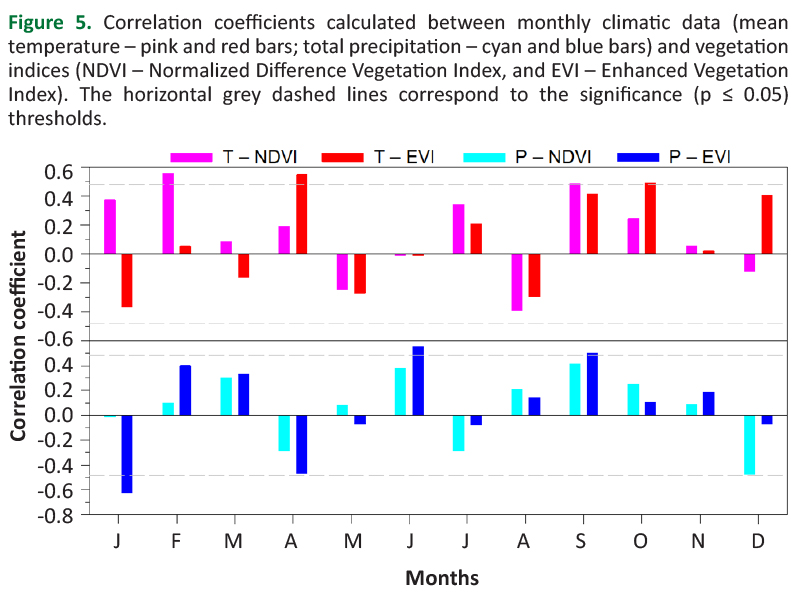
Climatic variables exerted a highly significant influence on vegetation dynamics at the study site (Figure 5). Overall, statistically significant positive correlations were observed between vegetation indices and temperature. NDVI exhibited a more consistent and robust response to temperature variation in February (r = 0.56, p = 0.020) and September (r = 0.48, p = 0.048), whereas EVI showed greater sensitivity in April (r = 0.55, p = 0.023) and October (r = 0.49, p = 0.045). Additionally, EVI showed significant positive correlations with precipitation in June (r = 0.56, p = 0.020) and September (r = 0.50, p = 0.039), but a significant negative correlation with January precipitation (r = -0.62, p = 0.008).
Tree growth responses to climatic variability differed among the radial growth variables (Figure 6). Temperature exerted a temporally variable yet statistically significant influence on radial growth, shifting from a positive effect in February (EW: r = 0.41, p = 0.021; BAI: r = 0.50, p = 0.003) and March (LW: r = 0.37, p = 0.039; TRW: r = 0.44, p = 0.012) to a negative impact during summer (LW: r = -0.39, p = 0.028; BAI: r = -0.35, p = 0.049). In contrast, summer precipitation (LW: r = 0.70, p < 0.001; TRW: r = 0.63, p < 0.001; BAI: r = 0.43, p = 0.013), particularly in July (LW: r = 0.79, p < 0.001; TRW: r = 0.72, p < 0.001; BAI: r = 0.44, p = 0.013), was consistently and positively associated with radial growth. Years characterised by high and low July precipitation coincided with marked increases and decreases, respectively, in LW, TRW, and BAI (Figure 7). Meanwhile, negative correlations were observed in November (LW: r = -0.46, p = 0.009; TRW: r = -0.42, p = 0.016) and during winter (EW: r = -0.42, p = 0.015).


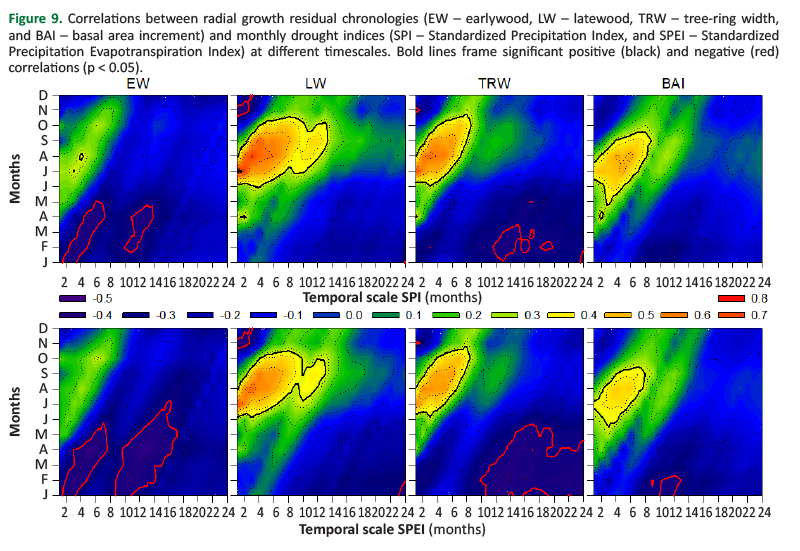
Radial growth variables at the study site exhibited clear temporal and magnitude-related responses to drought indices (Figure 9). EW showed a significant positive correlation with the SPI only in August at a 4-month timescale (r = 0.36, p = 0.049), but negative association with both SPI and SPEI over longer timescales (up to 14 and 18 months, respectively), particularly during winter and spring. LW correlated positively with SPI and SPEI at timescales up to 14 months, especially from June to August, peaking in July at the 1-month scale (SPI: r = 0.78, p < 0.001; SPEI: r = 0.69, p < 0.001), and showed negative correlations in November and December at ≤3-month timescales. TRW presented significant positive correlations with both indices from June to November at ≤8-months timescales, and negative relationships during winter–spring at ≥10-months timescales. The strongest positive TRW-drought correlation occurred in July at the 1-month timescale (SPI: r = 0.69, p < 0.001; SPEI: r = 0.60, p < 0.001). BAI exhibited its highest response to drought in August, with maximum correlations at the 6-month timescale for SPI (r = 0.53, p = 0.002) and the 4-month timescale for SPEI (r = 0.47, p = 0.008).
DISCUSSION
The results provide a comprehensive assessment of the interactions between climatic variables, vegetation indices, and radial growth dynamics of P. sylvestris in central Albania. Vegetation indices effectively captured seasonal fluctuations in canopy activity, with peak values in spring and summer corresponding to optimal photosynthetic conditions, and a decline in autumn indicating reduced physiological activity as evergreen trees approach dormancy (Alla et al. 2025, Alla and Pasho 2026). Throughout the growing season, NDVI consistently exhibited higher values than EVI, suggesting greater sensitivity to overall canopy greenness. Previous studies have shown that NDVI tends to saturate under conditions of high canopy density, which may enhance its responsiveness to peak greenness (Mašek et al. 2023, Alla et al. 2025). Temporal trends in radial growth revealed distinct developmental phases in P. sylvestris. The increase in both EW and TRW during the late 1980s likely reflects a period of favourable climatic and site conditions, while the decline and subsequent stabilisation observed after 2000 may be associated with increasing stand competition, recurrent summer droughts, and rising evaporative demand (Candel-Pérez et al. 2012, Misi and Náfrádi 2017). The high year-to-year variability of LW reflects its strong sensitivity to late-season moisture availability, while its higher synchrony with TRW, compared to EW, indicates that LW contributes more consistently to interannual variability in total ring width (Schweingruber 1996, Homfeld et al. 2025). The BAI growth pattern suggests a potential plateau, possibly driven by site-specific resource limitations or increasing climatic stress (Taeger et al. 2013, Herguido et al. 2016). This radial growth pattern corresponds with findings reported for other Mediterranean and continental populations of P. sylvestris (Taeger et al. 2013, Camarero et al. 2021). The 35-year radial growth chronology (1982–2017) revealed distinct structural and statistical differences among growth components. The consistently wider EW than LW reflects its formation under more favourable spring conditions, whereas the higher AC1 observed in EW indicates stronger temporal persistence and memory effects (Sánchez-Salguero et al. 2015). Moreover, higher LW Rbar values indicate a stronger response to year-to-year climatic variability (Camarero et al. 2021). The consistently high EPS values across all chronologies confirm the robustness and support their suitability for climate-growth analyses (Wigley et al. 1984).
The study revealed a high degree of synchrony between August vegetation activity and radial growth (particularly LW and BAI), highlighting the close coupling between photosynthetic activity and cambial processes in P. sylvestris (Mašek et al. 2023). These findings imply that carbohydrate supply plays a key role in LW growth, with climatic conditions indirectly shaping this supply by influencing photosynthetic activity and canopy dynamics (Cartenì et al. 2018, Alla et al. 2025). This confirms the significance of remote sensing-based vegetation indices as effective proxies for monitoring tree growth in Mediterranean forest ecosystems, thereby linking satellite-derived canopy signals with tree-ring measurements (Vicente-Serrano et al. 2012, Pasho and Alla 2015, Alla et al. 2025). In this context, a comparable integration of tree-ring and remotely sensed data was applied by Jevšenak et al. (2024) at a continental scale across central and eastern Europe. Their results similarly demonstrated a strong coupling between canopy activity and radial growth in multiple species, including P. sylvestris. However, as their dataset did not include sites from Albania, the present study extends these findings to the southern margin of the species’ distribution, where climatic constraints and growth responses may differ from those observed in more central populations.
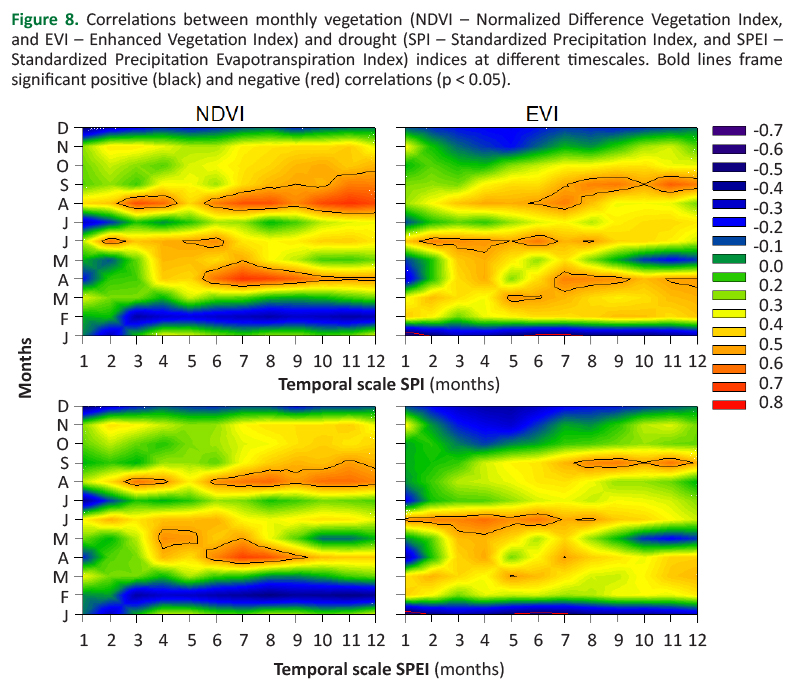
NDVI and EVI exhibited marked sensitivity to temperature and water availability, thereby emphasising their effectiveness in capturing intra-annual climatic influences on canopy function. Temperature emerged as the primary driver of canopy greenness in February, April, and the transitional months of September and October, suggesting that milder temperatures likely enhance early and late-season photosynthetic activity and reserve mobilization (Alla et al. 2017, 2025). The strong response of EVI to April and October temperatures is consistent with its sensitivity to changes in canopy structure and leaf area, thereby enabling it to capture seasonal phenological dynamics more effectively than NDVI (Huete et al. 2002, Pasho and Alla 2015, Alla et al. 2025). Conversely, precipitation exerted a more pronounced influence in June, and to a lesser extent in September, indicating a seasonal asymmetry in hydric control, whereby early- and late-season moisture availability enhances canopy vigour (Alla et al. 2017, 2025). The dual climatic influence is further elucidated through drought indices, as both SPI and SPEI significantly affected April–September NDVI and EVI values, highlighting the critical role of water balance in regulating vegetative activity throughout the growing season (Alla et al. 2017, 2025). The highest sensitivity of NDVI to SPI and SPEI on a 7-month timescale in April underscores the importance of antecedent moisture conditions in facilitating early canopy development, cambial reactivation, and the onset of EW growth (Pasho and Alla 2015, Alla et al. 2025, Römer et al. 2025). In contrast, the strongest correlations of EVI with SPI and SPEI in September and June indicate a closer relationship with mid- to late-season moisture availability, an essential determinant of sustained canopy function and LW growth (Pasho and Alla 2015, Alla et al. 2017, 2025, Camarero et al. 2021). These results demonstrate the responsiveness of vegetation indices to both thermal and hydric conditions, and further reinforce the value of remotely sensed data in providing temporally continuous insights into fine-scale climate–vegetation interactions. (Vicente-Serrano et al. 2012).
Radial growth of P. sylvestris was strongly influenced by both temperature and precipitation throughout the growing season. Positive correlations between February–March temperatures and radial growth variables align with previous studies linking early-season warming to the reactivation of cambial activity and EW formation (Matías et al. 2017, Waszak et al. 2021, Gurcay et al. 2025, Römer et al. 2025, Alla and Pasho 2026). In contrast, elevated summer temperatures reduced growth, reflecting the combined effects of increased evapotranspiration, soil moisture depletion, and hydraulic stress (Matías et al. 2017, Herrero et al. 2023, Gurcay et al. 2025). Populations of P. sylvestris in Mediterranean regions exhibit pronounced sensitivity to elevated summer temperatures (Sánchez-Salguero et al. 2015, Shestakova et al. 2017, Herrero et al. 2023). This vulnerability is likely attributable to the species’ isohydric water-use strategy, which limits carbon assimilation under drought through early stomatal closure (Taeger et al. 2013, Buras et al. 2023).
Summer precipitation emerged as a growth trigger for LW, TRW and BAI, suggesting that adequate moisture during mid-season appears to mitigate drought-induced growth constraints (Matías et al. 2017, Camarero et al. 2021, Gurcay et al. 2025, Alla and Pasho 2026). These findings are consistent with broader trends observed across southern and central Europe, where P. sylvestris growth is predominantly regulated by summer moisture availability, and where the potential benefits of warming are largely offset by the overriding influence of drought (Candel-Pérez et al. 2012, Tabakova et al. 2020, Camarero et al. 2021). Summer precipitation directly supports photosynthesis and carbon assimilation processes, which are essential for sustaining radial growth during periods of high evaporative demand (Sánchez-Salguero et al. 2015, Sidor et al. 2018). Conversely, negative correlations between November precipitation and both LW and TRW suggest potential frost-related growth inhibition, likely resulting from reduced light availability, lower temperatures, and excess moisture interfering with dormancy and carbon storage (Taeger et al. 2013, Matías et al. 2017, Römer et al. 2025).
Drought indices further clarified the temporal dynamics of moisture and temperature sensitivity in P. sylvestris growth. Positive associations between EW growth and short-term SPI and SPEI values in August highlight the importance of immediate soil moisture availability (Pasho et al. 2014). This indicates that EW growth depends heavily on current-year soil moisture availability, which directly influence cell division and expansion (Buras et al. 2023). However, negative relationships with longer-term drought conditions during winter and spring suggest that insufficient soil moisture recharge or depleted carbohydrate reserves may delay the onset of early-season growth (Waszak et al. 2021, Alla et al. 2025). The strong positive relationships between LW and short-term drought indices in July reveal heightened sensitivity to concurrent summer moisture conditions. This supports earlier findings that LW formation, occurring later in the season when evaporative demand peaks, is constrained by both immediate water availability and the depletion of stored resources (Candel-Pérez et al. 2012, Tabakova et al. 2020). The results also suggest that even short-term summer rainfall events can substantially enhance LW growth (Pasho et al. 2014, Pasho and Alla 2015, Alla and Pasho 2026). The bimodal response of TRW to drought indices reflects both immediate and long-term effects (Lévesque et al. 2014, Misi and Náfrádi 2017). The strongest positive TRW–drought correlation in July (1-month scale) underscores mid-summer moisture’s crucial role in P. sylvestris radial growth across both Mediterranean and continental environments (Sánchez-Salguero et al. 2015, Misi and Náfrádi 2017, Shestakova et al. 2017, Camarero et al. 2021). Similarly, BAI responses to drought indices, particularly in August at 4- to 6-month timescales, suggest a cumulative impact of seasonal moisture deficits (Taeger et al. 2013, Herguido et al. 2016, Alla et al. 2025). This highlights the prolonged influence of hydrological stress on wood growth and underscores the species’ vulnerability to increasingly frequent and severe summer droughts (Gruber et al. 2010, Candel-Pérez et al. 2012, Sánchez-Salguero et al. 2015).
Despite providing valuable insights into the climate–growth relationships of P. sylvestris at its southernmost range in central Albania, our study has some limitations. The analysis relies on a single study site, which may constrain the generalizability of the results across the broader regional distribution of the species. Moreover, the use of gridded climate data with relatively coarse spatial resolution may not fully capture local microclimatic variability, particularly in complex mountainous terrain where topography strongly affects temperature and moisture conditions. These factors should be taken into account when interpreting the magnitude and spatial representativeness of the observed climate–growth relationships.
CONCLUSIONS
This study offers an in-depth assessment of how climate and drought conditions affect vegetation dynamics and radial growth of P. sylvestris at its southern range limit in Albania. The results highlight the ecological responsiveness of P. sylvestris to increased early-season temperatures, sufficient mid-season precipitation, and the synergistic impact of elevated summer heat and drought stress, particularly during critical phenological periods. High correlations between vegetation indices and radial growth variables indicate a common response to climatic stress, highlighting the tight coupling between canopy activity and radial growth. The findings indicate that the species’ marginal position within its climatic range heightens its vulnerability to intensifying summer droughts and future warming. The implementation of adaptive forest management strategies will be essential to mitigate declines in P. sylvestris forest structure and function, strengthen ecosystem resilience, and maintain key ecosystem services. In the context of climate change, integrative and proactive management approaches are essential for promoting evidence-based conservation and enhancing resilience in Mediterranean forest ecosystems. Future research incorporating multiple sites along environmental gradients, as well as higher-resolution climate and remote sensing datasets, would help refine our understanding of spatial variability in growth responses and improve projections of forest dynamics under changing climatic conditions.
Author Contributions
AQA and EP conceived and designed the research; conducted field sampling and laboratory analyses; performed data curation and statistical analysis; and wrote the manuscript.
Funding
No financial support was received for the conduct of this study.
Acknowledgments
We would like to acknowledge the field support provided by T. Doli, E. Toska, as well as the technical assistance of A. Çota.
Conflicts of Interest
The authors declare no conflict of interest.
REFERENCES
Alla AQ, Pasho E, Marku V, 2017. Growth variability and contrasting climatic responses of two Quercus macrolepis stands from Southern Albania. Trees 31: 1491-1504. https://doi.org/10.1007/s00468-017-1564-0.
Alla AQ, Pasho E, Shallari S, 2025. Tree growth variability in Pinus nigra plantations modulated by climate and soil properties. Eur J Forest Res 144(1): 179-192. https://doi.org/10.1007/s10342-024-01749-y.
Alla AQ, Pasho E, 2026. Site orientation and tree social class modulate radial growth variability and climate sensitivity in Pinus nigra plantations. J Sustain Forest 1-21. . https://doi.org/10.1080/10549811.2026.2644429.
Brichta J, Šimůnek V, Bílek L, Vacek Z, Gallo J, Drozdowski S, Bravo-FernándezJA, Mason B, Roig Gomez S, Hájek V, Vacek S, Štícha Štícha, Brabec P, Fuchs Z, 2024. Effects of climate change on Scots pine (Pinus sylvestris L.) growth across Europe: decrease of tree-ring fluctuation and amplification of climate stress. Forests 15(1): 91. https://doi.org/10.3390/f15010091.
Briffa KR, Jones PD, 1990. Basic chronology statistics and assessment. In: Cook ER, Kairiukstis LA (eds) Methods of Dendrochronology: Applications in the Environmental Sciences. Kluwer Academic Publishers, Dordrecht, pp 137-152.
Buras A, Rehschuh R, Fonti M, Lange J, Fonti P, Menzel A, Gessler A, Rigling A, Treydte K, von Arx G, 2023. Quantitative wood anatomy and stable carbon isotopes indicate pronounced drought exposure of Scots pine when growing at the forest edge. Front For Glob Change 6: 1233052. https://doi.org/10.3389/ffgc.2023.1233052.
Camarero JJ, Collado E, Martínez-de-Aragón J, de-Miguel S, Büntgen U, Martinez-Peña F, Martín-Pinto P, Ohenoja E, Romppanen T, Salo K, Oria-de-Rueda JA, Bonet JA, 2021. Associations between climate and earlywood and latewood width in boreal and Mediterranean Scots pine forests. Trees 35(1): 155-169. https://doi.org/10.1007/s00468-020-02028-0.
Candel-Pérez D, Linares JC, Viñegla B, Lucas-Borja ME, 2012. Assessing climate–growth relationships under contrasting stands of co-occurring Iberian pines along an altitudinal gradient. For Ecol Manag 274: 48-57. https://doi.org/10.1016/j.foreco.2012.02.010.
Cartenì F, Deslauriers A, Rossi S, Morin H, De Micco V, Mazzoleni S, Giannino F, 2018. The physiological mechanisms behind the earlywood-to-latewood transition: A process-based modeling approach. Front Plant Sci 9: 1053. https://doi.org/10.3389/fpls.2018.01053.
Caudullo G, Welk E, San-Miguel-Ayanz J, 2026. Chorological data for the main European woody species. Mendeley Data, V19. https://doi.org/10.17632/hr5h2hcgg4.19
Cook ER, Peters K, 1981. The smoothing spline: a new approach to standardizing forest interior tree-ring width series for dendroclimatic studies. Tree-Ring Bull 41: 45-53.
Cook ER, 1985. A time series analysis approach to tree-ring standardization. University of Arizona, Tucson, USA.
Cook ER, Peters K, 1997. Calculating unbiased tree-ring indices for the study of climatic and environmental change. The Holocene 7(3): 361-370. https://doi.org/10.1177/095968369700700314.
Fritts HC, 1976. Tree rings and climate. Academic Press, London. https://doi.org/10.1016/B978-0-12-268450-0.X5001-0.
Fyllas NM, Christopoulou A, Galanidis A, Michelaki CZ, Dimitrakopoulos PG, Fulé PZ, Arianoutsou M, 2017. Tree growth-climate relationships in a forest-plot network on Mediterranean mountains. Sci Total Environ 598: 393-403. https://doi.org/10.1016/j.scitotenv.2017.04.145.
Gea-Izquierdo G, Montes F, Gavilán RG, Cañellas I, Rubio A, 2015. Is this the end? Dynamics of a relict stand from pervasively deforested ancient Iberian pine forests. Eur J Forest Res 134(3): 525-536. https://doi.org/10.1007/s10342-015-0869-z.
Gruber A, Strobl S, Veit B, Oberhuber W, 2010. Impact of drought on the temporal dynamics of wood formation in Pinus sylvestris. Tree Physiol 30(4): 490-501. https://doi.org/10.1093/treephys/tpq003.
Güner ST, Makineci E, 2017. Determination of annual organic carbon sequestration in soil and forest floor of Scots pine forests on The Türkmen Mountain (Eskişehir, Kütahya). J Fac For Istanbul U 67(2): 109-115. https://doi.org/10.17099/jffiu.199494.
Gurcay B, Kose N, Avci M, 2025. Dendroclimatological analyses in a protected area and its surroundings: A case study of the Örümcek Forest. Dendrobiology 93: 69-85. https://doi.org/10.12657/denbio.093.005.
Harris I, Osborn TJ, Jones P, Lister D, 2020. Version 4 of the CRU TS monthly high-resolution gridded multivariate climate dataset. Scientific Data 7(1): 109. https://doi.org/10.1038/s41597-020-0453-3.
Herguido E, Granda E, Benavides R, García-Cervigón AI, Camarero JJ, Valladares F, 2016. Contrasting growth and mortality responses to climate warming of two pine species in a continental Mediterranean ecosystem. For Ecol Manag 363: 149-158. https://doi.org/10.1016/j.foreco.2015.12.038.
Herrero A, González-Gascueña R, González-Díaz P, Ruiz-Benito P, Andivia E, 2023. Reduced growth sensitivity to water availability as potential indicator of drought-induced tree mortality risk in a Mediterranean Pinus sylvestris L. forest. Front For Glob Change 6: 1249246. https://doi.org/10.3389/ffgc.2023.1249246.
Holmes RL, 1983. Computer-assisted quality control in tree ring dating and measurement. Tree-Ring Bull 43: 69-78.
Homfeld IK, Reinig F, Martinez del Castillo E, Torbenson MCA, Konter O, Wilson R, Krusic PJ, Loader NJ, Grudd H, Reid E, Letherbarrow K, Esper J, 2025. Beyond maximum density: multi-parameter insights into Scots pine climate sensitivity. Trees 39: 101. https://doi.org/10.1007/s00468-025-02681-3.
Houston Durrant T, de Rigo D, Caudullo G, 2016. Pinus sylvestris in Europe: distribution, habitat, usage and threats. In San-Miguel-Ayanz J, de Rigo D, Caudullo G, Houston Durrant T, Mauri A (eds), European Atlas of Forest Tree Species. Publ Off EU, Luxembourg, pp e016b94+.
Huete A, Didan K, Miura T, Rodriguez EP, Gao X, Ferreira LG, 2002. Overview of the radiometric and biophysical performance of the MODIS vegetation indices. Remote Sens Environ 83(1-2): 195-213. https://doi.org/10.1016/S0034-4257(02)00096-2.
IHM, 1975. Klima e Shqipërisë. Tiranë, Albania.
IPCC, 2023. Climate Change 2023: Synthesis Report. Contribution of Working Groups I, II and III to the Sixth Assessment Report of the Intergovernmental Panel on Climate Change [Core Writing Team, Lee H, Romero J (eds.)]. IPCC, Geneva, Switzerland, 184 p. https://doi.org/10.59327/IPCC/AR6-9789291691647.
Jevšenak J, Klisz M, Mašek J, Čada V, Janda P, Svoboda M, et al., 2024. Incorporating high-resolution climate, remote sensing and topographic data to map annual forest growth in central and eastern Europe. Sci Total Environ 913: 169692. https://doi.org/10.1016/j.scitotenv.2023.169692.
Lévesque M, Rigling A, Bugmann H, Weber P, Brang P, 2014. Growth response of five co-occurring conifers to drought across a wide climatic gradient in Central Europe. Agr Forest Meteorol 197: 1-12. https://doi.org/10.1016/j.agrformet.2014.06.001.
Mašek J, Tumajer J, Lange J, Kaczka R, Fišer P, Treml V, 2023. Variability in tree-ring width and NDVI responses to climate at a landscape level. Ecosystems 26(5): 1144-1157. https://doi.org/10.1007/s10021-023-00822-8.
Matías L, Linares JC, Sánchez-Miranda A, Jump AS, 2017. Contrasting growth forecasts across the geographical range of Scots pine due to altitudinal and latitudinal differences in climatic sensitivity. Glob Change Biol 23(10): 4106-4116. https://doi.org/10.1111/gcb.13627.
McKee TBN, Doesken J, Kleist J, 1993. The relationship of drought frequency and duration to time scales. In: Eight Conference on Applied Climatology. American Meteorological Society, Anaheim, California, pp 179-184.
MedECC, 2020. Climate and environmental change in the Mediterranean Basin – Current situation and risks for the future. First Mediterranean assessment report [Cramer W, Guiot J, Marini K (eds.)]. Union for the Mediterranean, Plan Bleu, UNEP/MAP, Marseille, France.
Misi D, Náfrádi K, 2017. Growth response of Scots pine to changing climatic conditions over the last 100 years: a case study from Western Hungary. Trees 31(3): 919-928. https://doi.org/10.1007/s00468-016-1517-z.
Nechita C, Iordache AM, Costinel D, Botoran OR, DănilăG, Ionete RE, Varlam M, 2022. A tree ring proxy evaluation of declining causes in Pinus sylvestris L. and Pinus nigra J.F. Arnold in Northeastern Romania. Forests 13(2): 336. https://doi.org/10.3390/f13020336.
Norton DA, Palmer JG, Ogden J, 1987. Dendroecological studies in New Zealand 1. An evaluation of tree age estimates based on increment cores. New Zeal J Bot 25(3): 373-383. https://doi.org/10.1080/0028825X.1987.10413355.
Pasho E, Alla AQ, 2015. Climate impacts on radial growth and vegetation activity of two co-existing Mediterranean pine species. Can J For Res 45(12): 1748-1756. https://doi.org/10.1139/cjfr-2015-0146.
Pasho E, Camarero JJ, de Luis M, Vicente-Serrano SM, 2011a. Impacts of drought at different time scales on forest growth across a wide climatic gradient in north-eastern Spain. Agr Forest Meteorol 151(12): 1800-1811. https://doi.org/10.1016/j.agrformet.2011.07.018.
Pasho E, Papanastasis VP, Pelz D, Lako T, 2011b. Inventory and evaluation of grasslands in Albania. Grass Forage Sci 66(1): 123-137. https://doi.org/10.1111/j.1365-2494.2010.00771.x.
Pasho E, Toromani E, Alla AQ, 2014. Climatic impact on tree-ring widths in Abies borisii-regis forests from South-East Albania. Dendrochronologia 32(3): 237-244. https://doi.org/10.1016/j.dendro.2014.05.003.
Passayiannes G, Moulalis D, Scaltsoyiannes A, Tsaktsira M, 1998. Multilocus Study of Six Balkan Natural Populations of Pinus sylvestris (L.). In: Tsekos I, Moustakas M (eds) Progress in Botanical Research: Proceedings of the 1st Balkan Botanical Congress. Springer Netherlands, Dordrecht, pp 545-548.
Römer P, del Castillo EM, Reinig F, Torbenson MCA, Konter O, Klippel L, Büntgen U, Esper J, 2025. Growth characteristics and drought vulnerability of southwest German spruce and pine. Eur J Forest Res 144(3): 393-409. https://doi.org/10.1007/s10342-025-01765-6.
Royo-Navascues M, Martinez del Castillo E, Serrano-Notivoli R, Tejedor E, Novak K, Longares LA, Saz MA, de Luis M, 2021. When density matters: The spatial balance between early and latewood. Forests 12(7): 818. https://doi.org/10.3390/f12070818.
Sánchez-Salguero R, Camarero JJ, Hevia A, Madrigal-González J, Linares JC, Ballesteros-Canovas JA, Sánchez-Miranda A, Alfaro-Sánchez R, Sangüesa-Barreda G, Galván JD, Gutiérrez E, Génova M, Rigling A, 2015. What drives growth of Scots pine in continental Mediterranean climates: Drought, low temperatures or both? Agr Forest Meteorol 206: 151-162. https://doi.org/10.1016/j.agrformet.2015.03.004.
Schueler S, Falk W, Koskela J, Lefèvre F, Bozzano M, Hubert J, Kraigher H, Longauer R, Olrik DC, 2014. Vulnerability of dynamic genetic conservation units of forest trees in Europe to climate change. Glob Change Biol 20(5): 1498-1511. https://doi.org/10.1111/gcb.12476.
Schweingruber, F. H. (1996). Tree rings and environment. Dendroecology. Paul Haupt, Bern, pp 609
Senf C, Pflugmacher D, Zhiqiang Y, Sebald J, Knorn J, Neumann M, Hostert P, Seidl R, 2018. Canopy mortality has doubled in Europe’s temperate forests over the last three decades. Nat Commun 9(1):4978. https://doi.org/10.1038/s41467-018-07539-6.
Shestakova TA, Camarero JJ, Ferrio JP, Knorre AA, Gutiérrez E, Voltas J, 2017. Increasing drought effects on five European pines modulate Δ13C-growth coupling along a Mediterranean altitudinal gradient. Funct Ecol 31(7): 1359-1370. https://doi.org/10.1111/1365-2435.12857.
Sidor CG, Bosela M, Büntgen U, Vlad R, 2018. Mixed effects of climate variation on the scots pine forests: Age and species mixture matter. Dendrochronologia 52: 48-56. https://doi.org/10.1016/j.dendro.2018.09.005.
Tabakova MA, Arzac A, Martínez E, Kirdyanov AV, 2020. Climatic factors controlling Pinus sylvestris radial growth along a transect of increasing continentality in southern Siberia. Dendrochronologia 62: 125709. https://doi.org/10.1016/j.dendro.2020.125709.
Taeger S, Zang C, Liesebach M, Schneck V, Menzel A, 2013. Impact of climate and drought events on the growth of Scots pine (Pinus sylvestris L.) provenances. For Ecol Manag 307: 30-42. https://doi.org/10.1016/j.foreco.2013.06.053.
Vicente-Serrano SM, Beguería S, López-Moreno JI, 2010. A multiscalar drought index sensitive to global warming: the standardized precipitation evapotranspi.ration index. J Climate 23(7): 1696-1718. https://doi.org/10.1175/2009JCLI2909.1
Vicente-Serrano SM, Gouveia C, Camarero JJ, Begueria S, Trigo RM, López Moreno JI, Azorín Molina C, Pasho E, Lorenzo-Lacruz J, Revuelto J, Morán Tejeda E, Sánchez Lorenzo A, 2012. Drought impacts on vegetation activity, growth and primary production in humid and arid ecosystems. In: Cambio climatico. Extremos e impactos. Asociación Española de Climatología, Madrid, Spain, pp 691-699.
Waszak N, Robertson I, Puchałka R, Przybylak R, Pospieszyńska A, Koprowski M, 2021. Investigating the Climate-Growth Response of Scots Pine (Pinus sylvestris L.) in Northern Poland. Atmosphere 12(12): 1690. https://doi.org/10.3390/atmos12121690.
Wigley TML, Briffa KR, Jones PD, 1984. On the average value of correlated time-series, with applications in dendroclimatology and hydrometeorology. J Clim Appl Meteorol 23(2): 201-213.
© 2026 by the author(s). License: Croatian Forest Research Institute. This article is an open access article distributed under the terms and conditions of the Creative Commons Attribution 4.0 International License (CC BY 4.0).